US 10-year yield steadies as strong data backs steady Fed rate outlook
- Strong ADP and Retail Sales data lift Treasury yields across maturities.
- ISM Manufacturing Prices Paid surge reinforces concerns that inflation remain sticky.
- Traders now await Jobless Claims and Friday's Nonfarm Payrolls release.

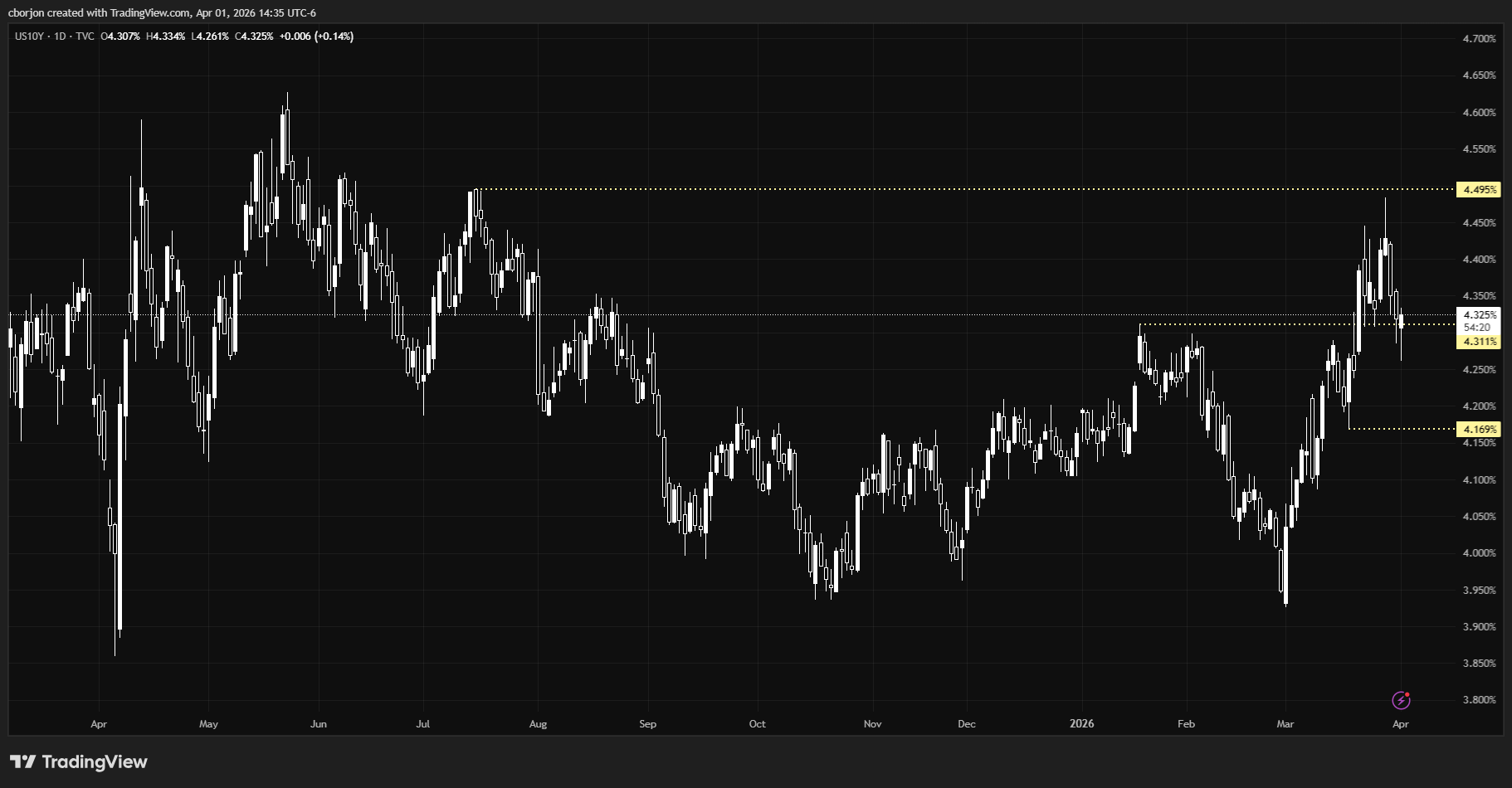
US Treasury yields recover across the curve on Wednesday, with the 10-year Treasury note erasing earlier losses after strong US economic data increased the odds of keeping interest rates unchanged throughout the year.
Treasuries reverse early drop as jobs, sales curb dovish Fed bets
March's ADP Employment Change came in at 62K, exceeding economists' projections for just 40K, but it was 4K lower than February's print. Meanwhile, Retail Sales for February rose to its highest level in seven months, increased 0.6% MoM, exceeding forecasts of 0.5% and January's -0.1% contraction.
Additionally, US manufacturing activity grew in March, as revealed by the ISM. The survey showed that prices paid for factory inputs reached their highest level in almost four years.
In the meantime, Federal Reserve (Fed) officials emphasized the need to push inflation towards its 2% goal. Governor Michael Barr said that they need to do more work, while Richmond Fed Thomas Barkin warned that if inflation expectations rise, a move would be warranted. St. Louis Fed Alberto Musalem said that policy is "well positioned" and sees policy at the low end of the neutral range. He added that supply shocks carry great inflation risks in the current environment.
The US Dollar Index (DXY), which measures the buck's value against six currencies, falls 0.27% to 99.58, a tailwind for Gold prices.
In the meantime, the US financial markets' five-year inflation expectations are at 2.54%, down from 2.57% a day ago, according to the 5-year Breakeven Inflation Rate. For 10 years, the 10-year Breakeven rate fell from 2.31% to 2.3%, suggesting markets expect medium-term inflation to decline.
Traders' focus shifts to the US employment report
Initial Jobless Claims and Fed speeches are scheduled for Thursday. On Friday, attention turns to March's Nonfarm Payrolls figures amid an ongoing holiday in the US.
US 10-year Treasury note yield
Interest rates FAQs
Interest rates are charged by financial institutions on loans to borrowers and are paid as interest to savers and depositors. They are influenced by base lending rates, which are set by central banks in response to changes in the economy. Central banks normally have a mandate to ensure price stability, which in most cases means targeting a core inflation rate of around 2%. If inflation falls below target the central bank may cut base lending rates, with a view to stimulating lending and boosting the economy. If inflation rises substantially above 2% it normally results in the central bank raising base lending rates in an attempt to lower inflation.
Higher interest rates generally help strengthen a country’s currency as they make it a more attractive place for global investors to park their money.
Higher interest rates overall weigh on the price of Gold because they increase the opportunity cost of holding Gold instead of investing in an interest-bearing asset or placing cash in the bank. If interest rates are high that usually pushes up the price of the US Dollar (USD), and since Gold is priced in Dollars, this has the effect of lowering the price of Gold.
The Fed funds rate is the overnight rate at which US banks lend to each other. It is the oft-quoted headline rate set by the Federal Reserve at its FOMC meetings. It is set as a range, for example 4.75%-5.00%, though the upper limit (in that case 5.00%) is the quoted figure. Market expectations for future Fed funds rate are tracked by the CME FedWatch tool, which shapes how many financial markets behave in anticipation of future Federal Reserve monetary policy decisions.
Author

Christian Borjon Valencia
FXStreet
Markets analyst, news editor, and trading instructor with over 14 years of experience across FX, commodities, US equity indices, and global macro markets.
















