Gold consolidates below $4,200 as traders reassess Fed interest rate outlook
- Gold falls as the US Dollar rebounds at the start of the week.
- Weak US NFP data and easing Oil-driven inflation concerns reduce expectations of a near-term Fed rate hike.
- The technical picture remains neutral above the $4,000 support level.

Gold (XAU/USD) consolidates losses on Monday as a firmer US Dollar (USD) and mild profit-taking cap gains following last week's rebound from a more than seven-month low of $3,941. At the time of writing, XAU/USD trades around $4,150 after briefly climbing above the $4,200 level during the Asian trading session.
Despite the intraday pullback, the near-term downside in Gold appears limited after weaker-than-expected US Nonfarm Payrolls (NFP) data released on Thursday reduced expectations of an immediate Federal Reserve (Fed) interest rate hike.
Meanwhile, Oil-driven inflation risks are also easing as shipping through the Strait of Hormuz continues to improve following last month's signature of a 60-day Memorandum of Understanding (MoU) between the United States and Iran. This suggests the Fed may not need to tighten policy as aggressively as markets had previously expected.
However, monetary policy is expected to remain restrictive until inflation shows clearer signs of cooling. Traders are currently pricing in a 56% probability of a rate increase at the September meeting, according to the CME FedWatch Tool.
Fed Governor Christopher Waller said on Monday that policymakers "have always been committed to 2% inflation, and it is a credible pledge," but added that "the exact inflation target is too extreme a standard."
The US and Iran have yet to reach a final agreement, with the future management of the Strait of Hormuz emerging as a key sticking point. Tehran views the strategic waterway as falling within its sovereignty and seeks to impose transit tolls. The next round of talks is expected to resume later this week following the funeral of Iran's Supreme Leader.
With geopolitical risks still in play and expectations that the Fed will keep borrowing costs elevated, the US Dollar continues to attract buyers. The US Dollar Index (DXY), which tracks the Greenback's value against a basket of six major currencies, trades around 100.00, up 0.10% on the day.
A stronger US Dollar makes Gold more expensive for holders of other currencies, while higher interest rates diminish the appeal of the non-yielding asset.
Looking ahead, the US economic calendar remains relatively light this week. The ISM Services PMI came in at 54.0 in June, in line with expectations and marking the 23rd straight month of expansion, although the reading edged down from 54.5 in May.
Traders now turn their attention to ADP Employment Change (4-week average) on Tuesday, the FOMC meeting minutes on Wednesday, and weekly Initial Jobless Claims on Thursday.
These reports could offer fresh clues about the Fed's next move and influence the direction of the US Dollar and Gold.
Technical analysis: XAU/USD holds above $4,000, upside remains limited
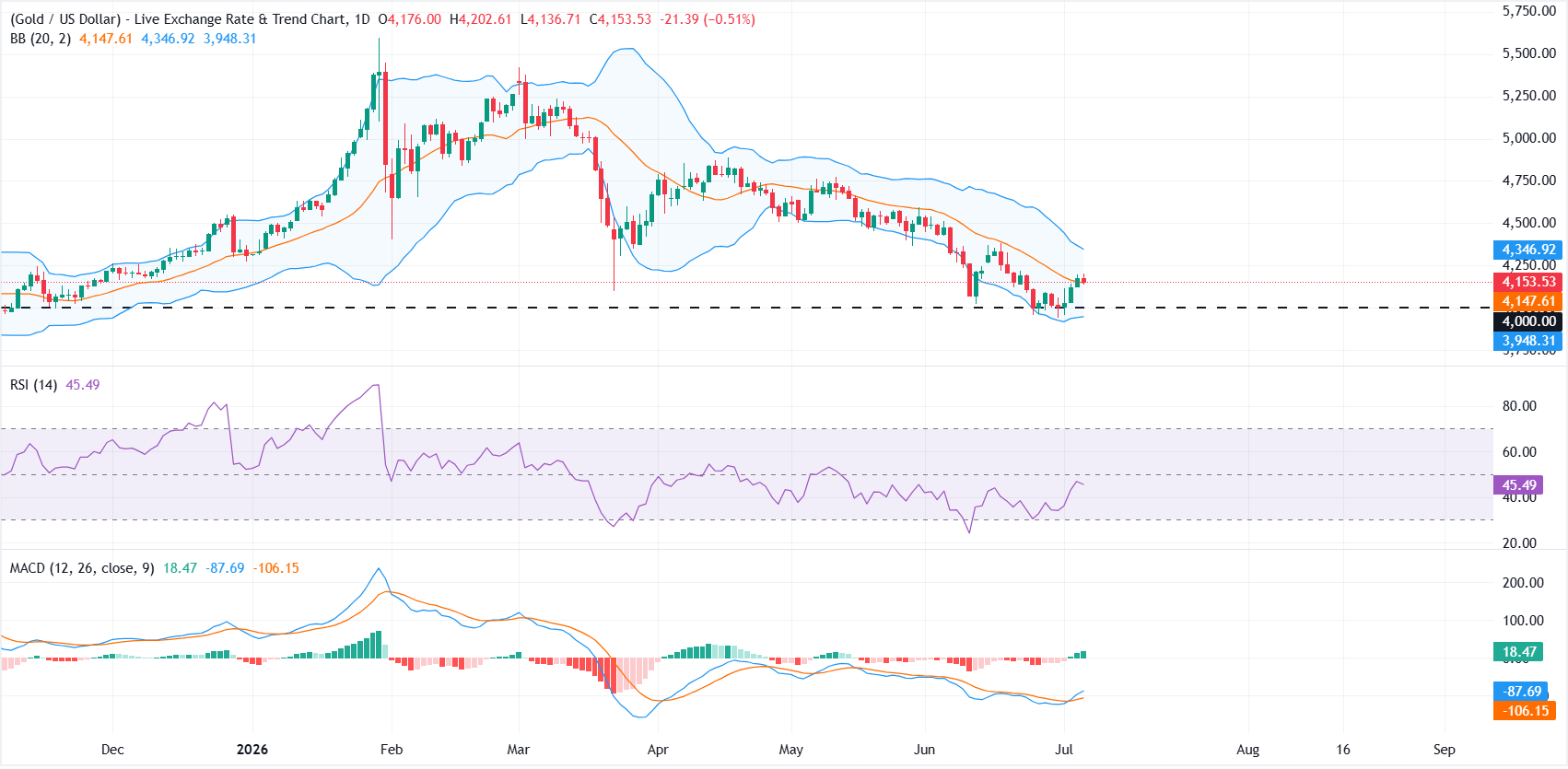
On the daily chart, XAU/USD is hovering just under the 20-day Simple Moving Average (SMA) from the Bollinger Bands at roughly $4,146.96, keeping the immediate topside capped
The Relative Strength Index (RSI) around 46 hints at subdued directional conviction, while the Moving Average Convergence Divergence (MACD) holds in positive territory, suggesting that upside attempts remain possible but not yet decisive.
On the downside, immediate support is seen at the Bollinger SMA pivot around $4,147, followed by the horizontal support at $4,000. A break below that level could expose the lower Bollinger Band near $3,948.
On the topside, a clear break of the upper Bollinger band near $4,347 would be needed to re-open the path for a stronger recovery, with a daily close above that zone likely to tilt the bias back in favor of the bulls.
(This article was created with the help of an Artificial Intelligence tool and reviewed by an editor. Know more.)
Gold FAQs
Gold has played a key role in human’s history as it has been widely used as a store of value and medium of exchange. Currently, apart from its shine and usage for jewelry, the precious metal is widely seen as a safe-haven asset, meaning that it is considered a good investment during turbulent times. Gold is also widely seen as a hedge against inflation and against depreciating currencies as it doesn’t rely on any specific issuer or government.
Central banks are the biggest Gold holders. In their aim to support their currencies in turbulent times, central banks tend to diversify their reserves and buy Gold to improve the perceived strength of the economy and the currency. High Gold reserves can be a source of trust for a country’s solvency. Central banks added 1,136 tonnes of Gold worth around $70 billion to their reserves in 2022, according to data from the World Gold Council. This is the highest yearly purchase since records began. Central banks from emerging economies such as China, India and Turkey are quickly increasing their Gold reserves.
Gold has an inverse correlation with the US Dollar and US Treasuries, which are both major reserve and safe-haven assets. When the Dollar depreciates, Gold tends to rise, enabling investors and central banks to diversify their assets in turbulent times. Gold is also inversely correlated with risk assets. A rally in the stock market tends to weaken Gold price, while sell-offs in riskier markets tend to favor the precious metal.
The price can move due to a wide range of factors. Geopolitical instability or fears of a deep recession can quickly make Gold price escalate due to its safe-haven status. As a yield-less asset, Gold tends to rise with lower interest rates, while higher cost of money usually weighs down on the yellow metal. Still, most moves depend on how the US Dollar (USD) behaves as the asset is priced in dollars (XAU/USD). A strong Dollar tends to keep the price of Gold controlled, whereas a weaker Dollar is likely to push Gold prices up.
Author

Vishal Chaturvedi
FXStreet
I am a macro-focused research analyst with over four years of experience covering forex and commodities market. I enjoy breaking down complex economic trends and turning them into clear, actionable insights that help traders stay ahead of the curve.

















