|

United States Nonfarm Payrolls beat expectations: Why is the US Dollar weakening?

The United States (US) created 115K new jobs in April, much better than the 62K anticipated by markets. The unemployment rate in the same month was confirmed at 4.3%, as expected. The Nonfarm Payrolls (NFP) report came in better than anticipated, yet the US Dollar (USD) eased with the news. Why is this happening?

A resilient US labor market isn't enough to push the Dollar up

The April NFP report also showed that the Labor Force Participation Rate ticked lower to 61.8% from 61.9%. Finally, annual wage inflation, as measured by the change in the Average Hourly Earnings, rose to 3.6% from 3.4% in March but came in below analysts' estimate of 3.8%, bringing some relief.

The USD slide seems more related to persistent confidence around a deal between Iran and the US. Wall Street runs higher on coupled war optimism and upbeat US data, ultimately weighing on the Greenback. Washington and Tehran continue to trade fire in the Strait of Hormuz, with skirmishes present throughout the week despite claims the ceasefire remains in place.
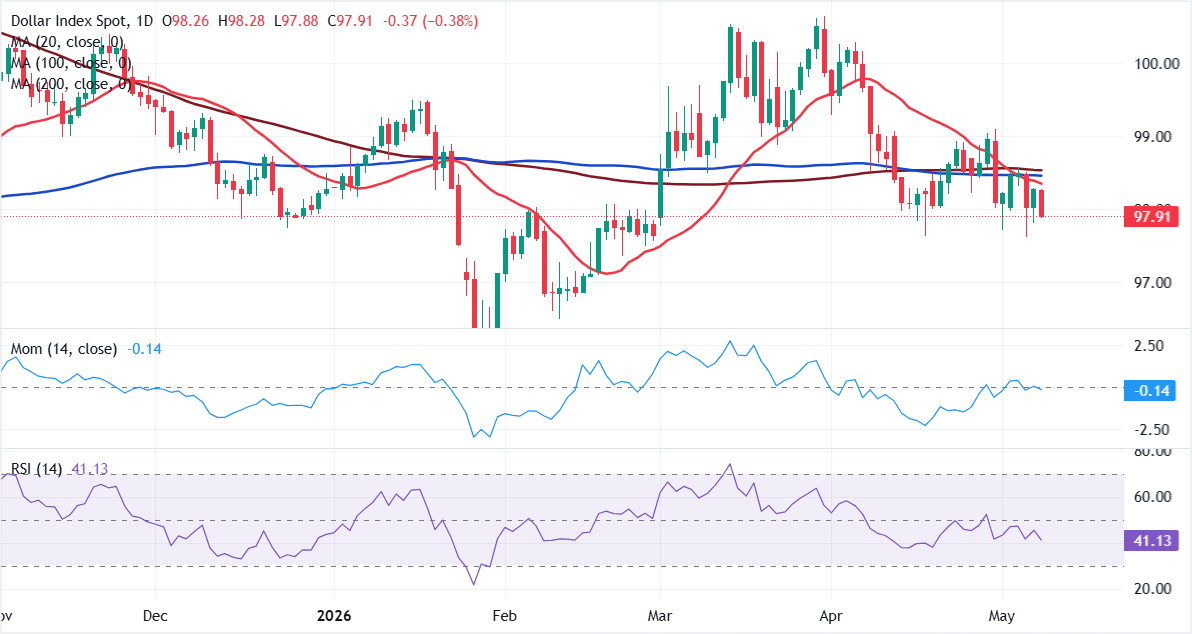
At the time of writing, the US Dollar Index (DXY) is down to 97.90, not far from a multi-week low posted on Wednesday at 97.62.

Author

FXStreet Team

Composed of a group of economic journalists and FX experts, the FXStreet content team produces and oversees all content published on FXStreet. It provides a purely journalistic approach to the Forex market.


More from FXStreet Team
Share:

Editor's Picks

GBP/USD remains in two-day highs around 1.3260

GBP/USD adds to Friday’s bounce, gathering fresh traction and flirting with the 1.3270 zone on Monday, or two-day tops. Cable’s decent advance comes despite the move higher in the Greenback and investors’ assessing of UK PM K. Starmer's resignation.

EUR/USD remains close to three-month lows near 1.1450

EUR/USD sets aside Friday’s bounce and trades with modest losses in the mid-1.1400s at the beginning of the week. The continuation of the bid bias in the US Dollar continues to weigh on spot despite improving sentiment from the geopolitical front.

Gold bounces off lows, looks to surpass $4,200

Gold regains composure and leaves behind three-consecutive daily declines on Monday, looking to regain the area above the $4,200 mark per troy ounce. Reports of progress in the latest round of US-Iran talks are helping the precious metal maintain its footing at the start of the week, although the stronger Greenback seems to limit the upside potential for now.

Breaking: Iran closes the Strait of Hormuz amid ceasefire deal violation
Iran says it is closing the Strait of Hormuz after accusing the United States (US) and Israel of violating the ceasefire. According to Iran, the decision came over the continued Israeli strikes in Lebanon. The Iranian Revolutionary Guard Corps Navy issued a warning to all vessels: "Do not approach the Strait of Hormuz; otherwise, your security will be jeopardized."
Is Shiba Inu dead or just in a crisis? The data behind SHIB's 95% crash

SHIB, the dog-themed meme coin that became one of the biggest success stories in crypto and turned early buyers into crypto millionaires, is facing tough times. Its price has fallen more than 32% so far this year, and it is down 95% from its all-time high in 2021. Is SHIB simply another fading meme coin, or is the market overlooking a possible recovery story?

Regime change: Inside Kevin Warsh's first move to make the Fed unreadable on purpose

The rate did not move. That was the least interesting thing about Kevin Warsh's first meeting in charge of the Fed. The FOMC held its benchmark at 3.50%-3.75% for the fourth straight meeting, exactly as priced, and then the new chair used his first press conference to dismantle the machinery the market has leaned on for a decade.