TSLA vs Ford: Oil, tariffs, and a recall collide


High pump prices should give Tesla room to run. Harder borders should favor Ford's American plants. October delivered both, but neither carmaker walks away with a clean win.
At 16:14 GMT on October 15, Brent crude futures traded at $106.08 a barrel and WTI at $98.05, according to Reuters. For Tesla vs. Ford, the sharper question is where higher fuel bills become orders and where government action eats the benefit.
Tariff geography starts pricing the business
President Trump threatened to raise tariffs on Canadian vehicles and automotive parts. He said he would increase them to 50% from January 1, 2027. This adds uncertainty to production planning. The announced price rise is for 2027, but the prices we already pay for crossing the border are already high.
The U.S.-Canada tariff fight from August and China's recall campaign both sit inside that calculation. Reuters reported that Tesla and eight other manufacturers announced recalls covering roughly 4.3 million vehicles over emergency door-opening problems. Tesla's share came to 2.98 million units. The fixes included software updates, warning labels, and clearer handle markings.
The count of affected cars does not set the campaign's financial cost. It does show how a design tied to advanced technology can create regulatory duties across a huge installed base.
Tesla's Shanghai plant pairs Chinese demand with export output. That concentration can make manufacturing efficient, but it also leaves export economics tied to rules in the markets that receive those cars. The American and German factories give alternatives, though moving production means dealing with capacity, suppliers, and costs.
Ford's global network creates a different weak spot in North America. Local assembly may shield the company from imported rivals, while Canadian components still carry border risk. Final assembly location alone does not establish the vehicle's exposure to tariffs on imported components.
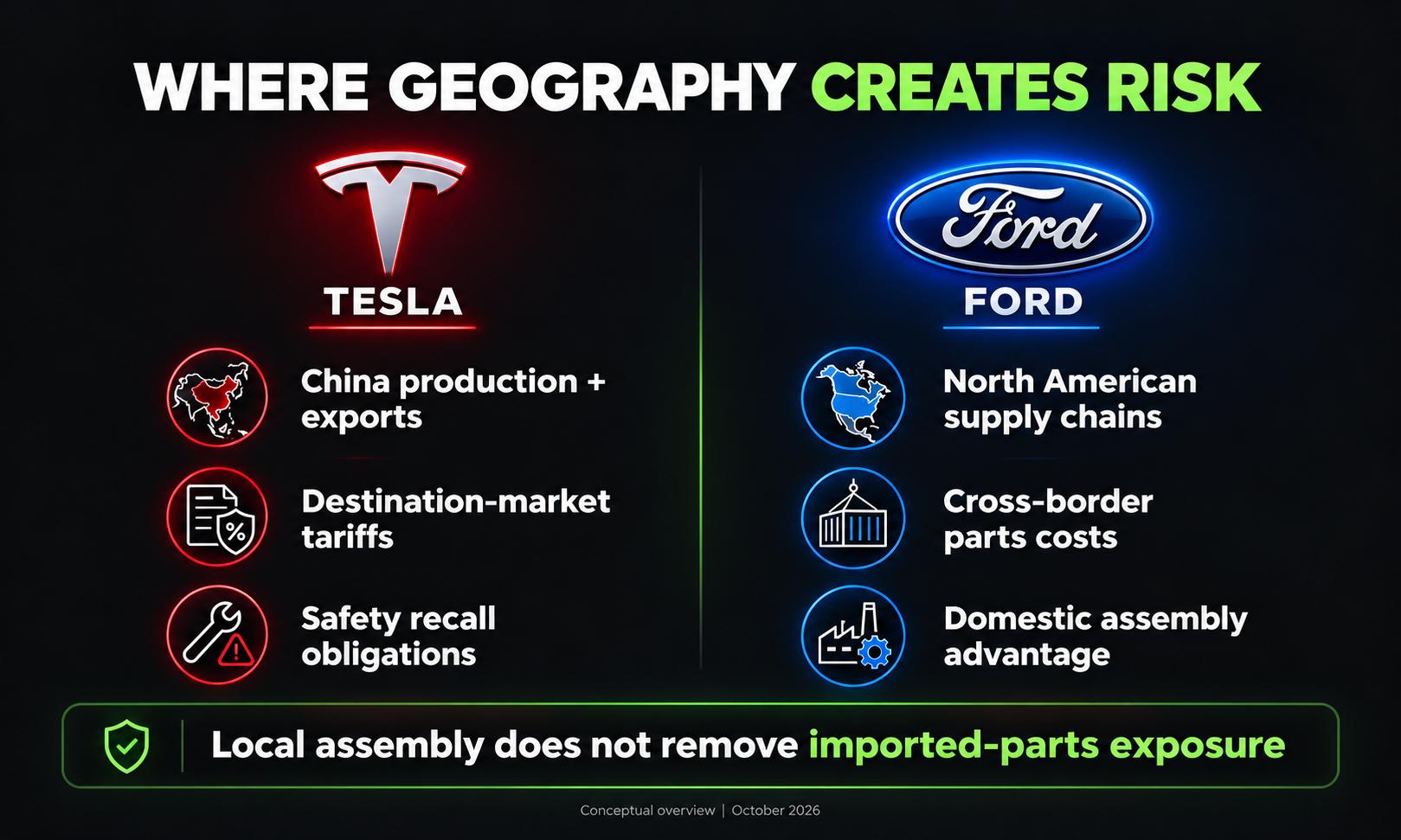
That adds difficulty to the familiar Tesla vs. Ford business model discussion. Technology still shapes costs and how buyers respond. Geography can determine how much of that edge survives the trip to the customer.
Expensive fuel produces different buyers
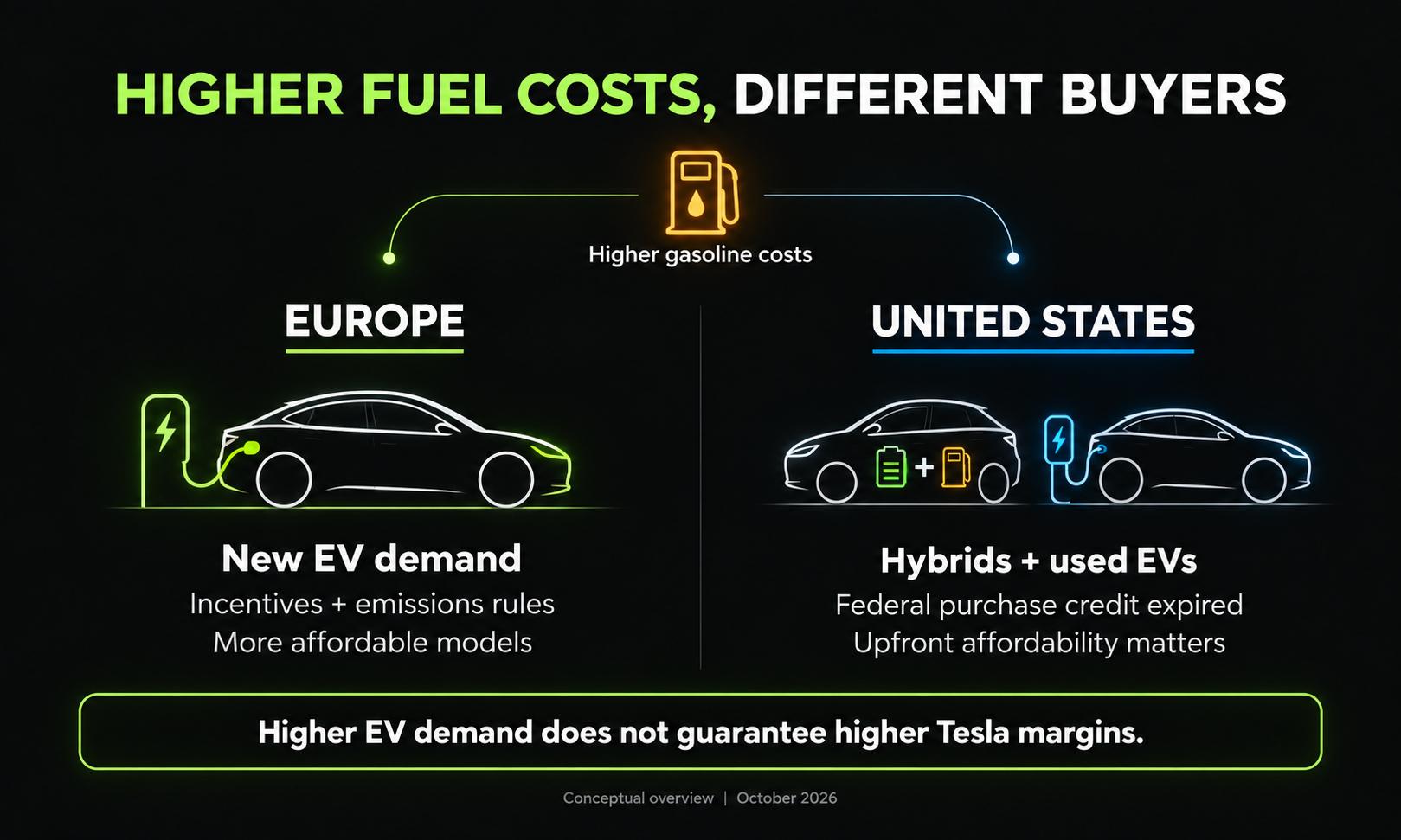
Demand is already uneven. On October 8, Reuters reported that EVs made up 23.2% of new car sales in Europe from January through September, up from 17.7% a year earlier. In the U.S., EV sales dropped 30.7% year over year in the same window, landing at 6% of new vehicle sales after the federal purchase credit lapsed.
European results also come from incentives, emissions laws, and a wider range of affordable models. American buyers shifted toward hybrids and used EVs. That split matters for Ford vs Tesla: money saved on fuel can flow to several vehicle types, including some that do not produce a new Tesla order.
A Tesla vs. Ford market share comparison, therefore, needs a specific region and a powertrain category. European EV growth does not establish the outlook for American showroom demand.
For Tesla, stronger EV demand could keep factories busier. Competitive pricing might still soak up some of that gain. For Ford, hybrid demand opens a door, while expensive fuel can make big combustion vehicles are harder to move without discounts. The result depends on the cars people pick.
TSLA/FORD comparison: What reaches shareholders
TSLA stock valuation stays hooked to expectations beyond current vehicle profit. A better Tesla shares forecast needs a believable route from demand to margins. A Tesla stock price forecast built only on expensive crude misses pricing pressure and regulatory costs.
The price of Ford shares depends partly on how much money is left after paying for tariffs, guarantees, and investments. The Ford stock dividend adds income to the Ford stock investment case, but payouts still depend on cash flow. A solid Ford stock forecast requires proof that shielding American production outweighs the disruption to its suppliers.
Ford stock performance and Tesla's returns can therefore move apart even when both manufacturers sell more cars.
This week's Versus Trade TSLA FORD analysis focuses on that gap. A choice to trade Tesla vs Ford can express a view about which company keeps more cash from the same political shock. Lower production costs lose some of their worth when the path to the buyer gets expensive.
Author

















