Tokyo CPI and a BoJ decision end a central bank week for the Yen
- USD/JPY has won back most of its October 22-23 drop and is just under 158.00.
- Fed Chair Warsh says most Fed officials don't think the economy is too hot.
- The BoJ decides Friday, and traders price a hold at 1.25% near 86%.

Most of USD/JPY's October 22-23 drop is back, and the Fed's hold didn't add to it. The pair was above 158.00 in the run-up to the Fed's decision and made its session high, short of 158.50, as Fed Chair Warsh's press conference began. It's back just under 158.00, above a session low just above 157.50.
Fed Chair Warsh said most Fed officials don't think the US economy is running too hot, and that faster growth doesn't by itself mean more inflation. USD/JPY gave back its rise above 158.00 during his answers, after the Fed held at 3.75%-4.00% against 1.25% at the Bank of Japan (BoJ).
USD/JPY's October 22-23 drop came with a global selloff in technology stocks, as investors bought back the Yen they had borrowed. It climbed back as chip stocks recovered on Monday and Tuesday. Wednesday's Fed decision and press conference moved USD/JPY across a smaller range than Monday's rebound in chip stocks did.
On the calendar
Thursday's 12:30 GMT US releases on third-quarter growth and September prices feed the Fed side of USD/JPY's rate gap. Tokyo's Consumer Price Index (CPI) for October follows at 23:30 GMT, with the measure excluding fresh food forecast at 2.6% after 2.7%. Japan's jobless rate is forecast to hold at 2.5%.
The BoJ's decision on Friday has no set time, its quarterly outlook report is due at 03:00 GMT, and BoJ Governor Ueda takes questions at 06:30 GMT. With a hold priced near 86%, they bear on the timing of the next hike, the BoJ side of the gap.
On the charts
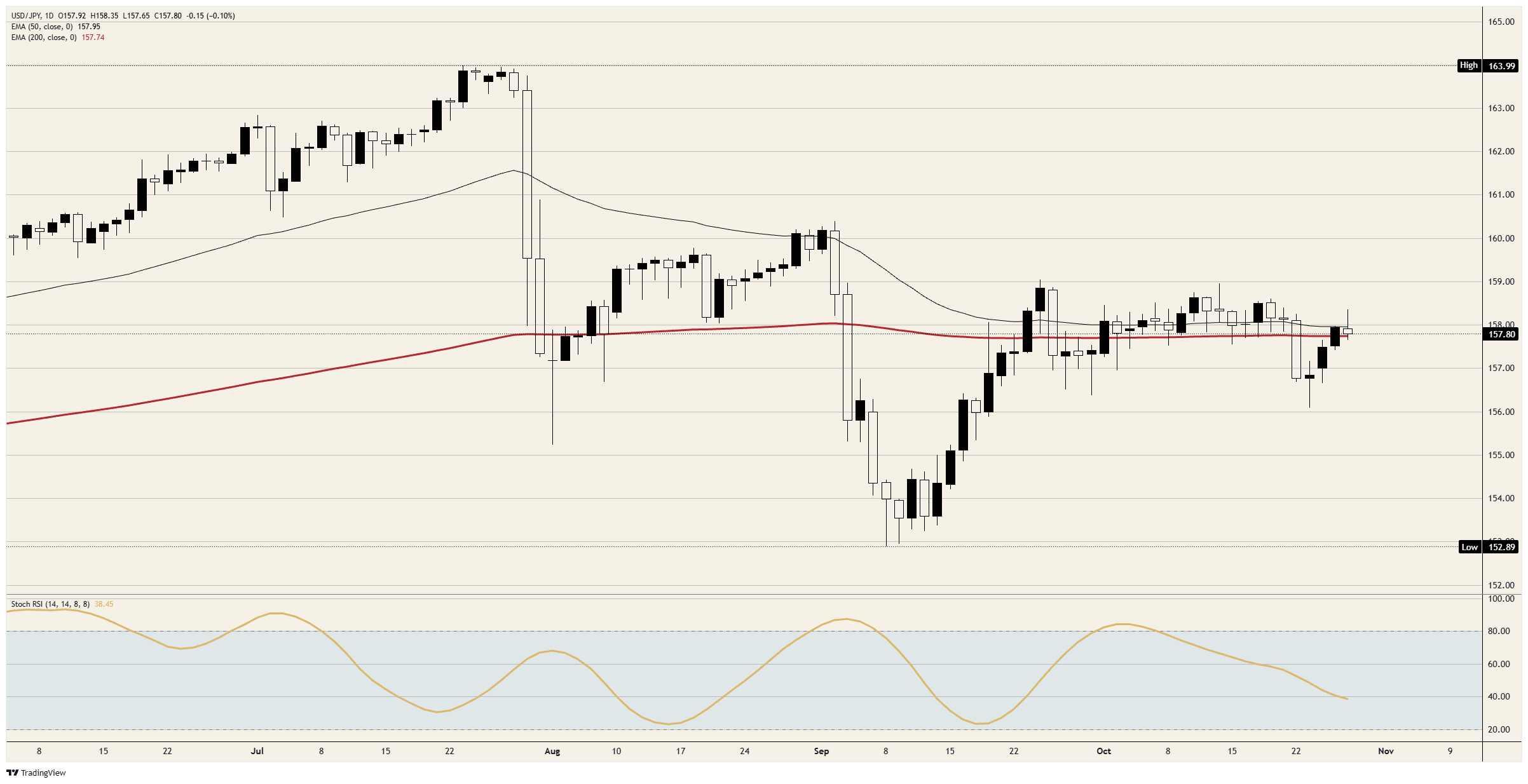
The 50-day and 200-day Exponential Moving Averages (EMA) are about a fifth of a yen apart, and USD/JPY is trading between them. Since October 1 it has traded between just above 156.00 and just under 159.00, and the October 23 low is the bottom of that run of sessions.
USD/JPY daily chart
Japanese Yen FAQs
The Japanese Yen (JPY) is one of the world’s most traded currencies. Its value is broadly determined by the performance of the Japanese economy, but more specifically by the Bank of Japan’s policy, the differential between Japanese and US bond yields, or risk sentiment among traders, among other factors.
One of the Bank of Japan’s mandates is currency control, so its moves are key for the Yen. The BoJ has directly intervened in currency markets sometimes, generally to lower the value of the Yen, although it refrains from doing it often due to political concerns of its main trading partners. The BoJ ultra-loose monetary policy between 2013 and 2024 caused the Yen to depreciate against its main currency peers due to an increasing policy divergence between the Bank of Japan and other main central banks. More recently, the gradually unwinding of this ultra-loose policy has given some support to the Yen.
Over the last decade, the BoJ’s stance of sticking to ultra-loose monetary policy has led to a widening policy divergence with other central banks, particularly with the US Federal Reserve. This supported a widening of the differential between the 10-year US and Japanese bonds, which favored the US Dollar against the Japanese Yen. The BoJ decision in 2024 to gradually abandon the ultra-loose policy, coupled with interest-rate cuts in other major central banks, is narrowing this differential.
The Japanese Yen is often seen as a safe-haven investment. This means that in times of market stress, investors are more likely to put their money in the Japanese currency due to its supposed reliability and stability. Turbulent times are likely to strengthen the Yen’s value against other currencies seen as more risky to invest in.
Author

Joshua Gibson
FXStreet
Joshua joins the FXStreet team as an Economics and Finance double major from Vancouver Island University with twelve years' experience as an independent trader focusing on technical analysis.

















