The US Dollar Index discovers that a vote record is not a reaction function
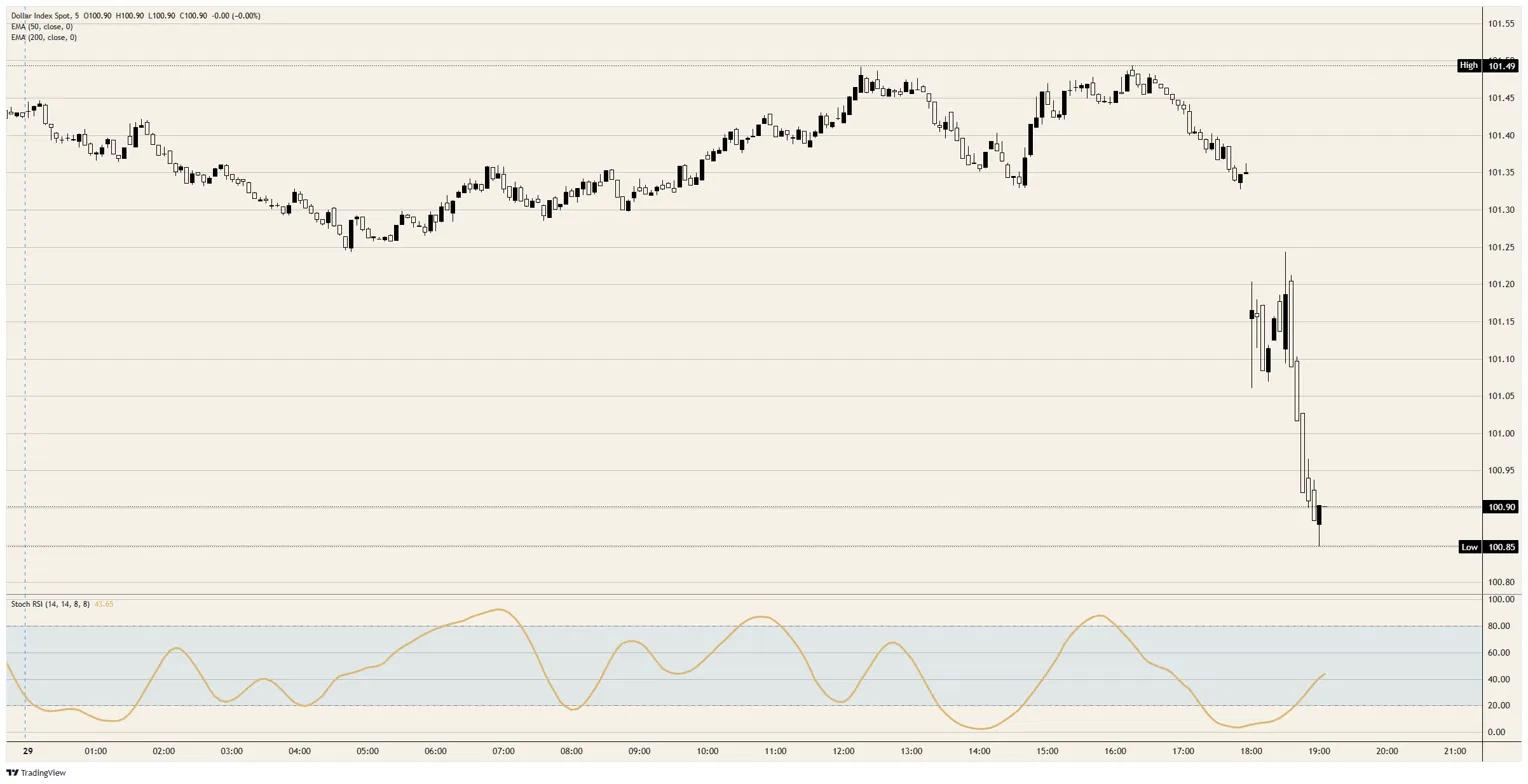
- DXY loses the 101.00 handle in the hour after the Federal Reserve hold, trading near 100.90 against a session high just short of 101.50.
- Three voting members dissented in favour of an immediate quarter-point increase, the first dissents of this chairmanship, and the market cut its September odds anyway.
- Futures now price roughly a two-in-three chance of at least one increase by 16 September, against four in five before the meeting.

The Federal Reserve held its target range at 3.50% to 3.75% at 18:00 GMT on a 9-3 vote, with three voting members preferring an immediate quarter-point increase. Previews had that configuration as the hawkish tail, the outcome that would bid the Dollar and punish risk assets. The index instead lost the 101.00 handle in the hour that followed, trading near 100.90 against a session high just short of 101.50.
A vote record is not a reaction function
Under this Chair the statement carries no forward guidance and this meeting attaches no Summary of Economic Projections, which leaves the briefing at 18:30 GMT as the only forward-looking instrument of the day. The briefing declined to point anywhere. Three dissents describe what three people wanted in July, not what nine people will do in September, and nobody at the microphone was willing to close that gap.
The Chair repeated that the committee has no tolerance for persistently elevated inflation and would not hesitate to act where necessary, then explained that rolling forecasts and running commentary are not this committee's business, because policy works better when markets react to developments unfiltered. That is a coherent doctrine, and it was stated plainly. Its first live test produced a market pricing less tightening after a meeting that produced more dissent.
The strip eased at every meeting
The repricing runs the length of the curve rather than sitting in one contract. At least one increase by September 16 now prices near 64%, against roughly 80% on the captures taken before the meeting and the four-in-five range circulating in Tuesday's previews. October carries at least one near 75% and December near 85%, both lower than they stood on Monday.
The more telling move is at the terminal, where the probability of at least two increases by December 9 has fallen to roughly 42% from 57%. The single most likely December outcome is no longer a 4.00%-4.25% range but the one step to 3.75%-4.00%. A committee that just produced its first dissents of the cycle was rewarded with a flatter path, which is not the trade anybody had on going in.
The next scheduled instrument capable of resolving this is the September meeting, which restores the Summary of Economic Projections and hands the hawks a set of dots rather than a dissent. Nine of 18 dots carried a 2026 increase in June, and only 12 of those participants hold a vote. Until that document prints, the US Dollar is holding a committee that says it will act and a Chair who will not date it.
Hawkish on the scorecard, dovish on the tape
The oddity is that neither document read soft. The statement scored well above its own running average on the hawkish measure, the briefing scored above average too, and the language committing the Committee to deliver price stability survived intact from June. Energy is now named in the statement as a driver of the price increases the Committee is looking through.
Naming the supply shock is precisely what gives a hold its alibi, and three voters treated the same shock as grounds to move immediately. The briefing also acknowledged that Treasury yields have risen since June across five consecutive holds, which is the awkward corner of the doctrine. A central bank that refuses to guide hands the term premium to somebody else, and the one instrument that reliably pulls long yields lower is a credible front-end move the Chair spent an hour declining to promise.
What the Dollar has to trade before Friday
The June Personal Consumption Expenditures (PCE) price index lands Thursday at 12:30 GMT, with the core measure seen at 0.2% MoM and 3.3% YoY against 0.3% and 3.4% prior, and the headline seen at -0.1% MoM and 3.7% YoY from 4.1%. That is a disinflationary set on paper, arriving at a market that has just cut its own hike odds without being asked to.
The same release carries preliminary second-quarter Gross Domestic Product at 2.1% and Initial Jobless Claims seen at 200K against a 187K prior. Friday adds the second-quarter Employment Cost Index at 0.8% and the Michigan inflation expectations series, where the one-year reading is seen unchanged at 4.2% and the five-year at 3.3%. A soft PCE print with sticky expectations leaves the Dollar where the Chair left it, holding a promise with no date on it.
Levels
Resistance: The 101.00 handle just surrendered is the first line, and reclaiming it on a daily closing basis is the minimum required to argue this move was noise. Above that, the 101.50 area caps where the session high stalled.
Support: The 100.85 area marks the session low. Beneath it the 100.50 area is the first shelf, with the 100.00 handle the level that matters, last lost overnight in mid-June and reclaimed inside a session.
Bias: Bearish. Sell rallies into 101.00 with objectives at 100.50 and then the 100.00 handle, invalidation on a daily close back above 101.50.
DXY 5-minute chart
US Dollar FAQs
The US Dollar (USD) is the official currency of the United States of America, and the ‘de facto’ currency of a significant number of other countries where it is found in circulation alongside local notes. It is the most heavily traded currency in the world, accounting for over 88% of all global foreign exchange turnover, or an average of $6.6 trillion in transactions per day, according to data from 2022. Following the second world war, the USD took over from the British Pound as the world’s reserve currency. For most of its history, the US Dollar was backed by Gold, until the Bretton Woods Agreement in 1971 when the Gold Standard went away.
The most important single factor impacting on the value of the US Dollar is monetary policy, which is shaped by the Federal Reserve (Fed). The Fed has two mandates: to achieve price stability (control inflation) and foster full employment. Its primary tool to achieve these two goals is by adjusting interest rates. When prices are rising too quickly and inflation is above the Fed’s 2% target, the Fed will raise rates, which helps the USD value. When inflation falls below 2% or the Unemployment Rate is too high, the Fed may lower interest rates, which weighs on the Greenback.
In extreme situations, the Federal Reserve can also print more Dollars and enact quantitative easing (QE). QE is the process by which the Fed substantially increases the flow of credit in a stuck financial system. It is a non-standard policy measure used when credit has dried up because banks will not lend to each other (out of the fear of counterparty default). It is a last resort when simply lowering interest rates is unlikely to achieve the necessary result. It was the Fed’s weapon of choice to combat the credit crunch that occurred during the Great Financial Crisis in 2008. It involves the Fed printing more Dollars and using them to buy US government bonds predominantly from financial institutions. QE usually leads to a weaker US Dollar.
Quantitative tightening (QT) is the reverse process whereby the Federal Reserve stops buying bonds from financial institutions and does not reinvest the principal from the bonds it holds maturing in new purchases. It is usually positive for the US Dollar.
Author

Joshua Gibson
FXStreet
Joshua joins the FXStreet team as an Economics and Finance double major from Vancouver Island University with twelve years' experience as an independent trader focusing on technical analysis.