The Canadian Dollar waited for the Fed and got paid
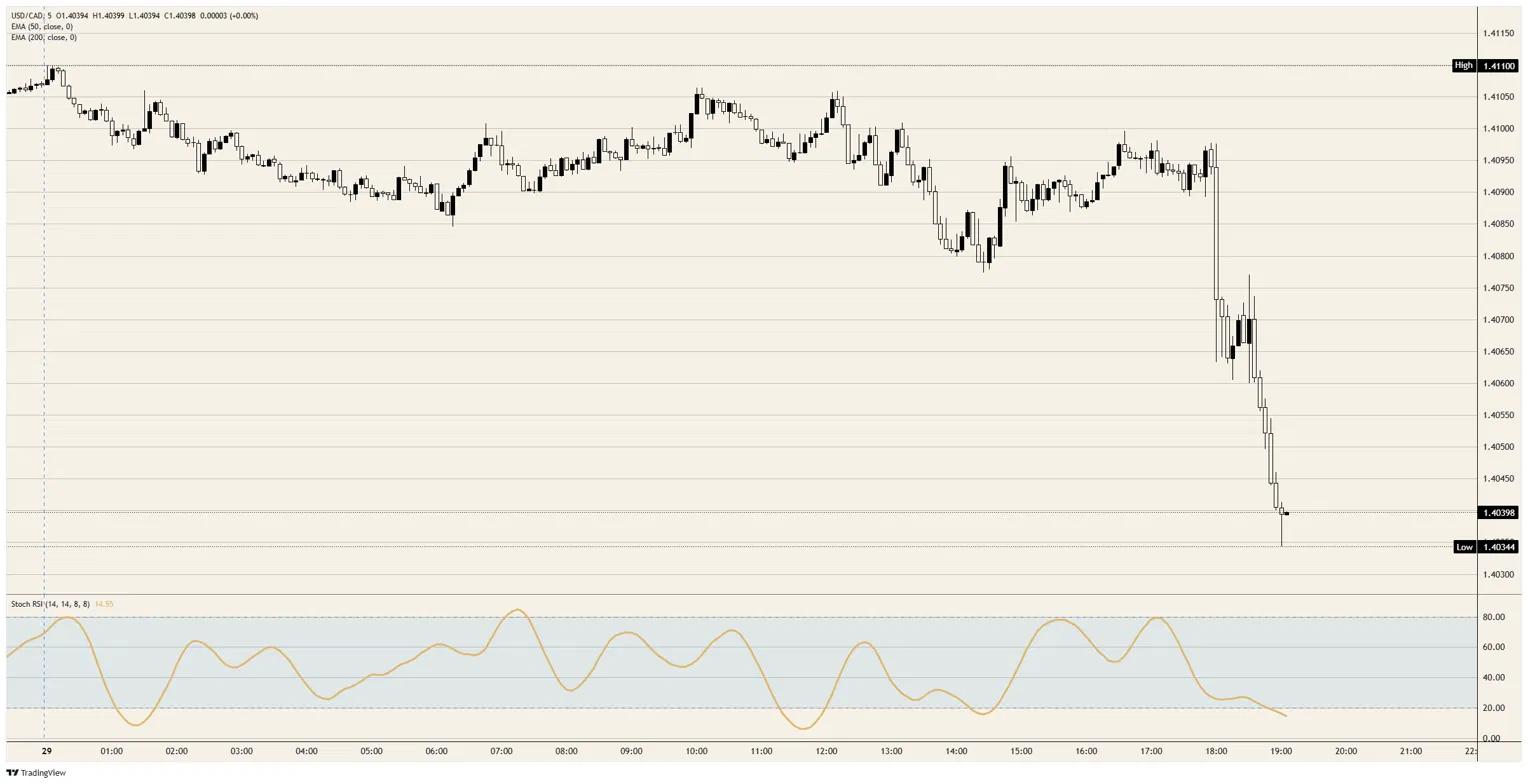
- USD/CAD breaks to a session low just beneath 1.4050 on the Federal Reserve hold, a 76-pip range with the entire move landing after 18:00 GMT.
- The Bank of Canada's Summary of Deliberations published 30 minutes ahead of the decision and moved nothing.
- A December Bank of Canada increase remains the priced base case while the Federal Reserve's own path just flattened at every meeting.

The Federal Reserve held its target range at 3.50% to 3.75% at 18:00 GMT on a 9-3 vote, with three voting members preferring an immediate quarter-point increase, and USD/CAD fell out of a session-long range to print its low just beneath 1.4050. The Canadian half of the day, a Summary of Deliberations at 17:30 GMT, produced nothing at all.
Only half of the gap moves
The standing case for this rate is that it trades the expected policy gap rather than the posted one, and the calendar rarely offers a cleaner demonstration than this. Both central banks were in play inside a single hour. The Canadian document landed at 17:30 GMT into a rate sitting near the 1.4100 handle and left it exactly there, unmoved.
Thirty minutes later the American decision took roughly 60 pips out of it. A December Bank of Canada increase has been the priced base case since the mid-July captures, so the Canadian leg of the expected gap has not shifted in a fortnight. Every basis point of movement in the spread has come from the side of the border that just cut its own hike odds.
The Federal Reserve flattened its own path
At least one increase by 16 September now prices near 64% against roughly 80% on the captures taken before the meeting, with October near 75% and December near 85%. The probability of at least two increases by 9 December has fallen to roughly 42% from 57%, and the most likely December outcome is one step rather than two. That is a meaningful narrowing of the expected gap from the American side.
It happened on a day the committee produced its first three dissents of this chairmanship and a statement that scored well above its own running average on the hawkish measure. The Chair declined to convert any of it into guidance, repeating that this committee is not in the forecasting business and that markets are better served reacting to developments unfiltered. Three hawks with no reaction function behind them do not move a curve.
The statement's new energy language cuts across the border in an unhelpful direction for the hawkish Canadian case. Washington now writes energy into its inflation paragraph while treating the shock as something to look through, and Ottawa's July projection was conditioned on a Crude Oil futures curve that has moved twice since it was finalised. Both central banks are now holding on an energy conditional that neither of them controls.
The reflexive loop runs the other way for once
A firmer Loonie is not a neutral event for the Bank of Canada. The July projection assumed the currency averaging roughly 71 cents US over the horizon, and every cent below that assumption imports inflation and hardens the December case. A move back toward 1.4000 works in the opposite direction, easing the imported-price impulse that has been doing the heavy lifting in the hawkish argument.
The trap in that logic is that it is self-limiting. If a stronger currency softens the Canadian inflation path, the December hike gets less certain, the expected gap widens again and the rate finds a floor. This is why the pair keeps failing to trend far in either direction, and why the 1.4000 handle has held as the base of the range since the 50-day band was reclaimed in July.
Two prints and a border
Canadian Gross Domestic Product for May publishes Friday at 12:30 GMT, with the calendar carrying 0.2% MoM against a 0.5% prior. That is the only domestic input of the week, and on a rate that has spent a fortnight ignoring Canadian data it is unlikely to be the thing that decides the range.
The American docket lands first and matters more. Thursday at 12:30 GMT brings the June Personal Consumption Expenditures price index, with core seen at 0.2% MoM and 3.3% YoY from 0.3% and 3.4%, preliminary second-quarter Gross Domestic Product at 2.1% and initial jobless claims at 200K against a 187K prior. A soft PCE print extends today's move and puts the 1.4000 handle in play before the week is out.
Levels
Resistance: The 1.4100 handle marks the session high and the top of the range that just broke. Above it the 1.4150 shelf is the reclaim line toward the year high near 1.4250.
Support: The 1.4000 handle is the objective, with the 50-day exponential moving average band tracking just above it. Beneath that the 1.3950 area is the first shelf.
Bias: Bearish beneath 1.4100. Sell rallies with the 1.4000 handle as the objective, invalidation on a daily close back above 1.4100.
USD/CAD 5-minute chart
Canadian Dollar FAQs
The key factors driving the Canadian Dollar (CAD) are the level of interest rates set by the Bank of Canada (BoC), the price of Oil, Canada’s largest export, the health of its economy, inflation and the Trade Balance, which is the difference between the value of Canada’s exports versus its imports. Other factors include market sentiment – whether investors are taking on more risky assets (risk-on) or seeking safe-havens (risk-off) – with risk-on being CAD-positive. As its largest trading partner, the health of the US economy is also a key factor influencing the Canadian Dollar.
The Bank of Canada (BoC) has a significant influence on the Canadian Dollar by setting the level of interest rates that banks can lend to one another. This influences the level of interest rates for everyone. The main goal of the BoC is to maintain inflation at 1-3% by adjusting interest rates up or down. Relatively higher interest rates tend to be positive for the CAD. The Bank of Canada can also use quantitative easing and tightening to influence credit conditions, with the former CAD-negative and the latter CAD-positive.
The price of Oil is a key factor impacting the value of the Canadian Dollar. Petroleum is Canada’s biggest export, so Oil price tends to have an immediate impact on the CAD value. Generally, if Oil price rises CAD also goes up, as aggregate demand for the currency increases. The opposite is the case if the price of Oil falls. Higher Oil prices also tend to result in a greater likelihood of a positive Trade Balance, which is also supportive of the CAD.
While inflation had always traditionally been thought of as a negative factor for a currency since it lowers the value of money, the opposite has actually been the case in modern times with the relaxation of cross-border capital controls. Higher inflation tends to lead central banks to put up interest rates which attracts more capital inflows from global investors seeking a lucrative place to keep their money. This increases demand for the local currency, which in Canada’s case is the Canadian Dollar.
Macroeconomic data releases gauge the health of the economy and can have an impact on the Canadian Dollar. Indicators such as GDP, Manufacturing and Services PMIs, employment, and consumer sentiment surveys can all influence the direction of the CAD. A strong economy is good for the Canadian Dollar. Not only does it attract more foreign investment but it may encourage the Bank of Canada to put up interest rates, leading to a stronger currency. If economic data is weak, however, the CAD is likely to fall.
Author

Joshua Gibson
FXStreet
Joshua joins the FXStreet team as an Economics and Finance double major from Vancouver Island University with twelve years' experience as an independent trader focusing on technical analysis.
















