The British Pound stops dead where American data left it
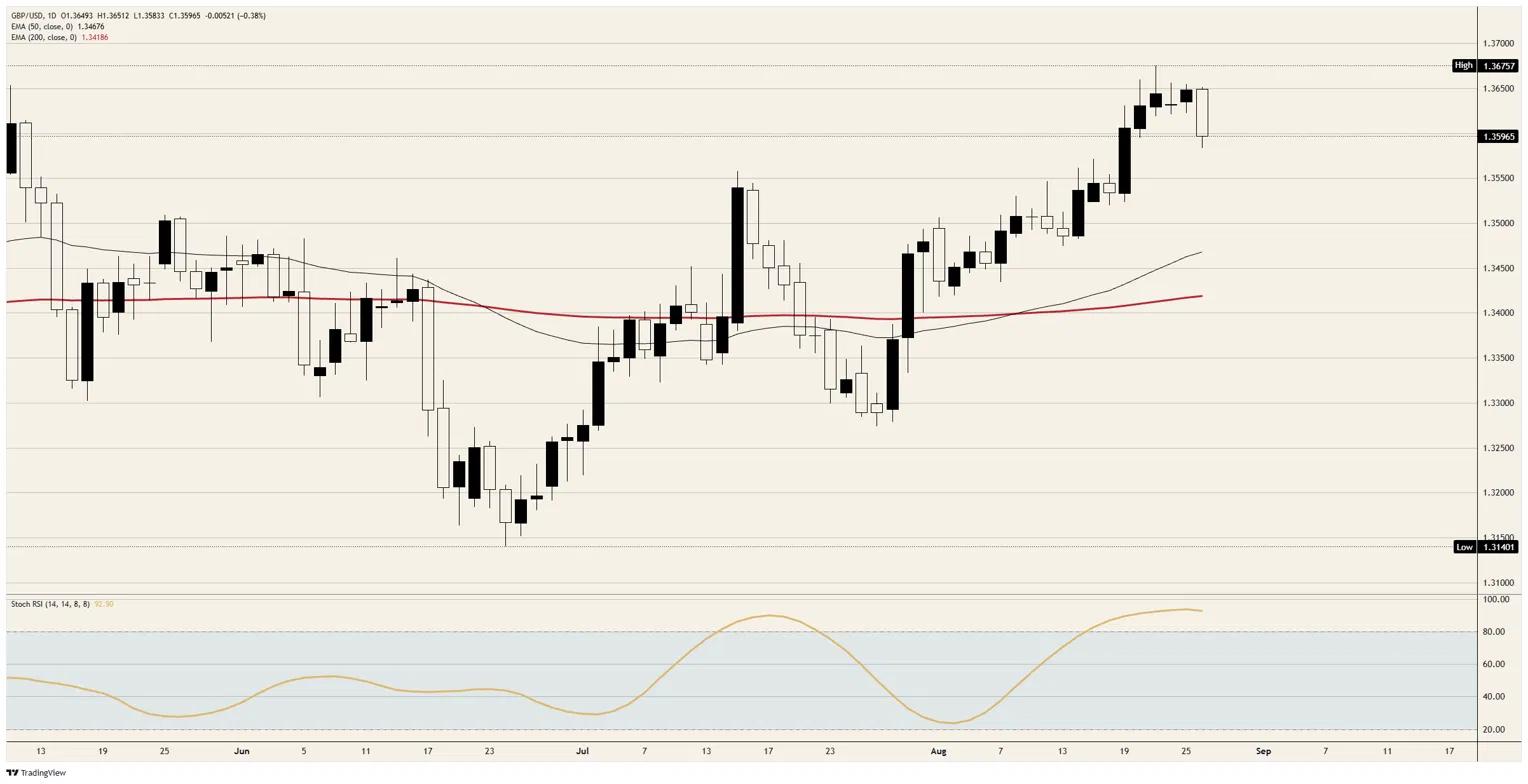
- GBP/USD trades just beneath 1.3600, roughly 55 pips under the session high.
- Daily Stoch RSI near 93, with the six-month high roughly 80 pips overhead.
- No UK data left this week, with the Fed keynote Friday at 14:00 GMT.

Sterling holds just beneath 1.3600 late on Wednesday, roughly 0.4% lower and some 55 pips under a session ceiling at 1.3650. The pair drifted through the European morning and then gave up close to 50 pips in the two hours after the 12:30 GMT American data block. The tape has ranged flat at the lows ever since, which is the more useful fact to carry into Thursday.
A rally with no British author
The August advance is the cleanest leg of the year for the Pound, running from roughly 1.3300 in the first week of the month to a peak short of 1.3700, and price still sits well clear of a 50-day Exponential Moving Average (EMA) just above 1.3450 and a 200-day EMA just above 1.3400. Both averages are rising, the structure is unambiguously bullish, and a daily Stochastic Relative Strength Index (Stoch RSI) near 93 says the move has been paid for in full. What is far less clear is who paid.
Britain's own contribution amounts to a July inflation rate of 2.9% and a July 30 decision that held Bank Rate at 3.75% on a 6-3 vote, with three members preferring 4.00%. Neither is trivial and neither is new. The dates that actually match the move run through Washington, where the Treasury's decision to at least double its purchases of longer-dated government debt knocked the Dollar across the board and paid every major currency in the same week.
That distinction sets out what has to hold for the trade to keep working. A currency bid on its own rate story absorbs a Dollar bounce and comes back, while a currency bid on Dollar weakness hands the move straight back the first time the Dollar is given a reason. Wednesday was the first sample.
The part of Wednesday's release nobody traded
The headline was the July Personal Consumption Expenditures (PCE) price index at 0.2% MoM against a 0.1% consensus, with the core measure in line at 0.2% and the annual rates at 3.7% and 3.3%. Markets treated the monthly figures as the signal and the annual ones as noise, easing September hike odds into the high 30s while leaving a year-end increase priced near 73%.
It is much harder to defend against the quarterly revisions buried in the same release. Second-quarter core PCE prices were marked up to 3.7% QoQ from 3.4%, headline PCE prices to 5.3% from 5.1%, and the Gross Domestic Product (GDP) price index to 6.4% from 6.3%, while real growth held at 1.5% annualised and exactly in line. Durable goods orders ran 1.1% against a 0.7% consensus and personal income 0.4% against 0.3%. The quarter got more inflationary and no more productive, which is the reverse of what the front end took away from it.
Nothing British is on the docket
The next scheduled British event of weight is the September 17 rate decision, three weeks out with no Monetary Policy Report attached. Pricing points to a rise rather than a cut, with curves carrying something close to 4.00% by November, and the dissent bloc has grown from two members to three across two meetings. None of that can be repriced before the weekend, because there is no British data left to reprice it with.
The fiscal leg is louder and equally frozen. Thirty-year gilt yields sit near 5.80% and the ten-year above 5.00%, a move since February that has taken an estimated £10 billion to £12 billion out of the headroom Healey carries into the October 28 Budget, now put at between £10 billion and £15 billion. Sterling holds a rate market pricing tightening and a bond market pricing fiscal risk at once, and neither gets a hearing this week.
The only vote that counts lands on Friday
Thursday carries almost nothing tradeable beyond initial jobless claims at 12:30 GMT against a 208K consensus from 206K prior, with the Kansas City Fed symposium opening for a three-day run that generates headlines rather than data. The Chicago Purchasing Managers Index (PMI) follows at 13:45 GMT Friday with a 57 consensus from 57.6.
Friday at 14:00 GMT is where the week is decided, and it arrives compressed into one minute. The Fed Chair delivers his first Jackson Hole keynote, final August Michigan sentiment prints against a 51 consensus and prior with one-year inflation expectations at a 4.3% prior and the five-year 3.3%, and the preliminary benchmark revision to nonfarm payrolls lands alongside both.
The keynote outweighs the arithmetic around it because this chair has stripped guidance out of the statement and relocated it to the podium. His stated rule leans toward tightening when underlying inflation moves higher with labour markets near equilibrium, and labour markets are not near equilibrium after a 23K payrolls contraction in July. Which half of that rule binds is what the speech has to answer, and the Pound has nothing British of its own to set against the answer.
Levels to watch
Resistance: The 1.3650 area caps everything, having turned the tape back on each attempt this week. A daily close above it reopens the August peak short of 1.3700, the last marker on the chart before the pair is trading above anything printed since February.
Support: The 1.3550 area is the first real shelf beneath a session floor that held just short of 1.3600. Below it, 1.3500 is the round number the August breakout ran through on its way up, and the 50-day EMA just above 1.3450 is the level at which the trend itself comes into question.
Bias: Bearish into Friday, on a rally that was authored in Washington rather than London, a Stoch RSI near 93 and a domestic calendar with nothing left on it. Objectives are 1.3550 and then 1.3500, with invalidation on a daily close back above 1.3650.
GBP/USD daily chart
Pound Sterling FAQs
The Pound Sterling (GBP) is the oldest currency in the world (886 AD) and the official currency of the United Kingdom. It is the fourth most traded unit for foreign exchange (FX) in the world, accounting for 12% of all transactions, averaging $630 billion a day, according to 2022 data. Its key trading pairs are GBP/USD, also known as ‘Cable’, which accounts for 11% of FX, GBP/JPY, or the ‘Dragon’ as it is known by traders (3%), and EUR/GBP (2%). The Pound Sterling is issued by the Bank of England (BoE).
The single most important factor influencing the value of the Pound Sterling is monetary policy decided by the Bank of England. The BoE bases its decisions on whether it has achieved its primary goal of “price stability” – a steady inflation rate of around 2%. Its primary tool for achieving this is the adjustment of interest rates. When inflation is too high, the BoE will try to rein it in by raising interest rates, making it more expensive for people and businesses to access credit. This is generally positive for GBP, as higher interest rates make the UK a more attractive place for global investors to park their money. When inflation falls too low it is a sign economic growth is slowing. In this scenario, the BoE will consider lowering interest rates to cheapen credit so businesses will borrow more to invest in growth-generating projects.
Data releases gauge the health of the economy and can impact the value of the Pound Sterling. Indicators such as GDP, Manufacturing and Services PMIs, and employment can all influence the direction of the GBP. A strong economy is good for Sterling. Not only does it attract more foreign investment but it may encourage the BoE to put up interest rates, which will directly strengthen GBP. Otherwise, if economic data is weak, the Pound Sterling is likely to fall.
Another significant data release for the Pound Sterling is the Trade Balance. This indicator measures the difference between what a country earns from its exports and what it spends on imports over a given period. If a country produces highly sought-after exports, its currency will benefit purely from the extra demand created from foreign buyers seeking to purchase these goods. Therefore, a positive net Trade Balance strengthens a currency and vice versa for a negative balance.
Author

Joshua Gibson
FXStreet
Joshua joins the FXStreet team as an Economics and Finance double major from Vancouver Island University with twelve years' experience as an independent trader focusing on technical analysis.
















