The British Pound sets a new September low as Fed officials argue for more
- GBP/USD falls to a new September low just above 1.3300 on more Fed hike talk.
- UK Bank Rate at 3.75%, an eighth of a point under the Fed's midpoint.
- UK flash services survey due Wednesday at 08:30 GMT, forecast at 52 from 52.5.

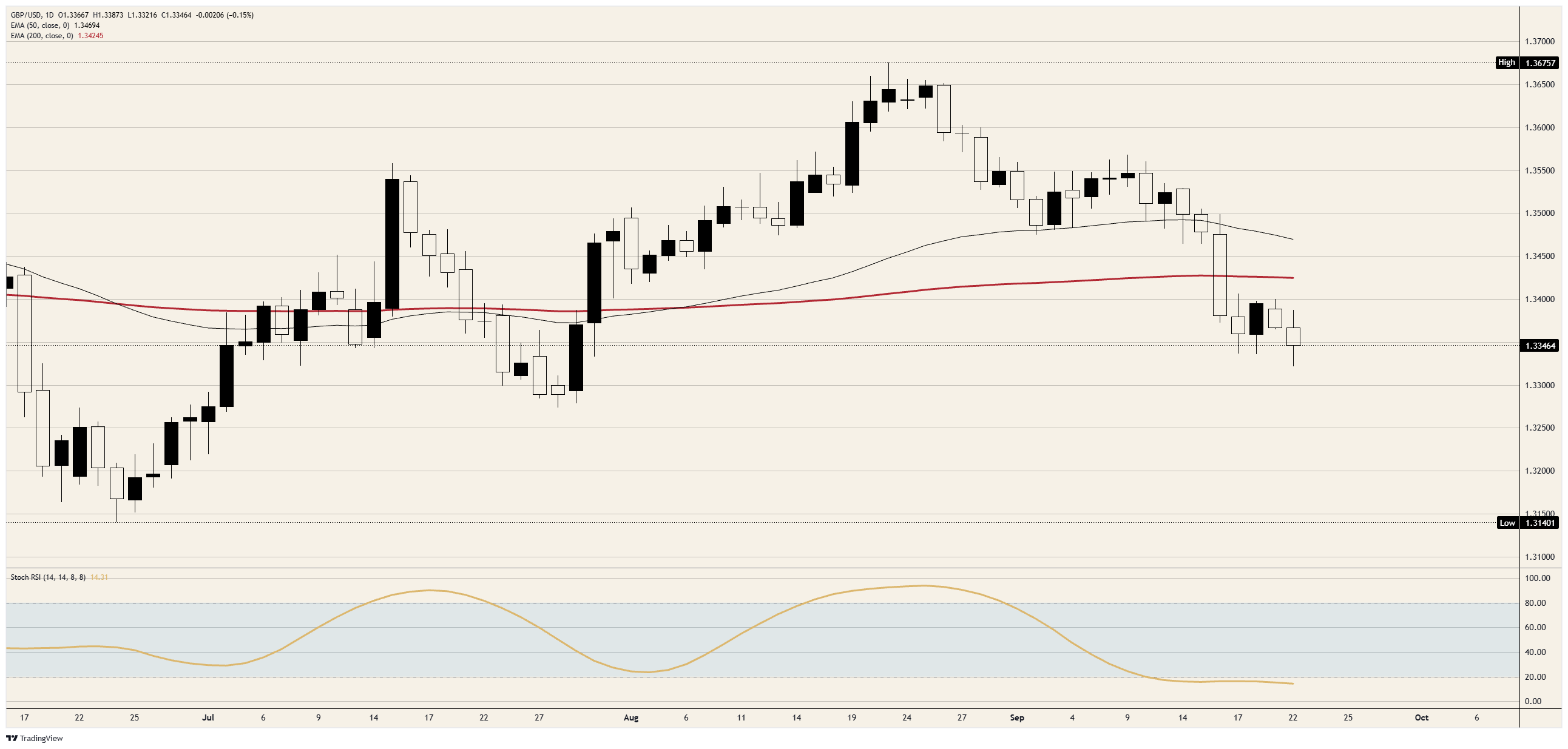
1.3400 has capped GBP/USD in every session since the Fed raised rates on September 16. The pair went through that level on the day of the decision and has failed to get back above it four times since. On Tuesday it fell to a new September low just above 1.3300, its lowest since late July, and it's trading near 1.3350. Nothing British caused it, since the UK calendar was empty and the Dollar rose as Fed officials made the case for another increase before the end of the year.
Sixteen Fed officials against three at the Bank of England
The UK's Bank Rate, which is what the Bank of England (BoE) calls its main interest rate, has been 3.75% since December 2025. The Fed's range is 3.75-4.00% after the September 16 increase, and its midpoint of 3.875% is an eighth of a point above the UK rate. That's why a Dollar deposit now earns more than a Pound deposit, which hadn't been true at any point this year before September 16. Money moves toward the better rate, so every extra Fed increase the market expects is another reason to swap Pounds for Dollars.
UK inflation was 3.1% in August, above the BoE's 2% target, and the BoE expects energy costs to push it higher in the coming quarters. That forecast is what the three members who want an increase are voting on, and the Pound needs a fourth to join them before a UK increase looks likely.
Sixteen of the Fed's 18 officials expect at least one more increase this year, according to the projections published with the decision. The BoE voted 6-3 to hold on September 17, with Chief Economist Pill and external members Greene and Mann wanting 4%. If the three win in November and the Fed adds its one more, the Pound finishes the year an eighth of a point behind, which is exactly where it is now.
Wednesday's survey covers the part of the economy the three worry about
S&P Global's flash surveys of UK purchasing managers are due on Wednesday at 08:30 GMT. The Purchasing Managers Index (PMI), a monthly poll of company buyers where anything over 50 means growth, is forecast at 52 for services, down from 52.5, and at 51.4 for manufacturing, down from 51.7. UK services inflation was 3.4% in August against 3.1% overall, so the services reading is the one the three members who want an increase will point to. Services make up about four-fifths of the UK economy, which is why that number carries more weight at the BoE than the factory one.
A weaker reading argues for the six who held and pushes a UK increase further out, which leaves the gap in the Dollar's favour for longer. A stronger one helps the Pound only if someone at the BoE says it matters. Deputy Governor Breeden and external member Dhingra speak on Thursday at 09:30 GMT and Deputy Governor Lombardelli at 14:00 GMT, and all three voted to hold, so the Pound's best chance of a lift runs through the people who voted against giving it one.
Most of what moves the Pound before the weekend is American
US new home sales for August come out on Thursday at 14:00 GMT after a 10.5% drop in July, the one US release before Friday built on the mortgage rates the Fed's increases feed into. On Friday at 14:00 GMT the University of Michigan survey reports what American households expect inflation to be in a year, forecast to hold at 4.6%, and a number that high is the argument Fed officials keep using for a second increase.
Each of those releases moves the odds of that second increase on October 28, and GBP/USD has followed those odds lower since September 16. The UK adds GfK's consumer confidence survey on Thursday at 23:01 GMT, forecast at -16 from -14, which would be another point for the six who held. The pair has fallen in four of the five sessions starting with the Fed's decision, and nothing on the UK side of the calendar is built to change that.
Levels and bias
Resistance: 1.3400, which has turned back every rally since the Fed's decision. Above it, the 200-day Exponential Moving Average (EMA) is just under 1.3450, and the pair hasn't had a daily close over it since it went under on September 16.
Support: Tuesday's low just above 1.3300, a new low for September. Below that, 1.3200 is where the pair was trading at the end of June, before the summer rally.
Bias: Bearish below 1.3400. The first objective is 1.3300, which Tuesday's low came within a few pips of, and the second is 1.3200. The daily Stochastic Relative Strength Index (Stoch RSI), a momentum gauge, reads 14 and has stayed near the bottom of its range for a week, so the selling is stretched but hasn't stopped. A daily close above 1.3450 would put the Pound back over its 200-day average and mean the bearish case is wrong.
GBP/USD daily chart
Pound Sterling FAQs
The Pound Sterling (GBP) is the oldest currency in the world (886 AD) and the official currency of the United Kingdom. It is the fourth most traded unit for foreign exchange (FX) in the world, accounting for 12% of all transactions, averaging $630 billion a day, according to 2022 data. Its key trading pairs are GBP/USD, also known as ‘Cable’, which accounts for 11% of FX, GBP/JPY, or the ‘Dragon’ as it is known by traders (3%), and EUR/GBP (2%). The Pound Sterling is issued by the Bank of England (BoE).
The single most important factor influencing the value of the Pound Sterling is monetary policy decided by the Bank of England. The BoE bases its decisions on whether it has achieved its primary goal of “price stability” – a steady inflation rate of around 2%. Its primary tool for achieving this is the adjustment of interest rates. When inflation is too high, the BoE will try to rein it in by raising interest rates, making it more expensive for people and businesses to access credit. This is generally positive for GBP, as higher interest rates make the UK a more attractive place for global investors to park their money. When inflation falls too low it is a sign economic growth is slowing. In this scenario, the BoE will consider lowering interest rates to cheapen credit so businesses will borrow more to invest in growth-generating projects.
Data releases gauge the health of the economy and can impact the value of the Pound Sterling. Indicators such as GDP, Manufacturing and Services PMIs, and employment can all influence the direction of the GBP. A strong economy is good for Sterling. Not only does it attract more foreign investment but it may encourage the BoE to put up interest rates, which will directly strengthen GBP. Otherwise, if economic data is weak, the Pound Sterling is likely to fall.
Another significant data release for the Pound Sterling is the Trade Balance. This indicator measures the difference between what a country earns from its exports and what it spends on imports over a given period. If a country produces highly sought-after exports, its currency will benefit purely from the extra demand created from foreign buyers seeking to purchase these goods. Therefore, a positive net Trade Balance strengthens a currency and vice versa for a negative balance.
Author

Joshua Gibson
FXStreet
Joshua joins the FXStreet team as an Economics and Finance double major from Vancouver Island University with twelve years' experience as an independent trader focusing on technical analysis.