The $1 trillion market rally

Us stocks are surging on Monday, as August gets off to a rip-raring start. The Nasdaq is higher by more than 2% today, and US tech stocks are the top global performers on the first trading day of August.
The S&P 500 is also higher by 1.6%, driven by strong gains for Oracle and Meta, which is bouncing back to the tune of 6.5%. Microsoft and Alphabet are also up sharply, rising more than 5%, and Amazon rose more than 4% reaching a record high 3 trillion-dollar valuation.
Magnificent 7 roar back to life
The magnificent 7 are roaring back to life, and further to our view from last week, it looks like the dip in tech stocks is over for now. Traders and hedge funds bought US tech stocks at their fastest ever pace in the last 5 weeks, which tells us two things: 1, big names in finance have seen the sell off across the tech sector and view it as good value. 2, this emphasizes the view that the selloff in tech that lasted from 22nd June to the end of July is now over.
The scale of the move is staggering, on Monday alone the S&P 500 added $1 trillion in market capitalization. Real money is ploughing back into US stocks as we progress through Q2, after the recent shake-out.
SpaceX joins in the rally
Even SpaceX is higher by 1.8% today, after falling to a record low on Friday. This comes after Elon Musk said that the stock is an ‘insane buy’ below $110. Musk’s comment comes a day before SpaceX reports its first earnings report since listing on the Nasdaq in June.
What is the fueling the rally
So, what is fueling this rally? There are a few reasons. In the short term, the drop in the oil prices is helping. Brent crude futures fell 4% today and are back around $83.50, as the potential for a flare up in US/ Iran tensions looks like it is on the back burner for now.
Fundamental basis strong for US stocks
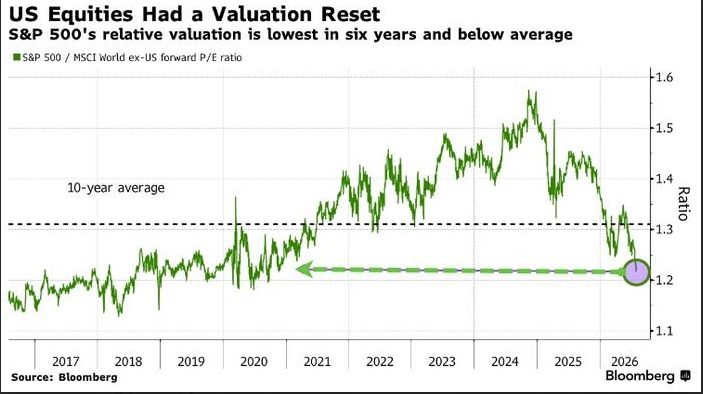
However, there are two fundamental details that are power-charging this rally. The first is valuation. The moderation in performance in the S&P 500 in the last 6 weeks has caused a massive revaluation of the main US blue-chip index. The S&P 500’s relative valuation compared to the MSCI world index, based on the forward P/E ratios, is now below its long-term average.
Earnings bonanza tempts investors back to the US
Added to this, earnings season has been phenomenal for the S&P 500 so far. Blended earnings growth is a whopping 47.4% YoY, which is the highest rate since Q2 2021. Excluding Alphabet and Amazon, which had huge, outsized beats that skew the data, the earnings growth rate is still a very respectable 28.8%. 86% of companies have beaten estimates, and 10 out of the 11 sectors in the S&P 500 have reported YoY earnings growth.
The fact that growth is being boosted by the tech sector but remains strong even when stripping out the tech influence, is a reminder why investors should never doubt the strength of corporate America.
US stocks are high quality and look like a bargain. Of course, if the rally continues, then they will quickly become expensive once more. However, for now, the economy is the perfect temperature. It is not hot enough to push most Fed members to vote for a rate hike, earnings growth is stellar and the Magnificent 7 are increasing their capex spend, which is adding to the recovery in the AI trade.
Europe and UK at risk from US stock comeback
As we start a new month, there is a rotation back into the tech trade. We think that this could come at the expense of UK and European stocks, as defensive sectors, energy stocks and pharma and healthcare are ditched in favour of large cap growth stocks.
The AI trade still has legs. Until recently, this was a split debate, but Q2 earnings have delivered, and the massive deleveraging that we have seen in recent weeks looks like it is behind us. While the AI trade is complex, and multi-faceted, the fact that the Magnificent 7 is rallying with chip stocks show that it is making a broad-based comeback at the start of this week.
Risks to US stocks
Looking ahead, in the short-term risks to the AI trade include a strong payrolls report on Friday that boosts the chance of a rate hike from the Fed in September, and a return to hostilities that pushes up the oil price.
Chart 1: S&P 500 relative valuation vs. the MSCI World Index
Source: XTB and Bloomberg
Author

Kathleen Brooks
XTB UK
Kathleen has nearly 15 years’ experience working with some of the leading retail trading and investment companies in the City of London.
















