Swiss Franc edges up against US Dollar amid heightened US debt concerns
- The Swiss Franc bounces back against the US Dollar after a corrective move on Thursday.
- Ballooning US government debt levels have dampened the appeal of the US Dollar.
- The Fed is expected to leave interest rates unchanged in the September meeting.

The Swiss Franc (CHF) resumes its upside journey against the US Dollar (USD) on Friday after a corrective move the previous day. The USD/CHF pair is down 0.17% to near 0.7990 in the Asian trading session.
The Swiss Franc pair is expected to remain under pressure as heightening United States (US) debt concerns have weighed on the US Dollar.
On Wednesday, the US Treasury Department unveiled its plans to double the pace of its debt repayment, in an effort to curb higher borrowing costs. The announcement led to a sharp decline in US Treasury yields and the US Dollar.
However, bond yields recovered a majority of their losses, as financial markets warned that the government’s bond-buying plan would prove to be a temporary solution.
US Treasury buybacks flatten curve as fiscal credibility weighs on Dollar
Strategists at Brown Brothers Harriman note that “US long-term Treasury yields have retraced most of yesterday’s drop triggered by the US Treasury’s buyback announcement, while USD has extended its decline.” They explain that “the Treasury buyback is essentially a debt-management swap,” in which the authorities “buy and retire older, less liquid bonds (off-the-run) in favor of new, more liquid debt (on-the-run) issued through its regular auction.” As a result, “total debt stays the same, but its composition shifts toward newer, more liquid securities.”
BBH expects that “the additional buyback size will probably be financed at the margin through greater bill issuance.” In their view, “more front-end supply combined with long-bond purchases, point to a flatter yield curve,” although they stress that “the impact should be limited given the small size of the operations relative to the overall Treasury market ($31.4 trillion).”
However, the bank is more uneasy about the policy signal. BBH argues that “the timing of the Treasury’s buyback announcement sends a less comfortable message,” noting that “the Treasury expanded the long-end buybacks shortly after the 30-year Treasury yield reached its highest level since 2007.” For them, this “suggests that heavy debt supply (public and private) is beginning to strain long-end liquidity and the Treasury is increasingly uncomfortable with rising borrowing costs.” Their “bottom line” is that “the perception the Treasury is managing yields rather than liquidity undermines US fiscal credibility and is a drag on USD.”
Meanwhile, rising government debt levels are undermining the appeal of the US currency.
In addition to rising US debt levels, firm expectations that the Federal Reserve (Fed) will not cut interest rates in the September meeting are also hurting the US Dollar.
USD/CHF Technical Analysis
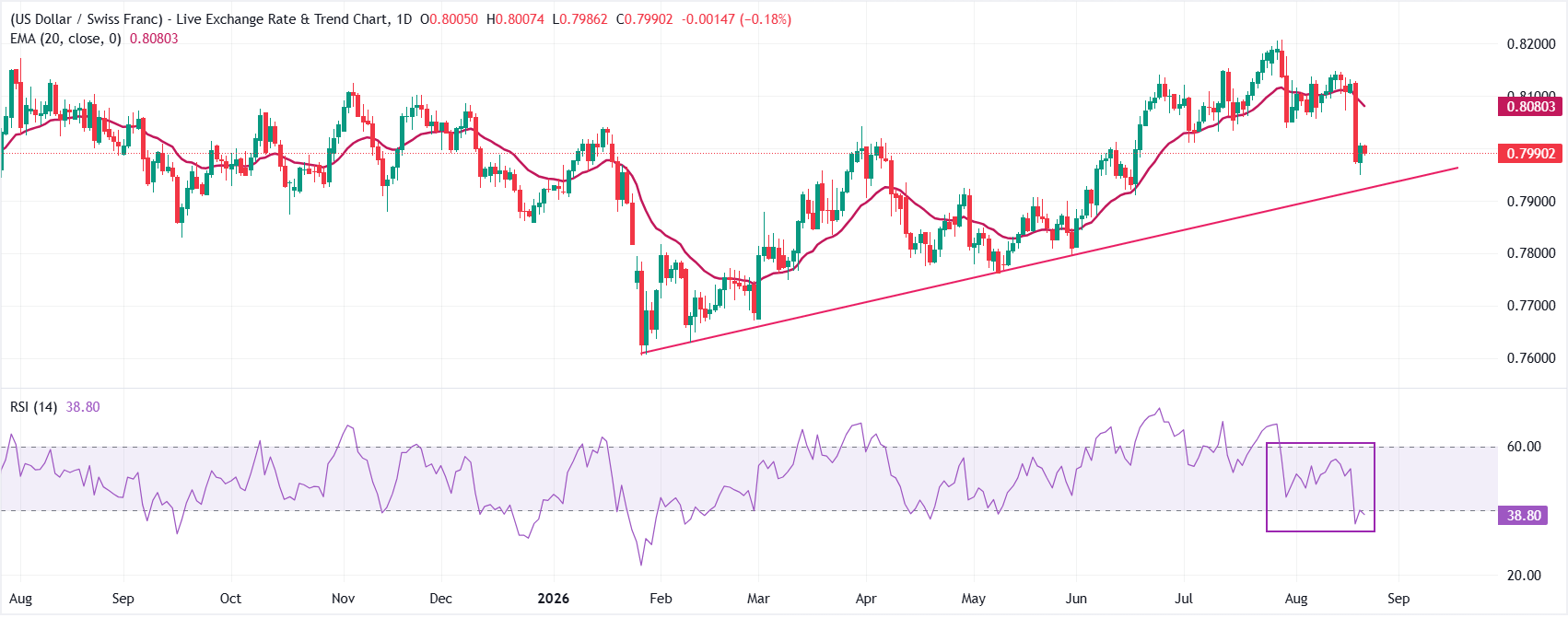
In the daily chart, USD/CHF trades at 0.7990, keeping a bearish near-term bias as it remains below the 20-day Exponential Moving Average (EMA) at 0.8080. The pair has recently slipped back towards the 0.80 handle, and price trading under the short-term EMA suggests rallies are likely to be capped while the broader uptrend support line from 0.7609 stays intact beneath the market. The Relative Strength Index (RSI) at 38.8 drifts in bearish territory but is not yet oversold, hinting that selling pressure could persist without an immediate exhaustion signal.
On the downside, initial support appears at the recent pivot zone around 0.7990, followed by the former break level of the rising trend line near 0.7922. On the topside, the 20-day EMA at 0.8080 is the first notable resistance, and only a sustained move above this barrier would start to ease the current bearish tone and open the way for a more meaningful recovery.
(The technical analysis of this story was written with the help of an AI tool. Know more.)
US Dollar FAQs
The US Dollar (USD) is the official currency of the United States of America, and the ‘de facto’ currency of a significant number of other countries where it is found in circulation alongside local notes. It is the most heavily traded currency in the world, accounting for over 88% of all global foreign exchange turnover, or an average of $6.6 trillion in transactions per day, according to data from 2022. Following the second world war, the USD took over from the British Pound as the world’s reserve currency. For most of its history, the US Dollar was backed by Gold, until the Bretton Woods Agreement in 1971 when the Gold Standard went away.
The most important single factor impacting on the value of the US Dollar is monetary policy, which is shaped by the Federal Reserve (Fed). The Fed has two mandates: to achieve price stability (control inflation) and foster full employment. Its primary tool to achieve these two goals is by adjusting interest rates. When prices are rising too quickly and inflation is above the Fed’s 2% target, the Fed will raise rates, which helps the USD value. When inflation falls below 2% or the Unemployment Rate is too high, the Fed may lower interest rates, which weighs on the Greenback.
In extreme situations, the Federal Reserve can also print more Dollars and enact quantitative easing (QE). QE is the process by which the Fed substantially increases the flow of credit in a stuck financial system. It is a non-standard policy measure used when credit has dried up because banks will not lend to each other (out of the fear of counterparty default). It is a last resort when simply lowering interest rates is unlikely to achieve the necessary result. It was the Fed’s weapon of choice to combat the credit crunch that occurred during the Great Financial Crisis in 2008. It involves the Fed printing more Dollars and using them to buy US government bonds predominantly from financial institutions. QE usually leads to a weaker US Dollar.
Quantitative tightening (QT) is the reverse process whereby the Federal Reserve stops buying bonds from financial institutions and does not reinvest the principal from the bonds it holds maturing in new purchases. It is usually positive for the US Dollar.
Author

Sagar Dua
FXStreet
Sagar Dua is associated with the financial markets from his college days. Along with pursuing post-graduation in Commerce in 2014, he started his markets training with chart analysis.