|

Stocks fluctuate following last week’s rally

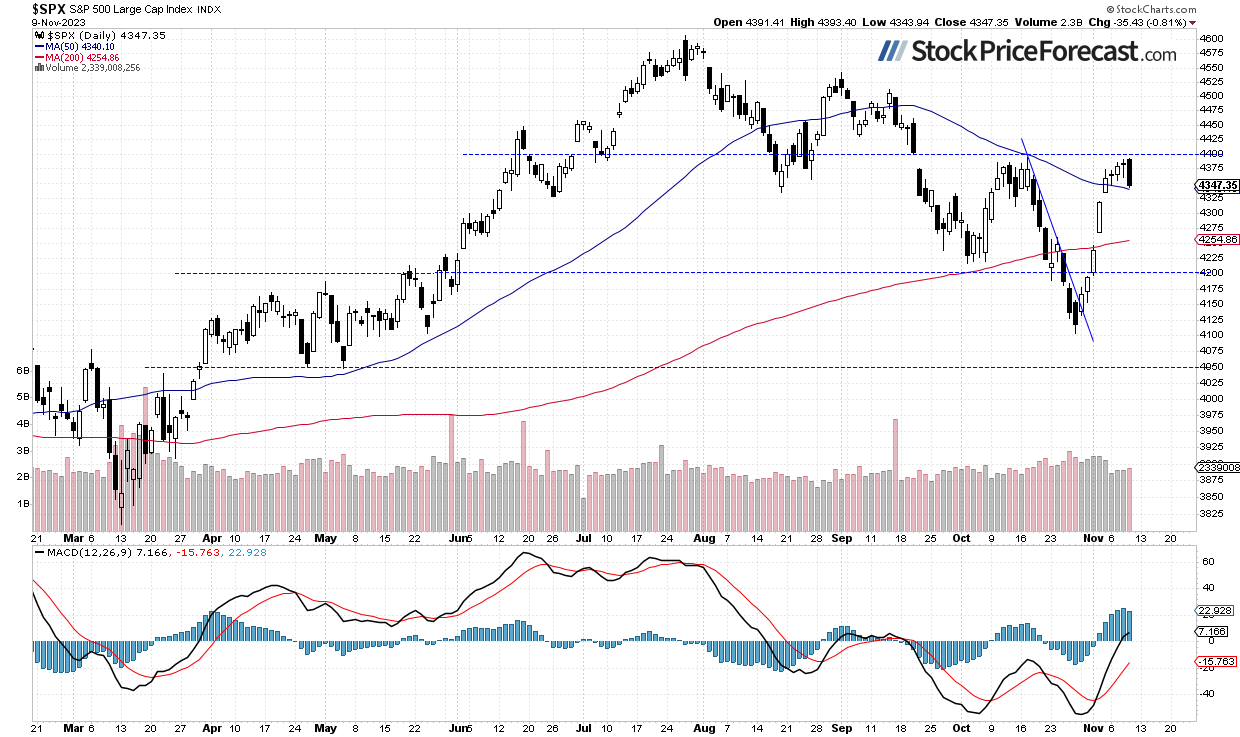
The S&P 500 index lost 0.81% on Thursday as it bounced from 4,400 level. Stocks retraced some of their recent advances following 30y bond auction results, Jerome Powell’s speech, among other factors. Yesterday’s daily low was at 4,343.94 and earlier in the day the S&P 500 reached new local high of 4,393.40. It was very close to mid-October high of 4,393.57. Investors’ sentiment remains positive despite a lot of uncertainty about monetary policy, economic growth and geopolitics. Last week the index rallied from October 27 local low of 4,103.78.

Stocks are expected to open 0.4% higher today. So the S&P 500 will likely extend a short-term consolidation below the resistance level of 4,400 as we can see on the daily chart:
Chart

Futures contract trades below 4,400

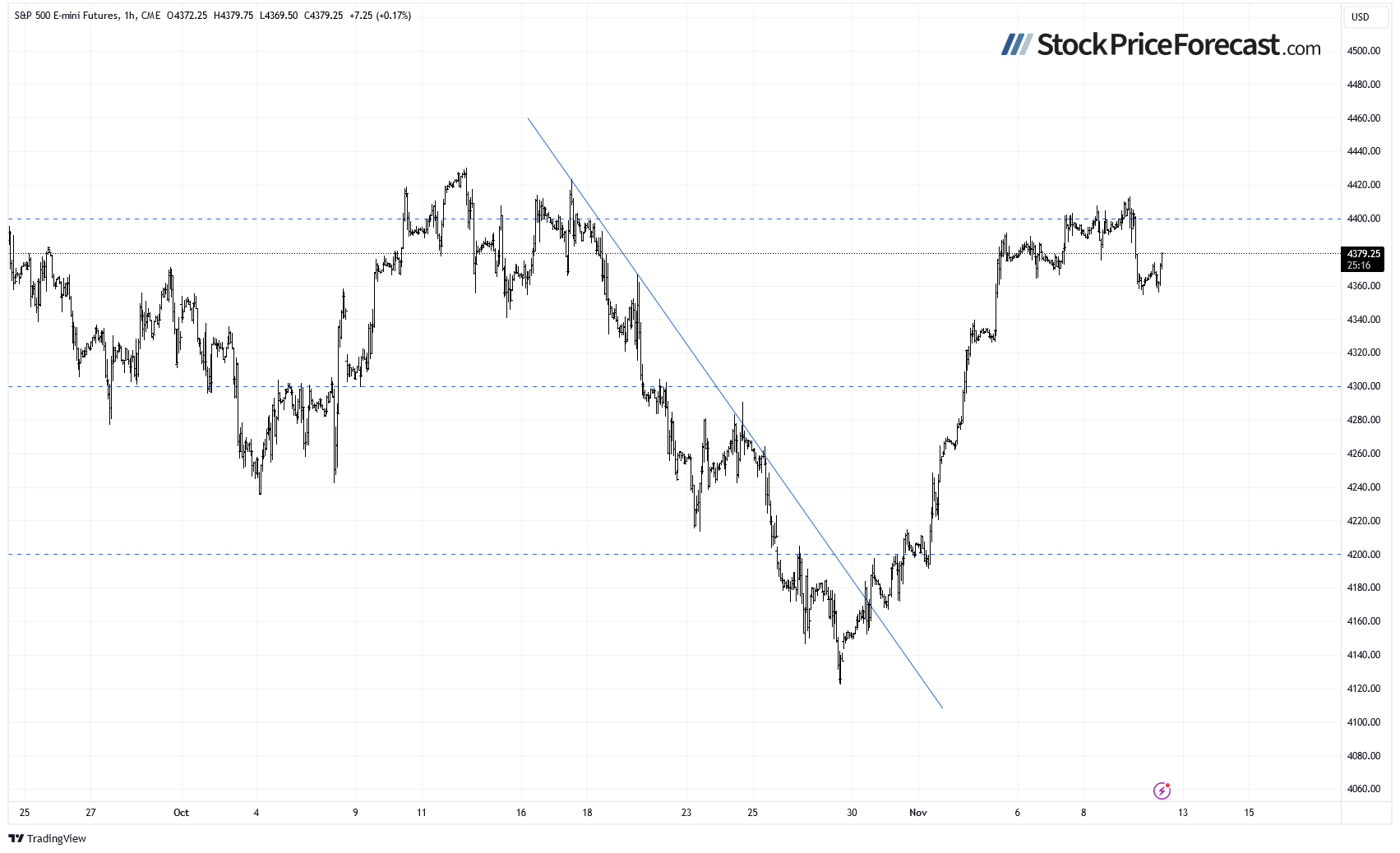
Let’s take a look at the hourly chart of the S&P 500 futures contract. Yesterday it was as high as 4,413 and this morning it’s trading slightly below 4,380. The resistance level is at 4,400-4,420 and support level is at 4,350, among others.
Chart

Conclusion

The S&P 500 index will likely extend its fluctuations following last week’s rally. Overall, the market went sideways this week. For now it looks like a consolidation or relatively flat correction within an uptrend. The resistance level is still at 4,400, marked by the previous local highs and the technically important September 21 daily gap down of around 4,376-4,401.

Here’s the breakdown

  • The S&P 500 retraced its recent advances yesterday, but it remained within a week-long consolidation.

  • For now it looks like a flat correction of an uptrend.

  • In my opinion, the short-term outlook is still bullish.


Want free follow-ups to the above article and details not available to 99%+ investors? Sign up to our free newsletter today!


Want free follow-ups to the above article and details not available to 99%+ investors? Sign up to our free newsletter today!

Author

Paul Rejczak

Paul Rejczak

Gold Price Forecast

Paul Rejczak is a stock market strategist who has been known for the quality of his technical and fundamental analysis since the late nineties.


More from Paul Rejczak
Share:

Editor's Picks

AUD/USD keeps the red near 0.6950 after weak Aussie jobs data

AUD/USD holds losses near 0.6950 on disappointing Australian jobs data, extending the previous day's retracement slide from the monthly high and hitting a fresh weekly low during Thursday’s Asian session. Meanwhile, declining US bond yields drag the US Dollar away from the April 2025 high, touched after Wednesday's hot US CPI, helping limit losses for the currency pair.

USD/JPY slides back below 158.00 as USD reverses post-CPI gains

USD/JPY extends the previous day's pullback from a three-week high, attracting follow-through selling and sliding below 158.00 during Thursday's Asian session. Traders remain on high alert amid speculation that authorities will step in to prop up the Japanese Yen. The US Dollar, meanwhile, reverses Wednesday's hot CPI-led gains to April 2025 highs as US bond yields retreat on China bond-buying talk, further pressuring the pair.

Gold rebounds firmly as China Treasuries-buying report smashes US yields

Gold stages a solid comeback from weekly lows, retakes $4,150 early Thursday. US Dollar declines sharply alongside Treasury yields on China’s bond-buying report. Technically, the daily RSI remains bearish and a headwind for Gold buyers.

XRP and XLM extend losses as US inflation data weighs in
Ripple (XRP) and Stellar (XLM) extend their losses on Thursday as bearish momentum builds, having corrected over 7% and 11% so far this week. XRP and XLM both slip below key support zones, indicating weakening technical structure.
China seems routing US Treasury holdings through Canada

According to a Bloomberg report, China seems to be moving United States securities to non-US custodian banks in other countries, masking its role in financing US deficits.

Has Bitcoin really escaped the macro forces it was built to fight?
Over 17 years ago, Satoshi Nakamoto designed Bitcoin (BTC) on the back of a global financial crisis as an alternative to the global monetary system outside the control of central banks, governments and traditional intermediaries. This raises a key question: has Bitcoin really become independent of the macroeconomic forces it was built to challenge?