|

Stocks: A failed rebound – But will the downtrend continue?

The stock market is fluctuating following last Friday’s sell-off, but is this a bottoming pattern?

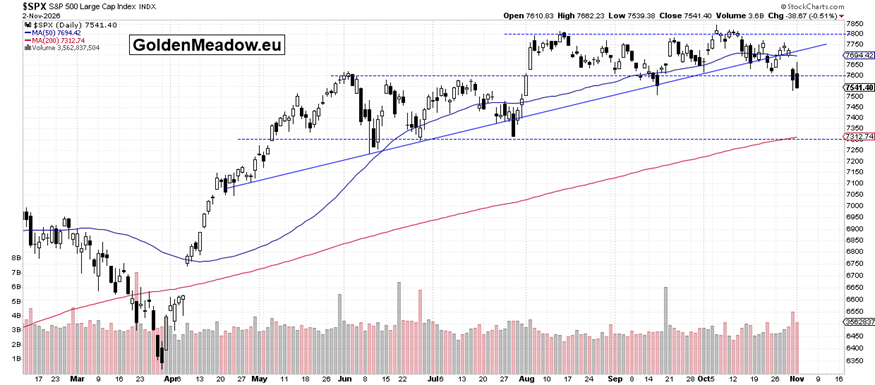
The S&P 500 index closed 0.51% lower on Monday, extending Friday’s sell-off but rebounding from a local low of around 7,540. Today, the index is expected to open 0.1% lower following yesterday’s earnings release from AAPL, whose shares are expected to open around 4% lower.

Recently, the investor sentiment has improved, as reflected in last Wednesday’s AAII Investor Sentiment Survey, which reported that 37.8% of individual investors are bullish, while 41.4% are bearish.

The S&P 500 index remained near its local lows on Monday, as shown on the daily chart.
Chart

S&P 500 futures contract: Trading near Friday’s low

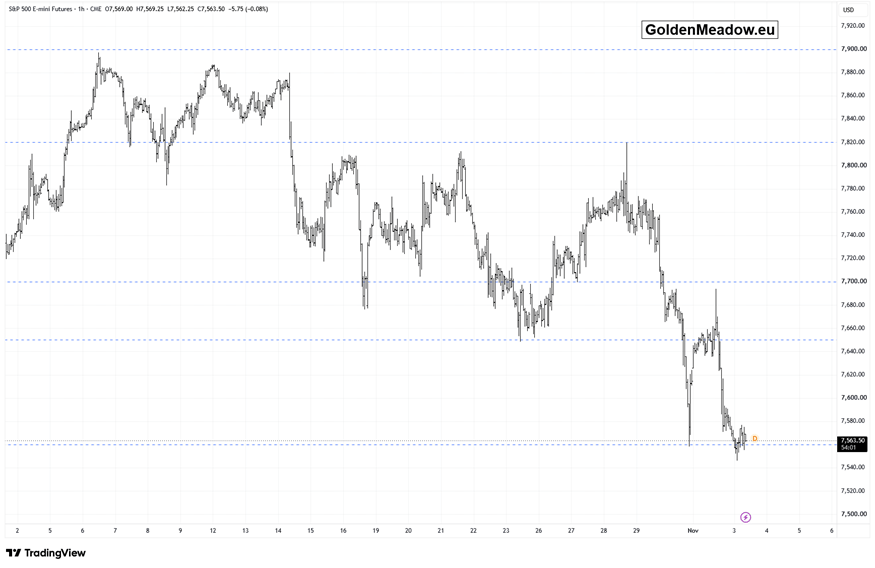
This morning, the S&P 500 futures contract is trading sideways following yesterday’s pullback and the sell-off triggered by AAPL’s earnings release.

Resistance is currently around 7,600, while a support is at 7,550, among other levels.
Chart

Market Outlook: Attempting to Break Below Three-Month-Long Consolidation

The S&P 500 index is likely to open slightly lower or close to flat today. Investors are awaiting further earnings releases and the results of the U.S. midterm elections.

So far, price action suggests that the index is extending the consolidation that began in early August. However, the market is trading near the lower boundary of this range.

Here's what I think is most likely:

  • The S&P 500 index moved back toward Friday’s low yesterday, but a short-term consolidation appears likely.
  • My Volatility Breakout System is currently long in the market.

Want free follow-ups to the above article and details not available to 99%+ investors? Sign up to our free newsletter today!

Author

Paul Rejczak

Paul Rejczak

Gold Price Forecast

Paul Rejczak is a stock market strategist who has been known for the quality of his technical and fundamental analysis since the late nineties.


More from Paul Rejczak
Share:

Editor's Picks

AUD/USD drops to two-week low, further below 0.7000 after RBA's less hawkish rate hike

AUD/USD drifts lower for the second straight day on Tuesday, hitting a fresh two-week low during the Asian session after the Reserve Bank of Australia's (RBA) widely expected 25 bps rate hike. The decision was far from unanimous, with three members preferring to hold rates at 4.60%. This tempers expectations of further tightening, which, along with modest US Dollar strength, weighs on the currency pair.


USD/JPY fails near 159.00 amid weak USD, intervention risks

USD/JPY edges lower during Tuesday’s Asian session, reversing part of the previous day's gains to 158.00 as the US Dollar remains depressed amid hopes for Iran diplomacy and ahead of US midterm elections. Meanwhile, intervention risks support the Japanese Yen, though the uncertainty over the timing of the next BoJ rate hike caps gains. This keeps the pair confined within a familiar range and warrants caution before placing directional bets.


Gold struggles near $3,900 as traders assess Middle East developments,US election risks

Gold (XAU/USD) loses momentum on Tuesday as Oil prices rebound after the Wall Street Journal (WSJ) reported a US strike on Iran’s Qeshm Island. At the time of writing, XAU/USD trades around $3,909, down 0.93% on the day.

Crypto Today: Bitcoin, Ethereum, XRP under pressure as investors pull capital

Bitcoin trades downward at $76,566 on Tuesday, testing six-week lows. Ethereum, like Bitcoin, trades under pressure as it consolidates within a narrow support range. Meanwhile, Ripple hovers marginally above $1.25.

US Dollar Index edges up within range with midterm elections front and centre

The US Dollar Index is picking up from session lows but remains within previous ranges, below 102.00. The Greenback is drawing support from hostilities in Iran and higher Oil prices, but US political uncertainty is capping gains.

The 2% inflation target came from a throwaway remark. It now moves trillions
The Federal Reserve's 2% inflation goal grew out of an off-the-cuff remark by a New Zealand politician in 1988. Bond investors still price long-term US debt as if 2% holds, so a change in how the Fed measures inflation would move markets.