Silver Price Forecast: XAG/USD tests channel resistance near one-month highs on the 4-hour chart
- Silver steadies near $80 as geopolitical risks and Fed outlook limit upside.
- Technically, XAG/USD trades within an upward-sloping channel on the 4-hour chart, maintaining a near-term bullish bias.
- Momentum indicators lean positive, with RSI approaching overbought conditions while MACD remains above the signal line.
Silver (XAG/USD) trades with a positive bias on Wednesday but lacks strong upside momentum as traders continue to monitor evolving geopolitical developments in the Middle East. At the time of writing, XAG/USD is trading around $80, hovering near one-month highs.
Meanwhile, the US Dollar Index (DXY), which tracks the Greenback's value against a basket of six major currencies, is trading around 98.10, holding near the six-week low reached on Tuesday.
Silver remains on the front foot for an eighth consecutive day, supported by broad-based weakness in the US Dollar (USD) as market sentiment improves on hopes that the United States and Iran could reach a deal through renewed negotiations. However, the lack of strong follow-through buying suggests traders are staying on the sidelines, awaiting clearer signs of de-escalation.
At the same time, the Federal Reserve (Fed) is expected to keep interest rates on hold in the near term as policymakers assess the economic impact of the conflict, particularly Oil-driven inflation risks, which continue to cap the upside in non-yielding assets such as Silver. Although Oil prices have eased from recent highs and revived expectations that the Fed could resume rate cuts later in the year, the absence of a sustained decline in energy prices keeps the outlook uncertain.
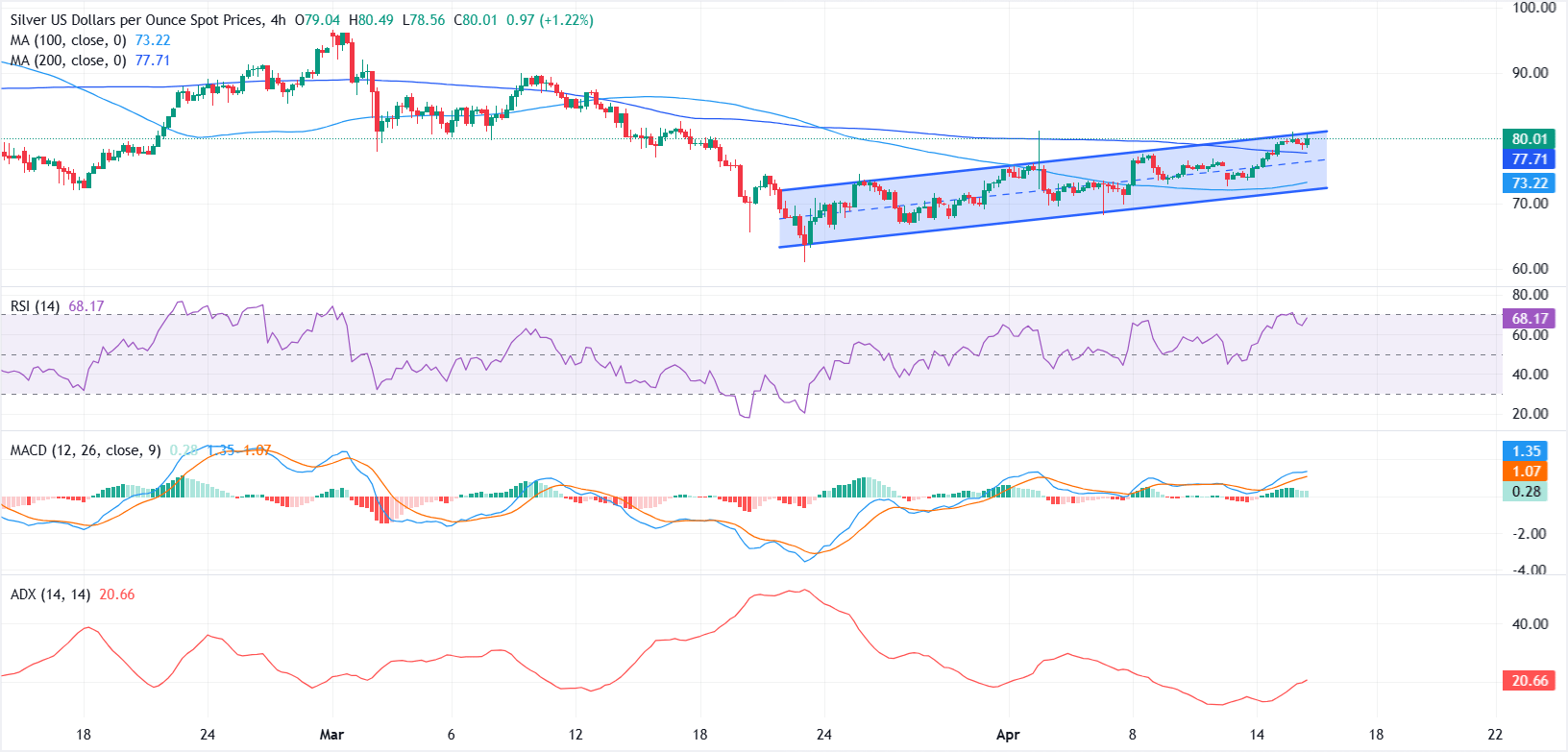
From a technical perspective, the 4-hour chart shows XAG/USD trading within an upward-sloping parallel channel, marked by a sequence of higher highs and higher lows since bottoming near $61 in March. The metal has also climbed back above the 100- and 200-period Simple Moving Averages (SMAs), reinforcing a bullish bias in the near term.
Prices are now pressing against the upper boundary of the channel; a clear break and consolidation above would open the door to further gains within the prevailing uptrend, with the next resistance seen near $85. On the downside, a failure to hold above the 200-period SMA near $77 could expose the 100-period SMA around $73.
The Relative Strength Index (14) at 68.38 flirts with overbought conditions, and the Moving Average Convergence Divergence (MACD) indicator stays positive, hinting that upside momentum persists but may be at risk of fatigue near the channel ceiling, with the Average Directional Index (ADX) at 20.66 pointing to only modest trend strength.
Silver FAQs
Silver is a precious metal highly traded among investors. It has been historically used as a store of value and a medium of exchange. Although less popular than Gold, traders may turn to Silver to diversify their investment portfolio, for its intrinsic value or as a potential hedge during high-inflation periods. Investors can buy physical Silver, in coins or in bars, or trade it through vehicles such as Exchange Traded Funds, which track its price on international markets.
Silver prices can move due to a wide range of factors. Geopolitical instability or fears of a deep recession can make Silver price escalate due to its safe-haven status, although to a lesser extent than Gold's. As a yieldless asset, Silver tends to rise with lower interest rates. Its moves also depend on how the US Dollar (USD) behaves as the asset is priced in dollars (XAG/USD). A strong Dollar tends to keep the price of Silver at bay, whereas a weaker Dollar is likely to propel prices up. Other factors such as investment demand, mining supply – Silver is much more abundant than Gold – and recycling rates can also affect prices.
Silver is widely used in industry, particularly in sectors such as electronics or solar energy, as it has one of the highest electric conductivity of all metals – more than Copper and Gold. A surge in demand can increase prices, while a decline tends to lower them. Dynamics in the US, Chinese and Indian economies can also contribute to price swings: for the US and particularly China, their big industrial sectors use Silver in various processes; in India, consumers’ demand for the precious metal for jewellery also plays a key role in setting prices.
Silver prices tend to follow Gold's moves. When Gold prices rise, Silver typically follows suit, as their status as safe-haven assets is similar. The Gold/Silver ratio, which shows the number of ounces of Silver needed to equal the value of one ounce of Gold, may help to determine the relative valuation between both metals. Some investors may consider a high ratio as an indicator that Silver is undervalued, or Gold is overvalued. On the contrary, a low ratio might suggest that Gold is undervalued relative to Silver.
Author

Vishal Chaturvedi
FXStreet
I am a macro-focused research analyst with over four years of experience covering forex and commodities market. I enjoy breaking down complex economic trends and turning them into clear, actionable insights that help traders stay ahead of the curve.