Silver Price Forecast: XAG/USD falls back below $50 amid mayhem in US bond markets
- Silver price turns lower below $50.00 amid rout in US bond markets.
- 10-year US Treasury Yields have jumped almost 5.5% to near 5.13% in the last two trading days.
- The CME FedWatch tool shows that the Fed is certain to hike interest rates in the December meeting.
Silver price (XAG/USD) gives up its slight early gains and falls back below $50.00 during the European trading session on Friday. The white metal resumes its broader downtrend amid intense sell-off in United States (US) bond markets, with financial participants anticipating an aggressive monetary tightening approach by the Federal Reserve (Fed) in the near term due to accelerating inflationary pressures.
As of writing, 10-year US Treasury Yields holds onto three-week high near $5.13%. Yields on 10-year US binds have jumped almost 5.5% in the past two trading days.
Theoretically, higher yields on US interest-bearing assets diminish the appeal of non-yielding assets, such as Silver.
US inflation surprise keeps pressure on Treasuries
Strategists at Deutsche Bank highlight that the latest US inflation release was the key driver of the day’s moves, noting that “that US CPI print drove the biggest moves of the day, with the monthly core CPI print for October above consensus at +0.30% (vs. +0.2% expected).” They stress that “it was the third consecutive month with core CPI at +0.3%, and if you take those three months together, the annualised pace for core CPI is running at +3.75%.” Deutsche Bank adds that “that’s the fastest pace on that measure since April 2024, so it made it increasingly difficult to dismiss this as a blip.”
The bank also points out that “meanwhile, the headline CPI numbers were faster still, with monthly headline CPI at +0.35% (vs. +0.3% expected), with the 3-month annualised pace at +5.72%.” Against that backdrop, Deutsche Bank says “for markets, the clearest impact could be seen in US Treasuries, with yields surging across the curve.”
Rising US inflation has also forced traders to raise hawkish Fed bets. According to the CME FedWatch tool, the Fed is certain to hike interest rates in the December meeting, with 10% chance of a 50 basis points (bps) interest rate hike.
Silver Technical Analysis
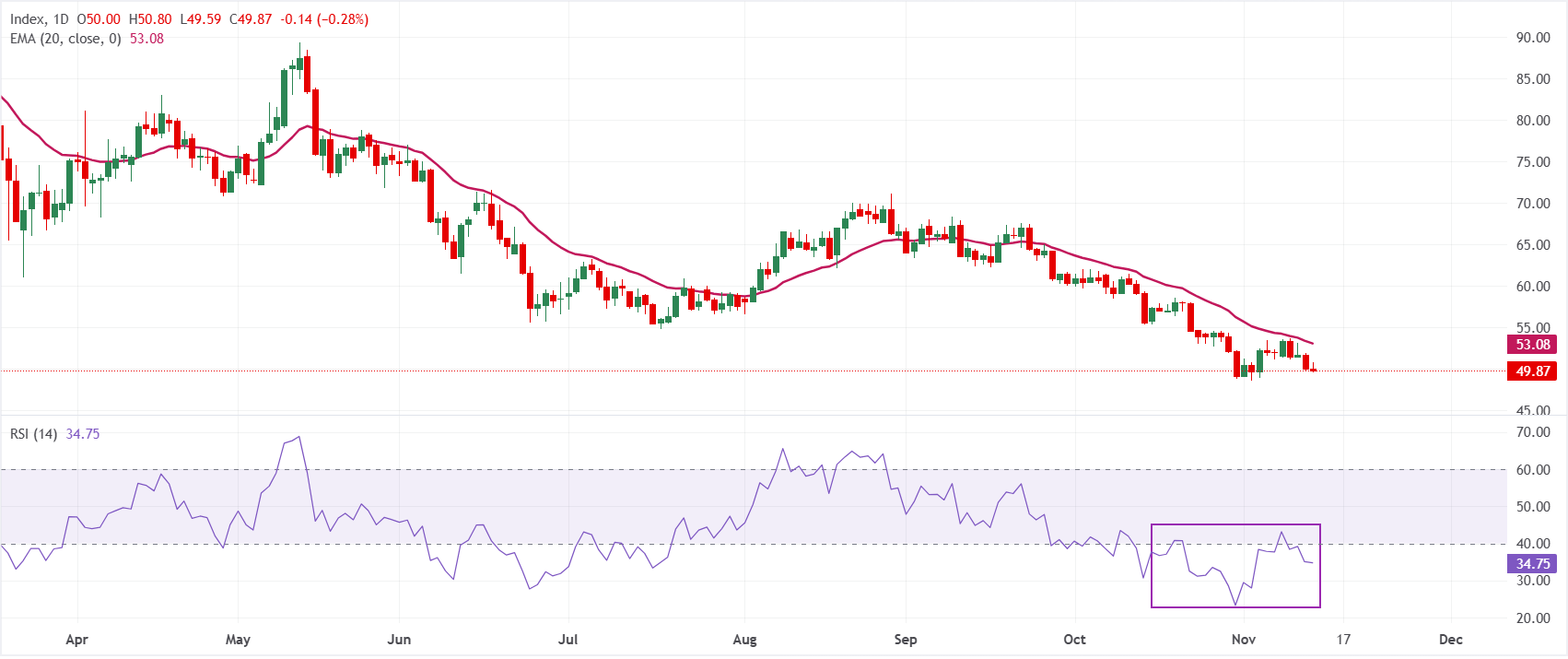
In the daily chart, XAG/USD trades at $49.87, keeping a bearish near-term bias as price holds below the 20-period exponential moving average (EMA) at $53.08. The location of spot under this short-term trend gauge suggests rallies remain capped for now, while the Relative Strength Index (RSI) at 34.76 stays below the neutral 50 line, hinting at persistent downside pressure rather than a decisive oversold rebound.
On the topside, immediate resistance emerges at the 20-day EMA around $53.08, and a sustained break above this level would be needed to ease the current bearish tone and open the way for a more constructive recovery phase. Until that overhead barrier is reclaimed, momentum readings near the lower mid-30s are more consistent with corrective bounces within a broader downside structure than with a durable trend reversal.
(The technical analysis of this story was written with the help of an AI tool. Know more.)
Silver FAQs
Silver is a precious metal highly traded among investors. It has been historically used as a store of value and a medium of exchange. Although less popular than Gold, traders may turn to Silver to diversify their investment portfolio, for its intrinsic value or as a potential hedge during high-inflation periods. Investors can buy physical Silver, in coins or in bars, or trade it through vehicles such as Exchange Traded Funds, which track its price on international markets.
Silver prices can move due to a wide range of factors. Geopolitical instability or fears of a deep recession can make Silver price escalate due to its safe-haven status, although to a lesser extent than Gold's. As a yieldless asset, Silver tends to rise with lower interest rates. Its moves also depend on how the US Dollar (USD) behaves as the asset is priced in dollars (XAG/USD). A strong Dollar tends to keep the price of Silver at bay, whereas a weaker Dollar is likely to propel prices up. Other factors such as investment demand, mining supply – Silver is much more abundant than Gold – and recycling rates can also affect prices.
Silver is widely used in industry, particularly in sectors such as electronics or solar energy, as it has one of the highest electric conductivity of all metals – more than Copper and Gold. A surge in demand can increase prices, while a decline tends to lower them. Dynamics in the US, Chinese and Indian economies can also contribute to price swings: for the US and particularly China, their big industrial sectors use Silver in various processes; in India, consumers’ demand for the precious metal for jewellery also plays a key role in setting prices.
Silver prices tend to follow Gold's moves. When Gold prices rise, Silver typically follows suit, as their status as safe-haven assets is similar. The Gold/Silver ratio, which shows the number of ounces of Silver needed to equal the value of one ounce of Gold, may help to determine the relative valuation between both metals. Some investors may consider a high ratio as an indicator that Silver is undervalued, or Gold is overvalued. On the contrary, a low ratio might suggest that Gold is undervalued relative to Silver.
Author

Sagar Dua
FXStreet
Sagar Dua is associated with the financial markets from his college days. Along with pursuing post-graduation in Commerce in 2014, he started his markets training with chart analysis.