British Pound Sterling gets a decent jobs report and sells off anyway
- GBP/USD is on track for a fourth consecutive daily decline after knifing below the converged 50- and 200-day EMAs in a single session.
- A labour market report that beat on employment and missed on pay handed the Bank of England's hike case its weakest data point in a month.
- June inflation lands Wednesday at 06:00 GMT, with consensus looking for a second straight month of cooling.

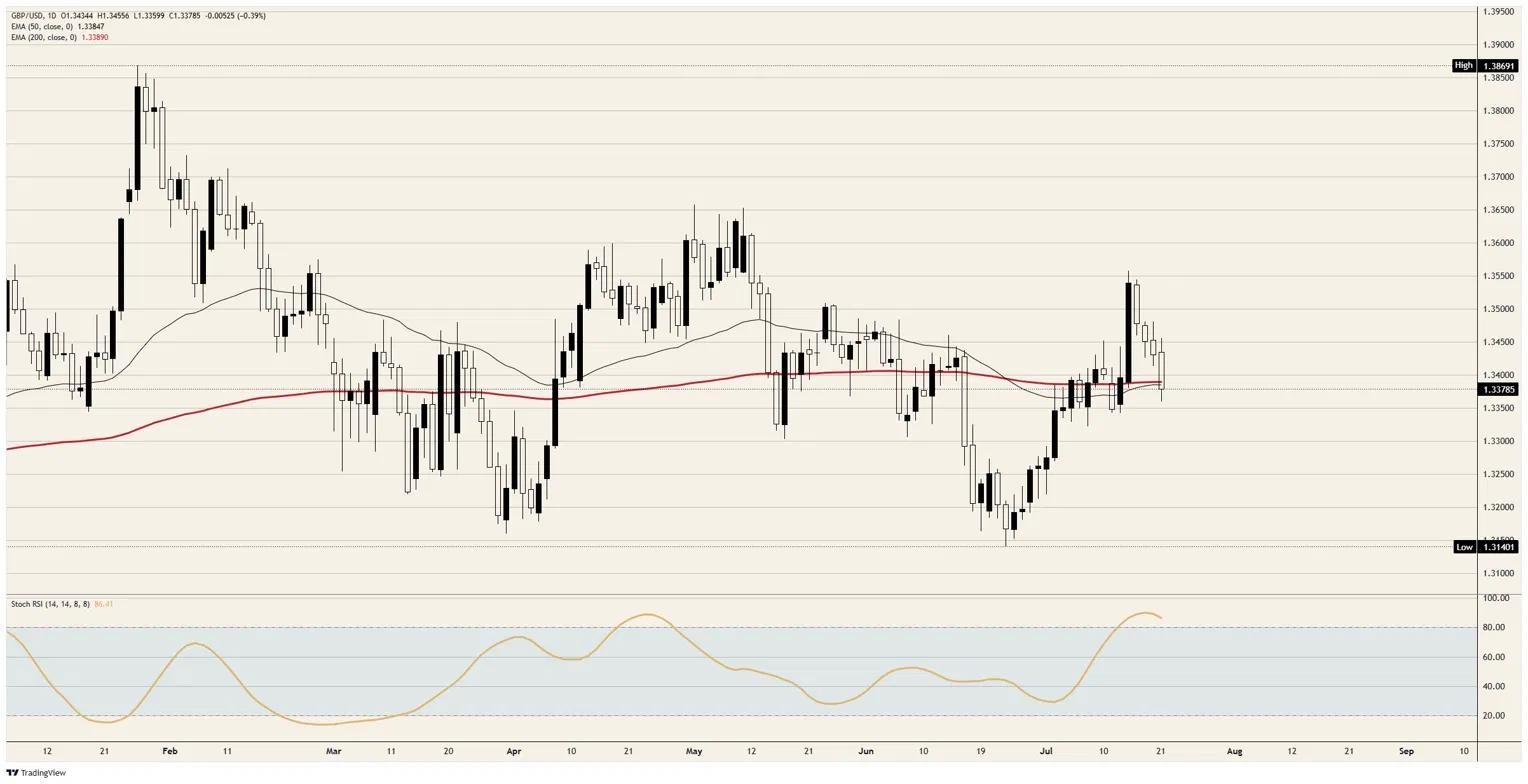
The British Pound received a labour market report on Tuesday that beat consensus on nearly every line, and sold off anyway. Sterling slid from a London morning high just above 1.3450 to a New York low just above 1.3350, knifing through the 50-day and 200-day Exponential Moving Averages that sit converged just below 1.3400. GBP/USD trades near 1.3380 late in the session, the weakest of the majors on the day, on track for a fourth consecutive daily decline, and holding its first session beneath both long-term averages since the mid-July rebound began. More than a third of that rebound off the summer base near the 1.3150 area is already gone.
The one number that mattered went the wrong way
On the surface, Tuesday's labour market data argued for a Pound bid rather than a fourth day of selling. Employment rose 147K in the three months to May against 100K prior, the claimant count climbed just 6.7K in June against a 28.3K consensus, and the unemployment rate slipped to 4.9% when the market expected 5%. The blemish sat in the pay figures, where average earnings including bonuses slowed to 4.3% against a 4.5% consensus, extending the cooling trend the Bank of England has spent months waiting for.
Pay is the line the Monetary Policy Committee actually trades on, and the market treated the rest of the report as noise accordingly. The Bank held at 3.75% in June with two dissenters voting for 4.00%, and rate pricing that carried nearly three hikes at the peak of the war panic has deflated to roughly one move to 4.00% over the coming months. Every wage print that cools chips away at what remains of that premium, and the premium is most of what has been holding Sterling up through a war-bid Dollar.
A new Prime Minister and the same old Dollar
The political layer is not helping matters, because Andy Burnham is newly installed in Downing Street and markets are still waiting for the cabinet list and fiscal arithmetic that will define his government. That information vacuum keeps the credibility discount on UK assets alive, the third layer of the term premium, debt structure, and political credibility framework this publication has been running since June. A currency already renegotiating its rate premium has little patience left over for an open-ended budget question, least of all one priced in a gilt market that carries the highest long-end yields in the Group of Seven on the bloc's second-lowest gross debt load.
Across the Atlantic, the Dollar keeps collecting a war premium the Pound cannot match. The strike campaign against Iran runs into a tenth consecutive night while a 10-day ceasefire proposal circulates alongside open talk of widening the war, a standoff that keeps Treasury yields and safe-haven demand pointed the same direction. With a Federal Reserve hike fully priced by December and the July meeting only a week away, the Dollar side of this pair holds every card the UK side keeps folding.
An inflation print with the premium on the line
Wednesday's Consumer Price Index at 06:00 GMT is now the whole ballgame for the week. Consensus expects headline inflation to cool to 2.7% YoY in June from 2.8%, with core easing to 2.5% and the monthly rate slowing to 0.1%. A soft print lands directly on the wound the wage data opened, dragging the last priced hike further down the curve, while an upside surprise would hand the hawkish dissenters fresh ammunition and give the Pound its first genuine reason to bounce in a week.
Friday stacks the rest of the risk in one session. June retail sales carry a -0.2% MoM consensus after May's 1.2% jump, and the preliminary July Purchasing Managers Indexes arrive with services already printing 48.8 and the composite at 49.3, both below the boom-bust line. Thursday's consumer confidence reading, seen improving marginally to -21, is the lone sentiment check in between. A currency trading beneath its long-term averages into that kind of docket needs the data to argue on its behalf, and this week's consensus sheet mostly argues the other way.
Technical levels to watch
Resistance: The converged 50-day and 200-day EMAs just below 1.3400 now cap the tape, with Tuesday's rejection high just above 1.3450 behind them and the mid-July peak near 1.3550 the far marker.
Support: The session floor just above 1.3350 is first support, followed by 1.3300, with the summer's line in the sand at the 1.3150 area beneath that.
Bias: Bearish. Four consecutive daily declines through both long-term averages, with a cooling inflation print expected within hours, point toward 1.3300 next, and only a daily close back above 1.3400 puts the recovery case back on the table.
GBP/USD daily chart
Pound Sterling FAQs
The Pound Sterling (GBP) is the oldest currency in the world (886 AD) and the official currency of the United Kingdom. It is the fourth most traded unit for foreign exchange (FX) in the world, accounting for 12% of all transactions, averaging $630 billion a day, according to 2022 data. Its key trading pairs are GBP/USD, also known as ‘Cable’, which accounts for 11% of FX, GBP/JPY, or the ‘Dragon’ as it is known by traders (3%), and EUR/GBP (2%). The Pound Sterling is issued by the Bank of England (BoE).
The single most important factor influencing the value of the Pound Sterling is monetary policy decided by the Bank of England. The BoE bases its decisions on whether it has achieved its primary goal of “price stability” – a steady inflation rate of around 2%. Its primary tool for achieving this is the adjustment of interest rates. When inflation is too high, the BoE will try to rein it in by raising interest rates, making it more expensive for people and businesses to access credit. This is generally positive for GBP, as higher interest rates make the UK a more attractive place for global investors to park their money. When inflation falls too low it is a sign economic growth is slowing. In this scenario, the BoE will consider lowering interest rates to cheapen credit so businesses will borrow more to invest in growth-generating projects.
Data releases gauge the health of the economy and can impact the value of the Pound Sterling. Indicators such as GDP, Manufacturing and Services PMIs, and employment can all influence the direction of the GBP. A strong economy is good for Sterling. Not only does it attract more foreign investment but it may encourage the BoE to put up interest rates, which will directly strengthen GBP. Otherwise, if economic data is weak, the Pound Sterling is likely to fall.
Another significant data release for the Pound Sterling is the Trade Balance. This indicator measures the difference between what a country earns from its exports and what it spends on imports over a given period. If a country produces highly sought-after exports, its currency will benefit purely from the extra demand created from foreign buyers seeking to purchase these goods. Therefore, a positive net Trade Balance strengthens a currency and vice versa for a negative balance.
Author

Joshua Gibson
FXStreet
Joshua joins the FXStreet team as an Economics and Finance double major from Vancouver Island University with twelve years' experience as an independent trader focusing on technical analysis.