Silver Price Forecast: XAG/USD drifts below $70.00 as hopes of ceasefire in Middle East wane
- Silver gives away recent gains on Thursday, falling back to levels below $70.00.
- The precious metal loses ground as Iran rejects the US proposal for a ceasefire.
- XAG/USD remains trapped within a bearish channel, with bulls capped below the $73.00 area.
Silver (XAG/USD) is trading lower for the second consecutive day on Thursday, testing levels below the $70.00 psychological level at the time of writing. The precious metal is losing the positive momentum seen earlier this week, as the US Dollar (USD) picks up with market hopes of a ceasefire in the Middle East starting to wane.
Iran has rejected the 15-point plan proposed by the US to end the war in the Middle East and denied intentions of holding negotiations with Washington. An anonymous official from the Islamic Republic also affirmed in an English-language broadcasting TV that Iran’s government has its own demands for a peace deal, AP reports.
Meanwhile, drones and missiles continue flying in the region, and the Strait of Hormuz, a bottleneck for approximately a fifth of the global Crude output, remains effectively locked. This is strangling the global economy and hammering investors' appetite for risk. In this context, the US Dollar is reemerging as a safe-haven asset.
Technical Analysis: Silver remains within a bearish channel
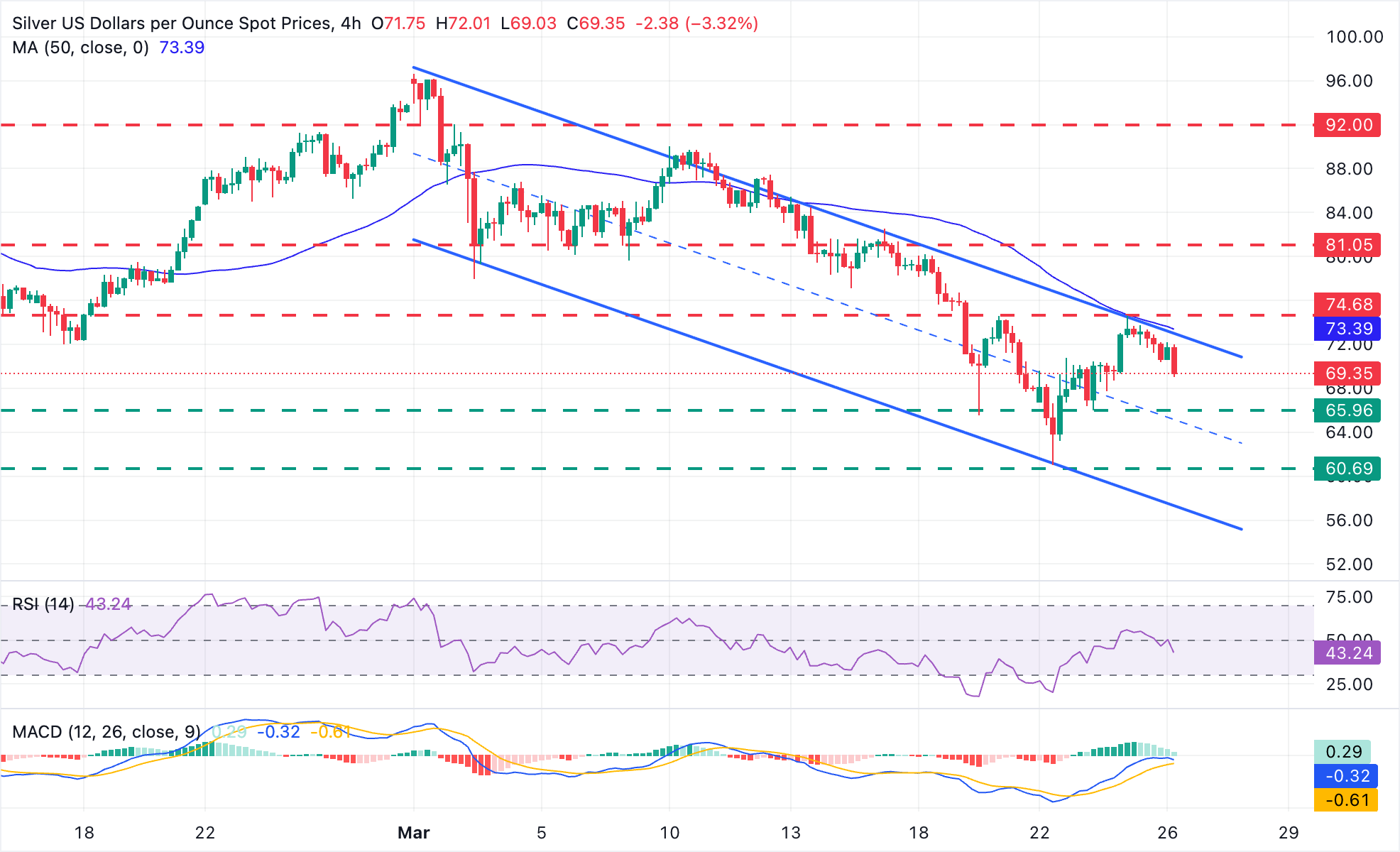
The 4-hour chart shows XAG/USD trading at $69.35 amid a mildly bearish near-term bias. The 50-period Simple Moving Average (SMA), now near $73.40, is keeping price action aligned with the broader downside structure.
The Relative Strength Index (RSI) has retreated from above 50 back toward the mid-40s, while the Moving Average Convergence Divergence (MACD) green histogram bars contract after a prior positive phase, which supports the bearish scenario.
The downward parallel channel from above $90, now around the the $73.00 level, emerges as first resistance ahead of the stronger $74.70 area, where the pair was held on March 20 and 25. On the downside, initial support is seen around $69.00, ahead of the more significant horizontal level at $65.96, and the recent swing low, in the area of $60.50.
(The technical analysis of this story was written with the help of an AI tool.)
Silver FAQs
Silver is a precious metal highly traded among investors. It has been historically used as a store of value and a medium of exchange. Although less popular than Gold, traders may turn to Silver to diversify their investment portfolio, for its intrinsic value or as a potential hedge during high-inflation periods. Investors can buy physical Silver, in coins or in bars, or trade it through vehicles such as Exchange Traded Funds, which track its price on international markets.
Silver prices can move due to a wide range of factors. Geopolitical instability or fears of a deep recession can make Silver price escalate due to its safe-haven status, although to a lesser extent than Gold's. As a yieldless asset, Silver tends to rise with lower interest rates. Its moves also depend on how the US Dollar (USD) behaves as the asset is priced in dollars (XAG/USD). A strong Dollar tends to keep the price of Silver at bay, whereas a weaker Dollar is likely to propel prices up. Other factors such as investment demand, mining supply – Silver is much more abundant than Gold – and recycling rates can also affect prices.
Silver is widely used in industry, particularly in sectors such as electronics or solar energy, as it has one of the highest electric conductivity of all metals – more than Copper and Gold. A surge in demand can increase prices, while a decline tends to lower them. Dynamics in the US, Chinese and Indian economies can also contribute to price swings: for the US and particularly China, their big industrial sectors use Silver in various processes; in India, consumers’ demand for the precious metal for jewellery also plays a key role in setting prices.
Silver prices tend to follow Gold's moves. When Gold prices rise, Silver typically follows suit, as their status as safe-haven assets is similar. The Gold/Silver ratio, which shows the number of ounces of Silver needed to equal the value of one ounce of Gold, may help to determine the relative valuation between both metals. Some investors may consider a high ratio as an indicator that Silver is undervalued, or Gold is overvalued. On the contrary, a low ratio might suggest that Gold is undervalued relative to Silver.
Author

Guillermo Alcala
FXStreet
Graduated in Communication Sciences at the Universidad del Pais Vasco and Universiteit van Amsterdam, Guillermo has been working as financial news editor and copywriter in diverse Forex-related firms, like FXStreet and Kantox.