Silver Price Forecast: Mild bullish bias holds, but trend strength stays weak
- Silver advances on Friday, but elevated Treasury yields and hawkish Fed expectations could limit gains.
- XAG/USD trades above the 50-day and 100-day SMAs, keeping the near-term bias constructive.
- Momentum indicators show a mild bullish bias, with RSI holding above the neutral level.
Silver (XAG/USD) trades on the front foot on Friday as the US Dollar reverses its intraday gains, with traders booking profits following the Greenback’s strong weekly advance. At the time of writing, XAG/USD trades around $66.76, its highest level since September 10, and is on track to end the week more than 3% higher.
US Dollar Price Today
The table below shows the percentage change of US Dollar (USD) against listed major currencies today. US Dollar was the strongest against the Japanese Yen.
| USD | EUR | GBP | JPY | CAD | AUD | NZD | CHF | |
|---|---|---|---|---|---|---|---|---|
| USD | -0.05% | -0.23% | 0.47% | 0.02% | -0.18% | 0.13% | -0.31% | |
| EUR | 0.05% | -0.18% | 0.54% | 0.05% | -0.15% | 0.22% | -0.26% | |
| GBP | 0.23% | 0.18% | 0.71% | 0.24% | 0.04% | 0.41% | -0.08% | |
| JPY | -0.47% | -0.54% | -0.71% | -0.43% | -0.68% | -0.32% | -0.78% | |
| CAD | -0.02% | -0.05% | -0.24% | 0.43% | -0.23% | 0.12% | -0.34% | |
| AUD | 0.18% | 0.15% | -0.04% | 0.68% | 0.23% | 0.36% | -0.11% | |
| NZD | -0.13% | -0.22% | -0.41% | 0.32% | -0.12% | -0.36% | -0.46% | |
| CHF | 0.31% | 0.26% | 0.08% | 0.78% | 0.34% | 0.11% | 0.46% |
The heat map shows percentage changes of major currencies against each other. The base currency is picked from the left column, while the quote currency is picked from the top row. For example, if you pick the US Dollar from the left column and move along the horizontal line to the Japanese Yen, the percentage change displayed in the box will represent USD (base)/JPY (quote).
However, the metal could struggle to extend its gains as US Treasury yields stay elevated and the Federal Reserve (Fed) signals that additional tightening may be needed after raising rates by 25 basis points on Wednesday to help bring inflation back to its 2% target.
Technical Analysis
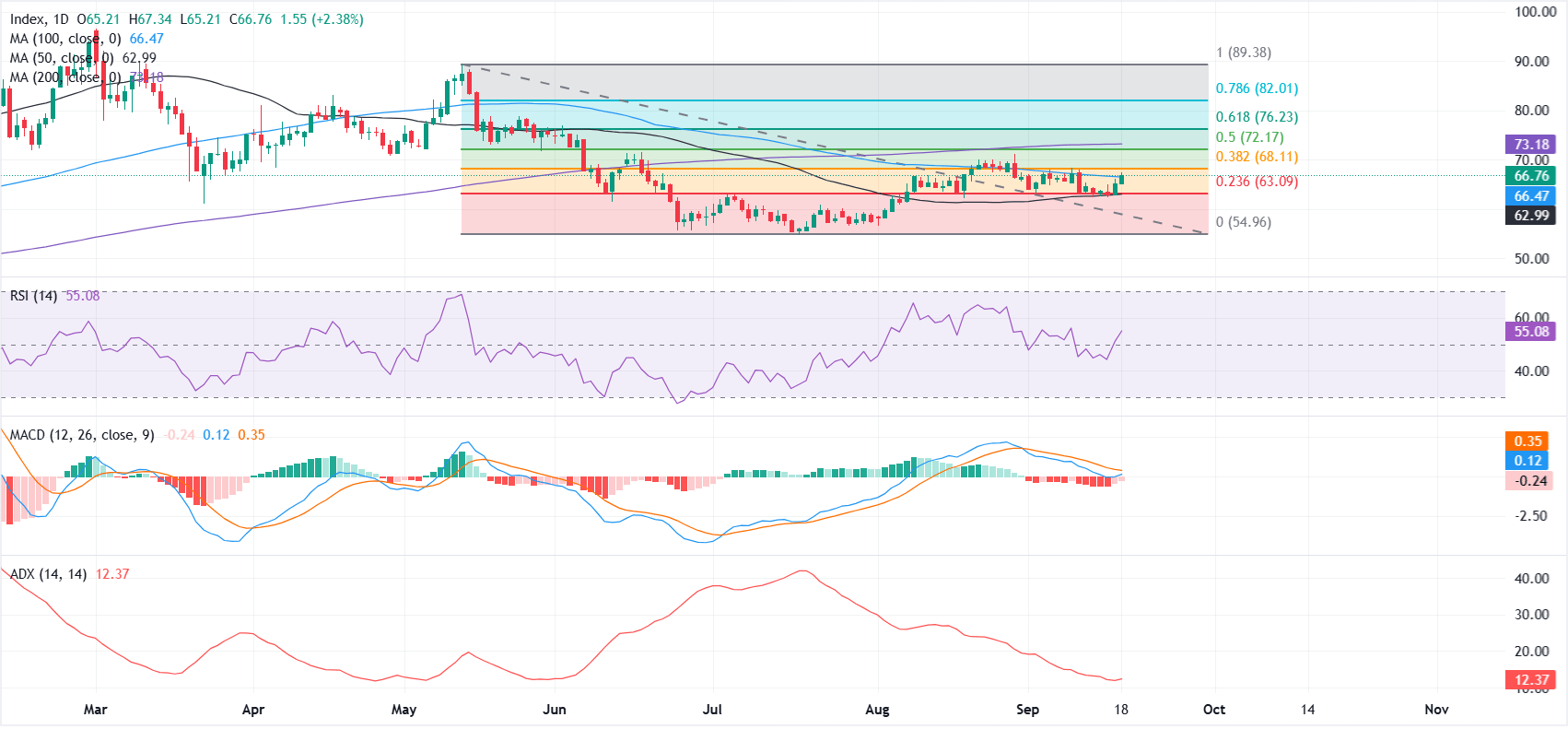
On the daily chart, XAG/USD preserves a constructive near-term tone as price holds above the 50-day Simple Moving Average (SMA) and the 100-day SMA. This positioning suggests the metal is supported by the medium-term trend even as the 200-day SMA at $73.18 remains a distant topside barrier.
The Relative Strength Index (RSI) at 55 leans mildly bullish without overbought signals, while the Moving Average Convergence Divergence (MACD) indicator stays slightly negative, hinting that upside momentum is improving but not yet decisive amid a low Average Directional Index (ADX) reading of 12 that points to a weak trend environment.
On the downside, immediate support is aligned with the 100-day SMA at $66, followed by the 50-day SMA near $63 and the 23.6% Fibonacci retracement at $63.09, which together define a broader demand area before the structural low around $55.
On the topside, initial resistance emerges at the 38.2% Fibonacci retracement at $68.11, ahead of the 50.0% retracement at $72.17 and the 200-day SMA at $73.18. A sustained break above this cluster would open the way toward the higher Fibonacci levels at $76.23 and $82.01, where the next significant supply zones are found.
(The technical analysis of this story was written with the help of an AI tool. Know more.)
Silver FAQs
Silver is a precious metal highly traded among investors. It has been historically used as a store of value and a medium of exchange. Although less popular than Gold, traders may turn to Silver to diversify their investment portfolio, for its intrinsic value or as a potential hedge during high-inflation periods. Investors can buy physical Silver, in coins or in bars, or trade it through vehicles such as Exchange Traded Funds, which track its price on international markets.
Silver prices can move due to a wide range of factors. Geopolitical instability or fears of a deep recession can make Silver price escalate due to its safe-haven status, although to a lesser extent than Gold's. As a yieldless asset, Silver tends to rise with lower interest rates. Its moves also depend on how the US Dollar (USD) behaves as the asset is priced in dollars (XAG/USD). A strong Dollar tends to keep the price of Silver at bay, whereas a weaker Dollar is likely to propel prices up. Other factors such as investment demand, mining supply – Silver is much more abundant than Gold – and recycling rates can also affect prices.
Silver is widely used in industry, particularly in sectors such as electronics or solar energy, as it has one of the highest electric conductivity of all metals – more than Copper and Gold. A surge in demand can increase prices, while a decline tends to lower them. Dynamics in the US, Chinese and Indian economies can also contribute to price swings: for the US and particularly China, their big industrial sectors use Silver in various processes; in India, consumers’ demand for the precious metal for jewellery also plays a key role in setting prices.
Silver prices tend to follow Gold's moves. When Gold prices rise, Silver typically follows suit, as their status as safe-haven assets is similar. The Gold/Silver ratio, which shows the number of ounces of Silver needed to equal the value of one ounce of Gold, may help to determine the relative valuation between both metals. Some investors may consider a high ratio as an indicator that Silver is undervalued, or Gold is overvalued. On the contrary, a low ratio might suggest that Gold is undervalued relative to Silver.
Author

Vishal Chaturvedi
FXStreet
I am a macro-focused research analyst with over four years of experience covering forex and commodities market. I enjoy breaking down complex economic trends and turning them into clear, actionable insights that help traders stay ahead of the curve.