Shell proves there’s Gas in the tank when it comes to earnings

Oil giant Shell managed to smash earnings estimates for Q4, on the back of a strong performance in its gas trading division and more production at its LNG plants. This cancelled out the impact of falling commodity prices last quarter and helped Shell beat earnings estimates by over $1bn, with adjusted profit coming in for the Q4 at $7.31bn, vs. estimates of $6.14bn.
Shell can handle its debt pile
Shell also boosted its dividend by more than expected, to 34.4 Cents a share, vs. estimates of 33 cents. They also announced that they will buyback $3.5bn of shares, higher than the $3bn some analysts were touting ahead of this earnings release. Interestingly, these buybacks won’t be funded by the surge in profits, and instead the company will increase debt to pay for their shareholder rewards. Net debt rose to an eye watering $43.5bn from $40.5bn in Q3. History will tell us whether or not this is a good strategy, especially when the company is trying to keep a lid on spending. However, with interest rates in Europe set to fall, and Shell’s gas division basically printing money, this giant debt pile should not be a problem for Shell to manage.
Shell’s shift from Oil to Gas continues
Shell’s profits may be 29% lower than 2022, however, that was mainly a reflection of the extreme levels of commodity prices back then, when commodity prices soared on the back of Russia’s invasion of Ukraine. Things have normalised now, and this new normal includes Shell turning towards gas rather than oil, as the main driver of its bottom line. LNG is an important segment at Shell, and it helped to offset lower refining margins and a lower contribution from its oil trading unit. This means that the future of its LNG business is vital for Shell to continue to boost its profits. The company attributed the strong performance at its gas division on seasonality and ‘optimisation opportunities’. The question for investors is whether or not these opportunities will still be available in 2024 and beyond?
Weaker spending on renewables, threatens greener future
Capital investment was mostly flat last year, however, spending at its renewables and energy solutions unit declined by 23% to its lowest level for 2-years. This may cheer shareholders in the oil major, as some question oil majors moving into the renewables business. However, this is hardly good news for switching to a greener future.
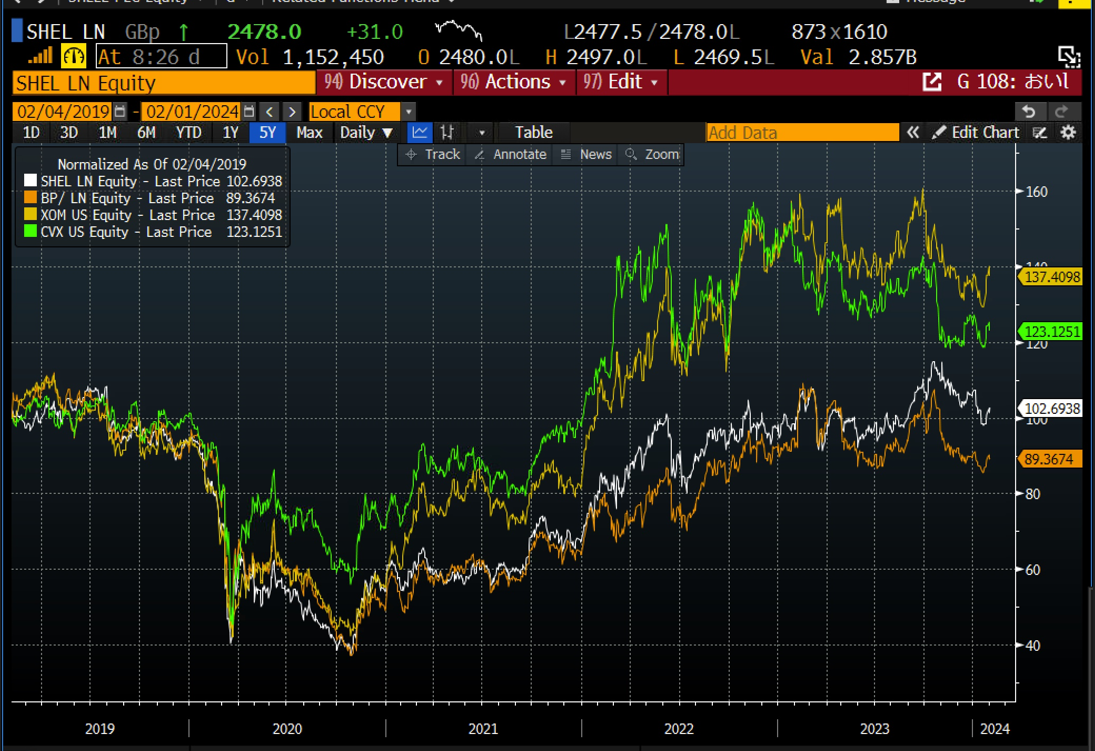
Shell’s share price is higher on the back of this earnings beat and the news about the share buyback programme and is up nearly 2%. The CFO of the company has justified the buyback by saying that the shares are undervalued, and indeed they are compared to US oil; majors over the last 5 years, although Shell’s shares have moved higher at a faster pace than their US counterparts over the past year.
Source: Blomberg
A lack of direction for Shell
But, with capital spending flat, and no major announcements in this report, we could see shares in Shell start to fade, as the market questions how they can grow in the future. Share buybacks can be a sweetener for shareholders, but its not a sustainable driver of price gains in the long term, and Shell’s earnings report is lacking detail about future growth drivers for the company.
Elsewhere, US stocks came under pressure after Fed chair Jerome Powell ruled out a March rate cut and instead said a rate cut this year was likely, without pre-committing to a date for when this could happen. Shares in Europe are lower, and as we mentioned in yesterday’s report, this could increase the volatility around major earnings releases like NFPs, CPI and PCE, as the Fed remains in data-watch mode.
A tale of two banks: Deutsche Bank surges, as BNP Paribas as sinks
European banks are also in focus, after a number of earnings releases on Thursday. Deutsche Bank reported a 5% jump in revenue YoY; however, it missed targets due to weakness in its fixed income unit. Pretax profit was lower than expected, and fell 10% on the year, costs increased by 5% and loan loss provisions rose by 39% vs, 2022. There was some good news, investment bank revenues rose by 10% vs 2022, and corporate bank profits were also higher by 9%, although both of these gains came off low bases. Deutsche Bank shares are surging on Thursday and are higher by 4%, in contrast to BNP Paribas, its shares are lower by nearly 8% at the time of writing. It reported a slump in profits due to one off factors, and it also lowered its targets for 2025, citing the end of the ECB’s payment on reserves. Its investment banking unit had a mixed performance with a strong performance for equities overshadowed by a weak performance in bond trading, which was worse than its Wall Street peers. The Eurostoxx banking index is lower on Thursday and dropped more than 2% at the open, although it is bouncing off the lows as we move through the European session.
Overall, it’s been a mixed performance from European banks so far this earnings season, and there has been some differentiation in earnings as banks handle this peak in interest rates differently.
On that note, we now wait for the Bank of England at midday. Ahead of this meeting, the FTSE 100 is the top performer in Europe, and is rising mildly after the Shell earnings beat, but GBP/USD is weaker by nearly 0.5%.
Author

Kathleen Brooks
XTB UK
Kathleen has nearly 15 years’ experience working with some of the leading retail trading and investment companies in the City of London.