Record: Chinese investors pull $2.22 billion from Gold ETFs in June, the highest monthly outflow ever
- Chinese investors pulled out around $2.22 billion of domestic Gold Exchange-Traded Funds in June, the largest monthly amount on record.
- Investors opted to take profits as risk appetite improved and the focus shifted to equities.
- Demand for Gold via ETFs from China remained significant in the first semester despite June’s pullback.

Chinese investors sharply trimmed their Gold ETF holdings in June, exacerbating global outflows for the month, as local investor risk appetite continued to improve amid equity market gains and a weaker Gold price, data from the World Gold Council (WGC) shows.
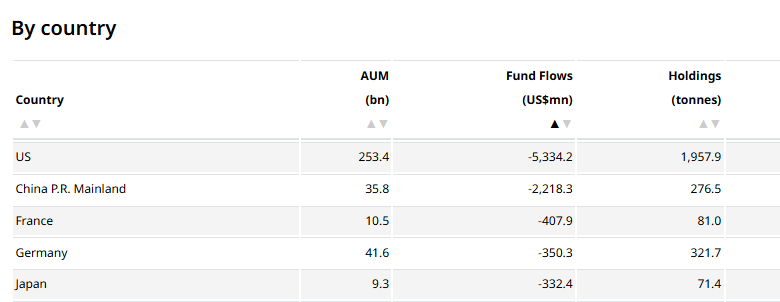
Physically-backed Gold ETFs in mainland China posted outflows of $2.22 billion in June, the highest monthly figure on record, according to data released on Wednesday. Over the month, Gold prices fell by more than 11%, similar to the pullback seen in January, as the US-Iran conflict continued to fuel inflation fears and central banks continued to signal potential interest-rate increases ahead.
“This anticipation contributed to rising real yields and a strengthening US Dollar, pushing up investors’ opportunity costs of holding gold,” the WGC said.
The pullback by Chinese investors is significant, as the country is the world’s largest market for the precious metal. The ETF facing the most outflows was Huaan Yifu Gold ETF with more than $1.1 billion.
Globally, Gold ETFs saw outflows of $8.9 billion in June, driven by Chinese investors’ pullback but also by those in the United States, with withdrawals of more than $5.3 billion.
Looking beyond June, data from the WGC shows that global Gold ETFs flows remained positive during the first semester at around $8 billion. Asia dominated global inflows (the region posted the strongest H1 on record), Europe also registered gains, while North America was the only region that recorded outflows.
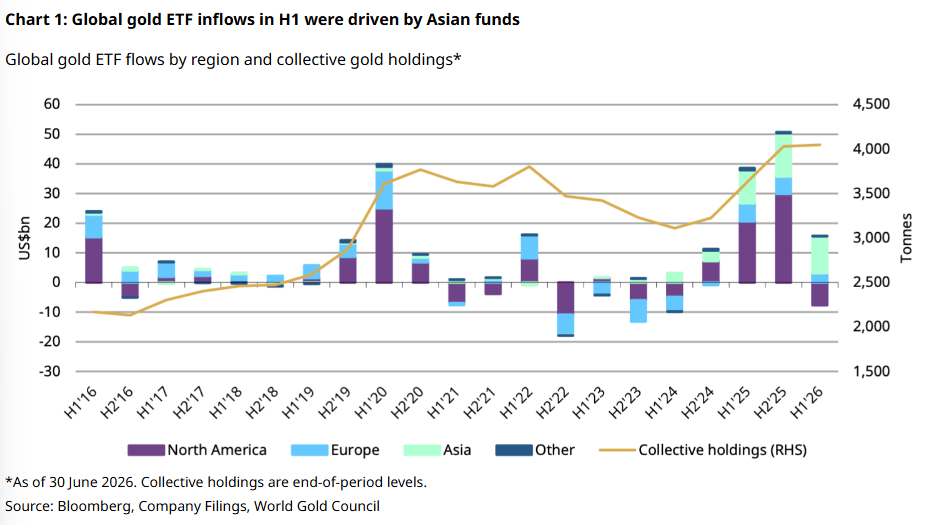
Looking ahead, the WGC projects that Gold ETF flows could stabilize due to the relatively steady outlook for the precious metal for the second half of the year.
“Uncertainties surrounding geopolitics, economic growth and financial markets linger. This backdrop may continue to support investor demand for portfolio protection and sustain interest in gold ETFs as a strategic safe-haven allocation,” the report said.
Author

Dhwani Mehta
FXStreet
Residing in Mumbai (India), Dhwani is a Senior Analyst and Manager of the Asian session at FXStreet. She has over 10 years of experience in analyzing and covering the global financial markets, with specialization in Forex and commodities markets.