Previewing the 2026 Q2 earnings season

The hot May jobs report may or may not have been caused by an earlier-than-normal Memorial Day holiday, but it has nevertheless put inflation and Fed outlook at the center of market discourse. Rising Treasury yields indicate the direction in which consensus expectations are evolving.
A key data point in that debate will be Wednesday’s inflation report, which is expected to show a year-over-year change in ‘core’ CPI of +2.8%, the same as the prior month’s reading.
The University of Michigan Sentiment Survey will also be worth watching, particularly its inflation expectations component. The prior-month reading had shown a jump in inflation expectations. The consensus view is that the one- and five-year readings will show growth rates comparable to the preceding month’s readings. It is generally believed that the Fed closely follows the Michigan survey’s inflation component.
The inflation question is directly tied to the status of the Strait of Hormuz. If the waterway can be reopened soon enough, many in the market will start discounting any lingering inflationary pressures as solely transitory, with no Fed implications. In other words, headlines about the evolving situation in the Persian Gulf are as relevant to the inflation discussion as are this week’s CPI and Michigan Sentiment readings.
Wednesday, June 10th, is important from an earnings standpoint as well, as Oracle (ORCL) will be reporting quarterly results for its fiscal quarter that ended in May, with Adobe (ADBE) doing the same the following day (Thursday, June 11th). The Oracle and Adobe reports get counted as part of the June-quarter tally.
The 2026 Q2 earnings season will take the spotlight when the big banks report their results in mid-July. But we will already have seen fiscal May-quarter results from almost two dozen companies, including Oracle and Adobe, by then. In fact, Oracle and Adobe aren’t the first such Q2 reporters; that distinction goes to AutoZone and Costco, whose quarterly releases for their fiscal quarters ending in May kicked off the 2026 Q2 earnings season.
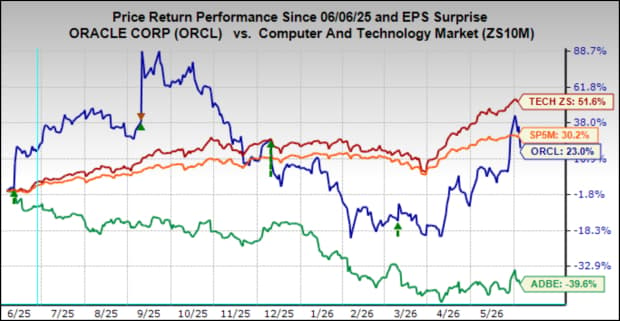
Oracle and Adobe shares have struggled lately, with the headwinds facing Oracle related to its AI-centric spending plans, while the downbeat sentiment on Adobe is tied to the long-term impact of AI on its core business. You can see this in the one-year performance of Oracle and Adobe shares relative to the S&P 500 index (orange line, up +30.2%) and the Zacks Tech sector (red line, up +51.6%).
Oracle is spending heavily on datacenters that it sees as essential to its aims in the AI space, but it lacks the financial firepower of other hyperscalers like Microsoft, Alphabet, and Amazon. The company’s AI fortunes are also seen as closely tied to OpenAI, which has contracted to use a large share of Oracle’s future data center capacity.
Unlike the Mag 7 hyperscalers, Oracle’s capex needs far exceed its internal cash flows, requiring outside funding at least through the next three years. The complicating factor for Oracle management is that their investment-grade credit profile will likely be at risk if they choose to fund all of their capital needs through the debt markets. Shareholders, on the other hand, don’t want to lose sleep over Oracle management diluting their ownership through secondary equity offerings.
Oracle shares were up following the better-than-expected quarterly release on March 10th. The expectation is that Oracle will report $1.96 per share in earnings on $19.08 billion in revenues, representing year-over-year changes of +15.3% and +20%, respectively. The revisions trend has been modestly positive, with estimates for the quarter a hair since the quarter got underway. The May quarter is the end of Oracle’s fiscal year, so we will likely get the outlook for the fiscal year ending May 2027.
For Adobe, the expectation is of $5.83 per share in earnings on $6.46 billion in revenues, representing year-over-year changes of +15.2% and +9.9%, respectively. Estimates for the quarter and fiscal year have been stable over the past two months (FY ends in November).
The earnings big picture
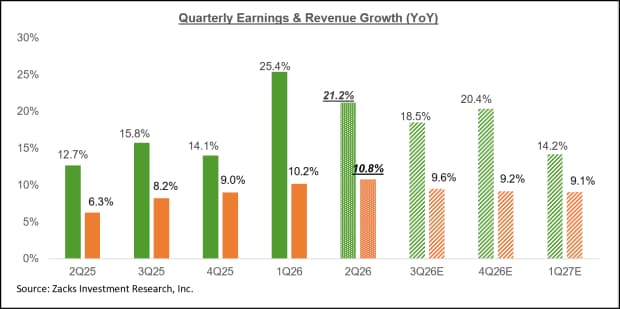
For 2026 Q2 as a whole, total S&P 500 earnings are expected to increase by +21.2% from the same period last year on +10.8% higher revenues.
The chart below shows the Q2 earnings and revenue growth expectations in the context of where growth has been in the preceding four quarters and what is expected in the coming three quarters.
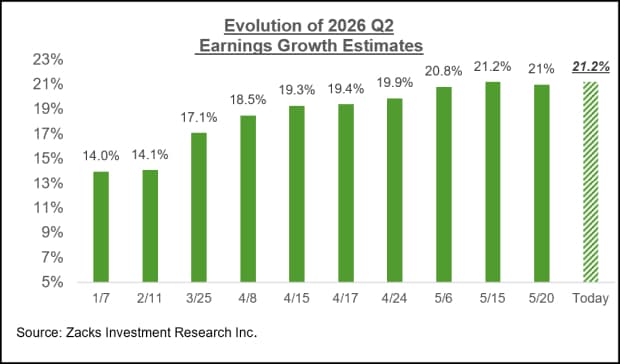
The revisions trend remains positive, a trend that we experienced in the last two quarters as well. Aggregate earnings estimates for the S&P 500 index have steadily moved higher since the quarter got underway in April, as the chart below shows.
Q2 earnings estimates have increased for 5 of the 16 Zacks sectors since the quarter began, offsetting negative revisions in the remaining 11 sectors.
The Energy sector has enjoyed the most obvious earnings outlook upgrade, with aggregate earnings estimates for the sector up more than +80% since the start of April. Earnings for the Zacks Energy sector are currently expected to increase by +113.3% from the year-earlier period. Other sectors enjoying favorable estimate revisions include Tech, Basic Materials, Utilities, and Business Services.
Excluding the positive revisions to either the Energy or Tech sectors, the aggregate Q2 revisions trend would have been negative.
Of the 11 sectors whose estimates have been under pressure since the start of April, the ones experiencing the most negative revisions are Transportation, Medical, Consumer Discretionary, Autos, and Construction.
The chart below shows the overall earnings picture on a calendar-year basis.
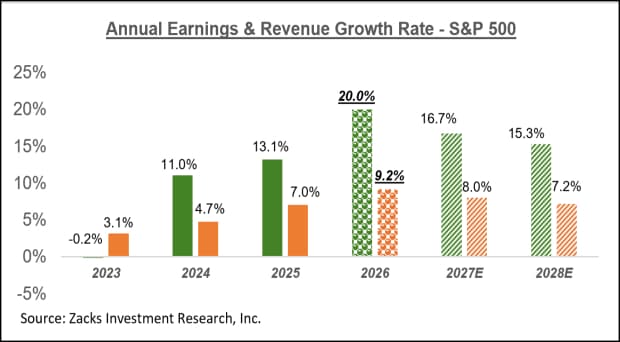
The revisions trend for full-year 2026 is even more positive than we noted in the case of 2026 Q2, with estimates for 11 of the 16 Zacks sectors going up since the start of March 2026. The Energy, Tech, and Basic Materials sectors are the most notable beneficiaries of the improving earnings outlook, but estimates have increased across the board.
The sectors that have suffered negative estimate revisions since the start of March are Transportation, Autos, Consumer Discretionary, Consumer Staples, and Medical.
2026 Q1 earnings season scorecard
We are in that part of the reporting cycle when the preceding earnings season (2026 Q1 in this case) has not yet fully ended, even as the coming earnings season (2026 Q2) has gotten underway, as we noted earlier.
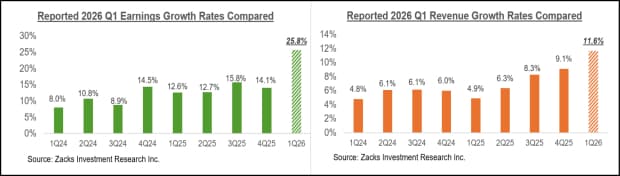
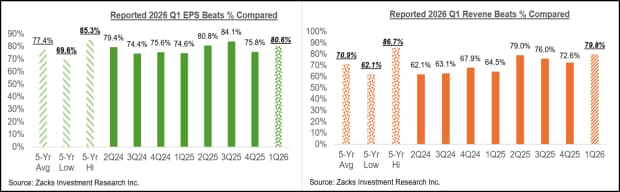
Through Friday, June 6th, we have seen Q1 results from 496 S&P 500 members or 99.2% of the index’s total membership. Total earnings for these companies are up +25.8% from the same period last year on +11.6% higher revenues, with 80.6% beating EPS estimates and 79.8% beating revenue estimates.
We have more than 50 companies on deck to report results this week, most of which qualify for the 2026 Q1 bucket, but some will fall into the 2026 Q2 tally, as will be the case for Oracle and Adobe. Of the remaining four S&P 500 members that are still to report Q1 results, three are on deck to report this week, including The Cambell’s Company (aka the Campbell Soup Company, The J.M. Smucker Company, and Casey’s General Stores.
The comparison charts below put the growth rates for the companies that have reported with what we had seen from this same group of companies in other recent periods.
The comparison charts below put the Q1 EPS and revenue beats percentages for this group of companies relative to what we had seen from them in other recent periods.
Want the latest recommendations from Zacks Investment Research? Download 7 Best Stocks for the Next 30 Days. Click to get this free report
Author

Zacks
Zacks Investment Research
Zacks Investment Research provides unbiased investment research and tools to help individuals and institutional investors make confident investing decisions.