Pound Sterling trades lower ahead of Fed Powell's speech at Jackson Hole Symposium
- The Pound Sterling drops to near 1.3400 against the US Dollar as the latter trades firmly.
- Investors await Fed Powell’s speech for fresh cues on the monetary policy outlook.
- Flash UK S&P Global Composite PMI for August beats estimates.

The Pound Sterling (GBP) posts a fresh two-week low around 1.3400 against the US Dollar (USD) during the European trading session on Friday. The GBP/USD pair extends its losing streak for the fifth trading day as the US Dollar continues to outperform on the back of easing Federal Reserve (Fed) dovish speculation for the September monetary policy meeting.
The US Dollar Index (DXY), which tracks the Greenback’s value against six major currencies, refreshes a 10-day high near 98.80 during European trading hours.
According to the CME FedWatch tool, the probability of the Fed cutting interest rates by 25 basis points (bps) in September has eased to 73.3% from 85.4% seen a week ago.
Dovish expectations have eased ahead of Fed Chair Jerome Powell’s speech at the Jackson Hole Symposium, scheduled at 14:00 GMT, in which he is expected to reiterate his argument that monetary policy adjustments are inappropriate until the central bank gains absolute clarity about the tariff-impact on inflation and the economy.
"With another inflation and payrolls print still due before the September meeting, Powell has every reason to stay patient and keep optionality open," analysts at Saxo said.
Meanwhile, the comments from Kansas City Fed Bank President Jeffrey Schmid on Thursday also signaled that there is no rush for interest rate cuts as inflation is still above the central bank’s target of 2%. "Not in a hurry to cut interest rates as the inflation number is likely closer to 3 than 2, and there is work to do," Schmid said, Reuters reported. Investors should note that Schmid is a voting member of the Federal Open Market Committee (FOMC).
Pound Sterling trades broadly stable after upbeat flash UK PMI data
- The Pound Sterling trades calmly against its major peers on Friday after the release of the upbeat preliminary S&P Global Purchasing Managers’ Index (PMI) data for August on Thursday.
- The report showed that the Composite PMI expanded at a faster-than-expected pace to 53.0 due to a robust growth in activities in the services sector. The agency also reported that new business has returned to growth in August after declining moderately in July. However, the continuation of lay-offs and rising prices charged by private players to offset the impact of an increase in National Insurance (NI) costs will remain key concerns for Bank of England (BoE) officials.
- The BoE would need to perform a delicate balancing act while announcing the interest rate decision in the September monetary policy meeting due to weak labor demand and escalating inflationary pressures.
- In the policy meeting earlier this month, the BoE reduced interest rates by 25 bps to 4%, with a narrow majority, and reiterated a “gradual and careful” monetary easing guidance.
- This week, the UK Consumer Price Index (CPI) report for July showed that both headline and core inflation grew at a faster-than-projected pace of 3.8% on year.
- On the global front, the uncertainty over a truce between Russia and Ukraine has increased after Moscow’s mass overnight attack in Kyiv on Thursday. This came at a time when US President Donald Trump is pushing both nations to come to the table to end the three-year-long war. “Now the signals from Russia are simply, to be honest, indecent," Ukrainian President Volodymyr Zelenskiy said, Reuters reported.
- Earlier this week, US President Trump met with Ukrainian President Zelenskiy to discuss concessions on ending the war in Ukraine after meeting with Russian leader Vladimir Putin on August 15.
Pound Sterling Price Today
The table below shows the percentage change of British Pound (GBP) against listed major currencies today. British Pound was the strongest against the Japanese Yen.
| USD | EUR | GBP | JPY | CAD | AUD | NZD | CHF | |
|---|---|---|---|---|---|---|---|---|
| USD | 0.07% | -0.03% | 0.21% | 0.01% | -0.02% | 0.15% | 0.15% | |
| EUR | -0.07% | -0.06% | 0.10% | -0.04% | -0.14% | 0.09% | 0.11% | |
| GBP | 0.03% | 0.06% | 0.18% | 0.02% | -0.08% | 0.17% | 0.17% | |
| JPY | -0.21% | -0.10% | -0.18% | -0.20% | -0.23% | -0.12% | -0.10% | |
| CAD | -0.01% | 0.04% | -0.02% | 0.20% | -0.09% | 0.14% | 0.15% | |
| AUD | 0.02% | 0.14% | 0.08% | 0.23% | 0.09% | 0.24% | 0.24% | |
| NZD | -0.15% | -0.09% | -0.17% | 0.12% | -0.14% | -0.24% | 0.00% | |
| CHF | -0.15% | -0.11% | -0.17% | 0.10% | -0.15% | -0.24% | -0.01% |
The heat map shows percentage changes of major currencies against each other. The base currency is picked from the left column, while the quote currency is picked from the top row. For example, if you pick the British Pound from the left column and move along the horizontal line to the US Dollar, the percentage change displayed in the box will represent GBP (base)/USD (quote).
Technical Analysis: Pound Sterling struggles to hold 1.3400
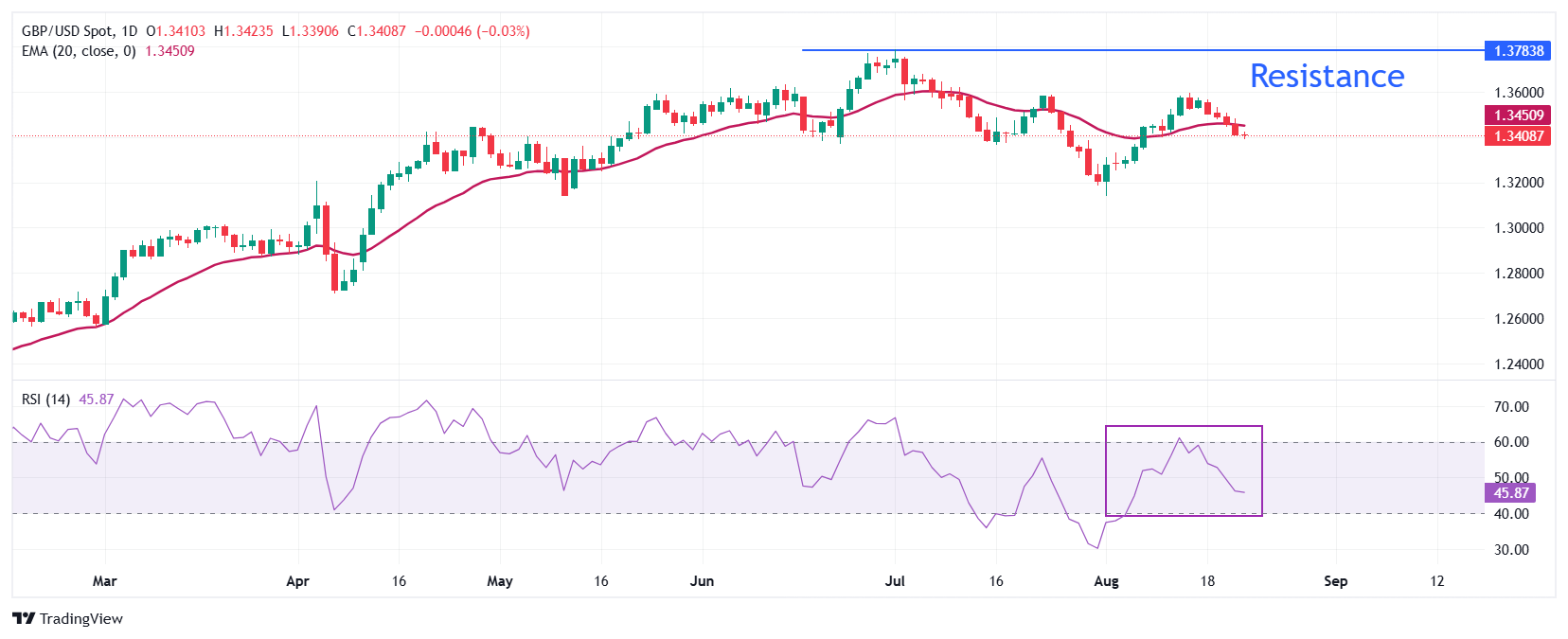
The Pound Sterling slides to near 1.3400 against the US Dollar on Friday. The near-term trend of the GBP/USD pair has become uncertain as it has dropped below the 20-day Exponential Moving Average (EMA), which trades around 1.3450.
The 14-day Relative Strength Index (RSI) drops towards 40.00. A fresh bearish momentum would emerge if the RSI breaks below that level.
Looking down, the August 11 low of 1.3400 will act as a key support zone. On the upside, the July 1 high near 1.3790 will act as a key barrier.
Economic Indicator
Fed's Chair Powell speech
Jerome H. Powell took office as a member of the Board of Governors of the Federal Reserve System on May 25, 2012, to fill an unexpired term. On November 2, 2017, President Donald Trump nominated Powell to serve as the next Chairman of the Federal Reserve. Powell assumed office as Chair on February 5, 2018.
Read more.Next release: Fri Aug 22, 2025 14:00
Frequency: Irregular
Consensus: -
Previous: -
Source: Federal Reserve
Author

Sagar Dua
FXStreet
Sagar Dua is associated with the financial markets from his college days. Along with pursuing post-graduation in Commerce in 2014, he started his markets training with chart analysis.