Pound Sterling rallies into its own coronation
- GBP/USD has closed higher for eight straight sessions and now trades at the 200-day EMA.
- A fading Dollar and an orderly Labour succession are doing most of the lifting.
- FOMC Minutes on Wednesday and the leadership nomination window decide whether the run survives the week.
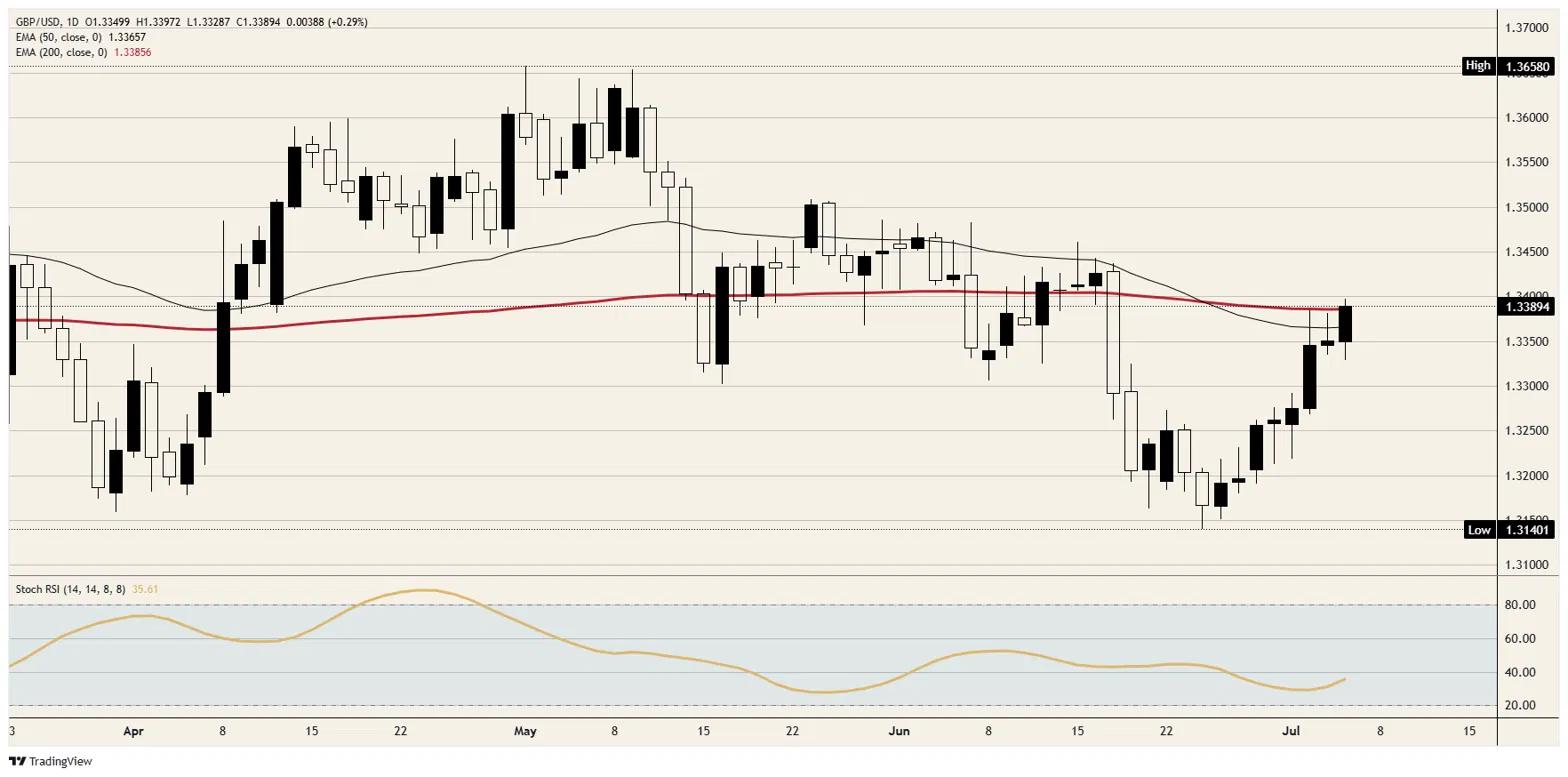
GBP/USD has quietly put together eight consecutive higher daily closes, a grind from near 1.3150 that has delivered the pair directly onto its 200-day Exponential Moving Average (EMA), with the 50-day EMA just beneath it and the 1.3400 handle immediately overhead. Monday added another modest gain: Cable based near 1.3350 through the London morning, then climbed all afternoon to stall just shy of 1.3400.
The interesting part is what did not stop it. A hawkish Federal Reserve (Fed) governor was on the wires mid-afternoon, US services data came in warm enough to keep the hike debate alive, and the pair rallied through all of it, which suggests Monday was less about fresh good news for the Pound and more about a Dollar that has run out of new arguments.
The Dollar blinked first
The Dollar's late-June surge was built on the new Fed Chair's hawkish debut, and that trade has been unwinding since the June Nonfarm Payrolls (NFP) report printed 57K against expectations above 100K last Thursday. Rate markets now assign roughly three-in-four odds to a July hold, the hike chatter has cooled, and Monday's soft composite activity survey did nothing to revive it. Cable's streak is, in large part, the US handing back its own premium.
Westminster clears its throat
Sterling's own contribution began as a crisis. The Prime Minister announced his resignation on June 22 and the pair bottomed near 1.3150 two days later, right at peak uncertainty; since then, the succession has turned into a procession. Would-be challengers have stood down, the cabinet has lined up behind Andy Burnham, and nominations open Thursday and close on July 16, meaning an uncontested race installs a new Prime Minister as soon as July 17. Markets punished the vacuum and are now pricing the resolution, even though the presumptive winner's economic platform remains mostly unwritten.
The Bank is the quiet tailwind
The Bank of England (BoE) held at 3.75% on June 18 with a 7-2 vote, and both dissenters wanted a hike to 4.00%; the hawkish camp has doubled since April. Inflation sits at 2.8% for now, but the Bank's own projections put it back above 3% by autumn as war-era energy costs pass through, and sell-side calls for the next hike cluster around late 2026. Sterling is one of the few major currencies whose next policy move is priced upward, though the same Crude Oil collapse flattering everyone else's inflation outlook quietly erodes that hike case with every passing week. One of the Monetary Policy Committee's (MPC) most reliably hawkish external voices spoke late Monday and returns Tuesday afternoon, keeping the drumbeat audible.
Two tripwires before Friday
The Financial Stability Report lands Tuesday at 09:30 GMT, with the hawkish external member speaking again at 14:15 GMT. Wednesday brings Minutes from the June Federal Open Market Committee (FOMC) meeting at 18:00 GMT, and a hawkish read is the single most direct threat to this streak, since the Dollar leg of the rally is doing most of the work. Thursday opens the leadership nomination window, adds a BoE deputy governor at 09:30 GMT, and brings US jobless claims at 12:30 GMT with consensus near 220K.
Levels to watch
Resistance: The 200-day EMA and the 1.3400 handle sit close enough together to count as one barrier, a zone that has capped the pair repeatedly since May. Above it, the late-June breakdown shelf near 1.3450 is the real test, with the 1.3500 handle behind it.
Support: Monday's base near 1.3350 is the first shelf, with the 1.3300 handle and then 1.3250 beneath it. The streak's origin near 1.3150 is the level that separates a pullback from a reversal.
Bias: Bullish while 1.3300 holds. Daily momentum gauges sit mid-range rather than overheated, so the streak has fuel left, and a daily close above 1.3400 opens 1.3450 and then 1.3500. Hawkish FOMC Minutes or a credible leadership challenger emerging after Thursday are the two developments that end this early; absent them, dips remain for buying.
GBP/USD daily chart
Pound Sterling FAQs
The Pound Sterling (GBP) is the oldest currency in the world (886 AD) and the official currency of the United Kingdom. It is the fourth most traded unit for foreign exchange (FX) in the world, accounting for 12% of all transactions, averaging $630 billion a day, according to 2022 data. Its key trading pairs are GBP/USD, also known as ‘Cable’, which accounts for 11% of FX, GBP/JPY, or the ‘Dragon’ as it is known by traders (3%), and EUR/GBP (2%). The Pound Sterling is issued by the Bank of England (BoE).
The single most important factor influencing the value of the Pound Sterling is monetary policy decided by the Bank of England. The BoE bases its decisions on whether it has achieved its primary goal of “price stability” – a steady inflation rate of around 2%. Its primary tool for achieving this is the adjustment of interest rates. When inflation is too high, the BoE will try to rein it in by raising interest rates, making it more expensive for people and businesses to access credit. This is generally positive for GBP, as higher interest rates make the UK a more attractive place for global investors to park their money. When inflation falls too low it is a sign economic growth is slowing. In this scenario, the BoE will consider lowering interest rates to cheapen credit so businesses will borrow more to invest in growth-generating projects.
Data releases gauge the health of the economy and can impact the value of the Pound Sterling. Indicators such as GDP, Manufacturing and Services PMIs, and employment can all influence the direction of the GBP. A strong economy is good for Sterling. Not only does it attract more foreign investment but it may encourage the BoE to put up interest rates, which will directly strengthen GBP. Otherwise, if economic data is weak, the Pound Sterling is likely to fall.
Another significant data release for the Pound Sterling is the Trade Balance. This indicator measures the difference between what a country earns from its exports and what it spends on imports over a given period. If a country produces highly sought-after exports, its currency will benefit purely from the extra demand created from foreign buyers seeking to purchase these goods. Therefore, a positive net Trade Balance strengthens a currency and vice versa for a negative balance.
Author

Joshua Gibson
FXStreet
Joshua joins the FXStreet team as an Economics and Finance double major from Vancouver Island University with twelve years' experience as an independent trader focusing on technical analysis.