British Pound eases as UK sales drop, US services beat forecasts
- GBP/USD dips slightly but remains on track for weekly gains.
- US services PMI beats estimates, lifting yields and US Dollar.
- Weak UK Retail Sales fail to erase BoE hike bets.

The Pound Sterling (GBP) loses some ground against the US Dollar (USD) on Friday, though it remains poised to end the week with gains of over 0.60%, even as UK Retail Sales disappointed investors and US business activity improved in August. The GBP/USD pair trades at 1.3626, down some 0.02%, retreating from a daily high of 1.3675, its highest level since February 11.
GBP/USD slips as weak UK sales meet stronger US services data
Data in the US was mixed, with S&P Global releasing Flash PMIs. On the positive side, the Services PMI in August rose from 54.6 to 56.8, crushing estimates of 54, while the Manufacturing PMI was 53.2, below estimates and July’s print of 53.9.
In the meantime, the US Dollar Index (DXY), which tracks the buck’s performance against a basket of six currencies, is flatlined at 98.88, underpinned by the rise in US yields. The US 10-year T-note yield is up nearly three basis points to 4.736%, approaching weekly highs, following the US Treasury bond buyback.
On Wednesday, the US Treasury announced that it would buy $4 billion in long-end bonds, in the 10-30-year range, to provide liquidity. Although the market initially priced in the move, it has now faded, with US yields soaring as traders see it as a Yield Curve Control (YCC) move.
Now eyes turn to Jackson Hole meeting, with traders awaiting the speech by Federal Reserve (Fed) Chair Kevin Warsh, which is expected to outline the forward path for interest rates.
In the UK, Retail Sales disappointed markets, shrinking 0.5% MoM in July compared to the previous 0.7% print.
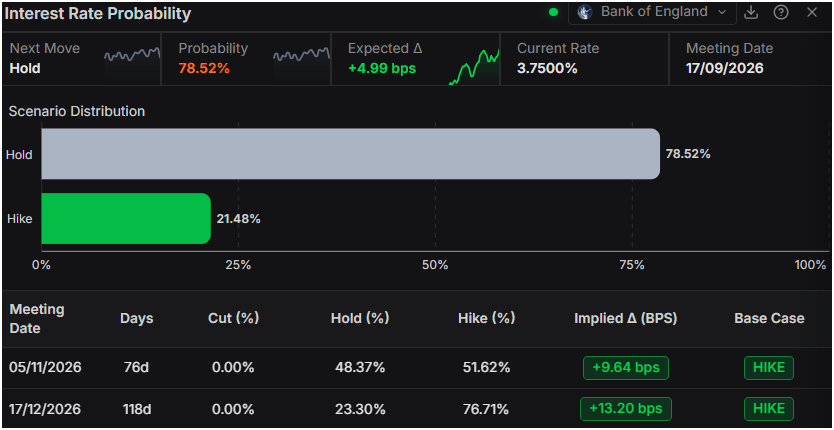
In the meantime, money markets are still pricing in one rate hike by the Bank of England, following the release of recent inflation and GDP data, a sign that the BoE may need to raise rates further.
GBP/USD Price Forecast: Technical outlook
In the daily chart, GBP/USD trades at 1.3638. The pair holds firmly above the cluster of structural supports, including the triple simple moving average (50, 100 and 200 SMAs) around 1.3395 and a series of trend lines that now sit below price, which together suggest a bullish near-term bias. Momentum is stretched, with the Relative Strength Index (14) hovering near 70.6, hinting at overbought conditions but not yet signaling a clear reversal, while the latest Fed Sentiment Index reading at 132.4 points to a still-elevated but moderating policy-pressure backdrop.
On the downside, initial support appears at the upward trend line from 1.3159 near 1.3612, ahead of the former resistance trend line from 1.3653 now acting as support around 1.3498. Below there, the downward trend line linked to the earlier 1.3869 high offers additional support near 1.3407, closely followed by the triple SMA zone around 1.3395 and another rising trend line anchored at 1.3140 near 1.3370. With no clear resistance levels above the current price in this dataset, any pullback toward these supports would likely define whether the bullish bias can be preserved or transitions into a broader consolidation.
(The technical analysis of this story was written with the help of an AI tool. Know more.)
Pound Sterling FAQs
The Pound Sterling (GBP) is the oldest currency in the world (886 AD) and the official currency of the United Kingdom. It is the fourth most traded unit for foreign exchange (FX) in the world, accounting for 12% of all transactions, averaging $630 billion a day, according to 2022 data. Its key trading pairs are GBP/USD, also known as ‘Cable’, which accounts for 11% of FX, GBP/JPY, or the ‘Dragon’ as it is known by traders (3%), and EUR/GBP (2%). The Pound Sterling is issued by the Bank of England (BoE).
The single most important factor influencing the value of the Pound Sterling is monetary policy decided by the Bank of England. The BoE bases its decisions on whether it has achieved its primary goal of “price stability” – a steady inflation rate of around 2%. Its primary tool for achieving this is the adjustment of interest rates. When inflation is too high, the BoE will try to rein it in by raising interest rates, making it more expensive for people and businesses to access credit. This is generally positive for GBP, as higher interest rates make the UK a more attractive place for global investors to park their money. When inflation falls too low it is a sign economic growth is slowing. In this scenario, the BoE will consider lowering interest rates to cheapen credit so businesses will borrow more to invest in growth-generating projects.
Data releases gauge the health of the economy and can impact the value of the Pound Sterling. Indicators such as GDP, Manufacturing and Services PMIs, and employment can all influence the direction of the GBP. A strong economy is good for Sterling. Not only does it attract more foreign investment but it may encourage the BoE to put up interest rates, which will directly strengthen GBP. Otherwise, if economic data is weak, the Pound Sterling is likely to fall.
Another significant data release for the Pound Sterling is the Trade Balance. This indicator measures the difference between what a country earns from its exports and what it spends on imports over a given period. If a country produces highly sought-after exports, its currency will benefit purely from the extra demand created from foreign buyers seeking to purchase these goods. Therefore, a positive net Trade Balance strengthens a currency and vice versa for a negative balance.
Author

Christian Borjon Valencia
FXStreet
Markets analyst, news editor, and trading instructor with over 14 years of experience across FX, commodities, US equity indices, and global macro markets.