|

Pound Sterling Price News and Forecast: GBP/USD rebounds to around 1.3175 during Asian session
British Pound holds gains above 1.3150, US PCE inflation data looms

The GBP/USD pair recovers some lost ground to near 1.3175 during the Asian trading hours on Thursday. However, the potential upside for the major pair might be limited amid UK political instability and rising expectations of US interest rate hikes this year. Traders await the US May Personal Consumption Expenditures (PCE) inflation data on Thursday for fresh impetus.

UK Prime Minister Keir Starmer resigned on Monday, throwing the country into yet another political crisis. Starmer stepped down under intense pressure following Andy Burnham's victory in the Makerfield by-election last week. His Labour Party will now need to select a new leader to lead the country. Read more...

British Pound Sterling's turnaround is dead on arrival

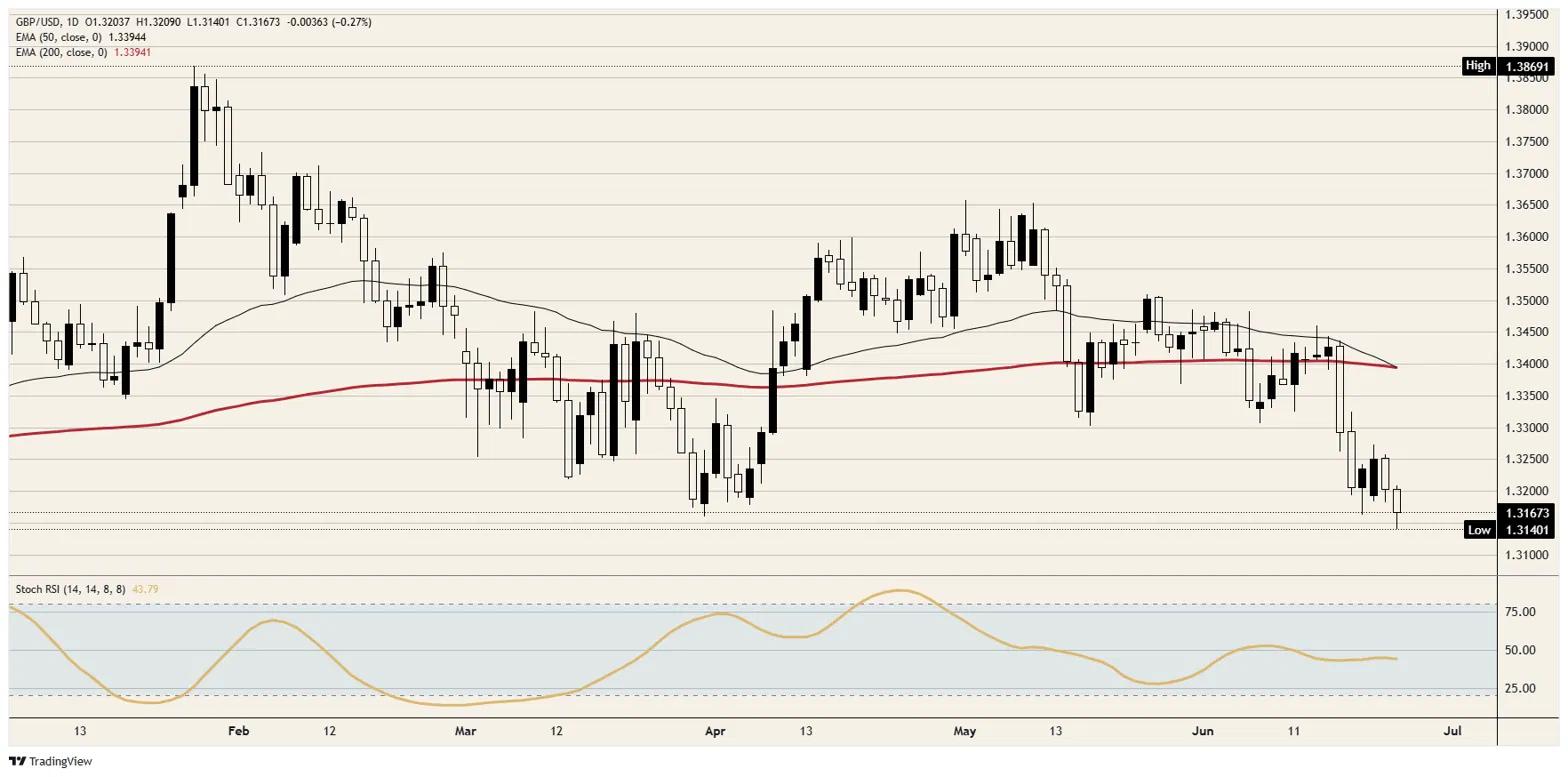
GBP/USD spent Wednesday confirming what the daily chart has signalled for a week, that the Pound's attempted recovery has run out of road. Cable drifted lower through the session to a low just under 1.3150 before clawing back a little into the close, settling just above fresh lows for the move. The pressure is all on the Dollar, lifted broadly by a Federal Reserve (Fed) that has turned hawkish, and nothing on the UK side has been able to stand in its way.

The daily chart is unambiguous, and not flattering. Price has broken below both the 50-day Exponential Moving Average (EMA) and the 200-day EMA, which have converged almost exactly near the 1.3400 handle and now form a single thick band of resistance roughly 225 pips overhead. Beneath that wall there is little obvious support before the 1.3000 handle. The daily Stochastic Relative Strength Index (Stoch RSI) sits only mid-range, nowhere near oversold, so the chart has room to extend lower before anything looks stretched. Read more...
Author

FXStreet Team

Composed of a group of economic journalists and FX experts, the FXStreet content team produces and oversees all content published on FXStreet. It provides a purely journalistic approach to the Forex market.


More from FXStreet Team
Share:

Editor's Picks

AUD/USD keeps the red near 0.6950 after weak Aussie jobs data

AUD/USD holds losses near 0.6950 on disappointing Australian jobs data, extending the previous day's retracement slide from the monthly high and hitting a fresh weekly low during Thursday’s Asian session. Meanwhile, declining US bond yields drag the US Dollar away from the April 2025 high, touched after Wednesday's hot US CPI, helping limit losses for the currency pair.

USD/JPY slides back below 158.00 as USD reverses post-CPI gains

USD/JPY extends the previous day's pullback from a three-week high, attracting follow-through selling and sliding below 158.00 during Thursday's Asian session. Traders remain on high alert amid speculation that authorities will step in to prop up the Japanese Yen. The US Dollar, meanwhile, reverses Wednesday's hot CPI-led gains to April 2025 highs as US bond yields retreat on China bond-buying talk, further pressuring the pair.

Gold pares intraday gains, trades below $4,150 as Fed hike bets cap upside

Gold struggles to capitalize on its strong Asian session move up on Thursday and currently trades below $4,150. The commodity, however, retains an intraday bullish bias, snapping a three-day losing streak to a one-week low, touched on Wednesday, amid a broadly weaker US Dollar (USD). 

Zcash declines as US inflation surprise offsets fresh ETF inflows
Zcash (ZEC) is trading in the red on Friday, extending its previous day’s roughly 6% losses as the broader cryptocurrency market falls on rising US inflation. The US Consumer Price Index (CPI) print came in higher than expected, at an annual increase of 3.7% versus the expected 3.6%, raising concerns about inflation and rate hikes.
China seems routing US Treasury holdings through Canada

According to a Bloomberg report, China seems to be moving United States securities to non-US custodian banks in other countries, masking its role in financing US deficits.

Has Bitcoin really escaped the macro forces it was built to fight?
Over 17 years ago, Satoshi Nakamoto designed Bitcoin (BTC) on the back of a global financial crisis as an alternative to the global monetary system outside the control of central banks, governments and traditional intermediaries. This raises a key question: has Bitcoin really become independent of the macroeconomic forces it was built to challenge?















