|

PAAS correction concludes, bullish continuation expected

Pan American Silver Corp. (PAAS) is one of the world’s largest primary silver producers, with a diversified portfolio of mines and exploration projects across the Americas. Headquartered in Vancouver, the company has built a reputation for operational scale and resource depth, producing not only silver but also significant volumes of gold and base metals. Its long history in the sector, combined with exposure to multiple jurisdictions, makes PAAS a key player in the precious metals market and a closely watched stock among investors seeking leverage to silver prices.

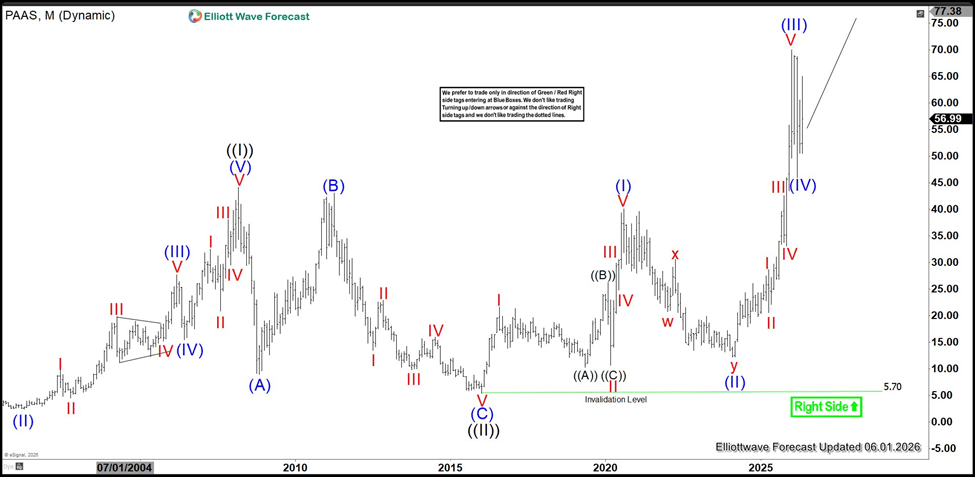
PAAS monthly Elliott Wave chart
Chart

Pan American Silver (PAAS) completed wave ((II)) of the Grand Supercycle at the $5.70 low, marking a significant long‑term pivot. From that base, the stock advanced in wave ((III)), reaching an all‑time high of $69.99. The subsequent pullback in wave (IV) is proposed complete at $45.94, aligning with the 38.2%–50% Fibonacci retracement of wave ((III)). The stock has since turned higher in wave (V), though a decisive break above the wave ((III)) peak at $69.99 remains necessary to fully invalidate the risk of a double correction.

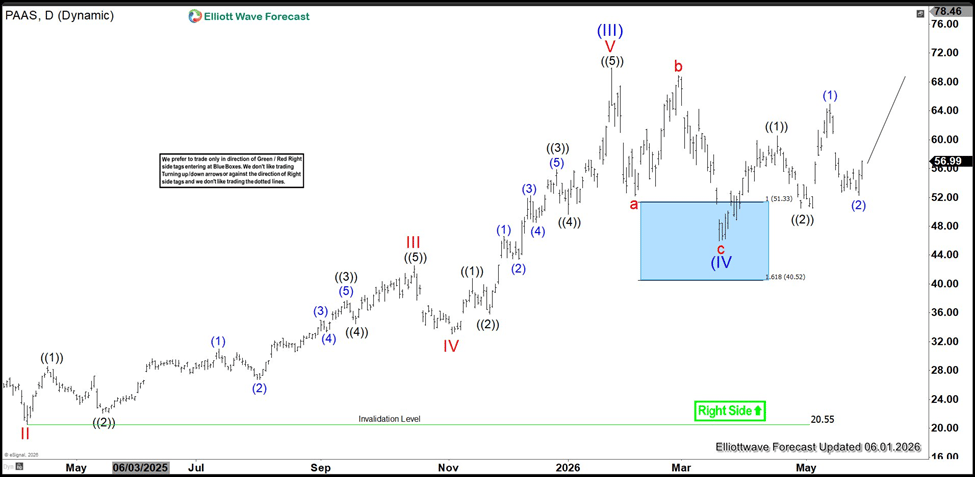
PAAS daily Elliott Wave chart
Chart

Pan American Silver (PAAS) began its rally from the February 13, 2024 low in an impulsive structure. Wave I peaked at $27.47, followed by a wave II correction to $20.55. The stock then advanced in wave (III) to $42.57, with wave IV pulling back to $33.08. Wave V extended to $69.99, completing wave ((III)) of the higher degree. The subsequent wave (IV) correction bottomed at $45.94, and the stock has since turned higher in wave (V). From wave (IV), wave ((1)) ended at $60.56, with wave ((2)) pulling back to $50.51. The next advance carried wave (1) to $64.94, followed by a wave (2) retracement to $52.22. While price remains above $20.55, the expectation is for the stock to continue extending higher.

Author

Elliott Wave Forecast Team

Elliott Wave Forecast Team

ElliottWave-Forecast.com

More from Elliott Wave Forecast Team
Share:

Editor's Picks

GBP/USD loses as rising US Dollar, geopolitical tensions weigh on sentiment

GBP/USD inches lower after remaining flat in the previous day, trading around 1.3500. The currency pair continues to hold its losses as the US Dollar gains strength ahead of a crucial inflation report. Investors are watching this upcoming reading closely, as it is expected to play a major role in shaping the Federal Reserve’s next interest rate decision.

EUR/USD consolidates below mid-1.1500s ahead of German HICP, US CPI

The EUR/USD pair struggles to gain any meaningful traction and holds steady around mid-1.1500s during the Asian session, within a familiar range held over the past week or so. Traders keenly await the release of the key US inflation data and further developments surrounding the Middle East crisis before placing fresh directional bets.

Gold awaits US CPI inflation for the next big move

Gold is back on the bids and looks to regain the $4,400 level in Wednesday’s Asian trading, having found buyers near the $4,350 region. All eyes remain on the high-impact US Consumer Price Index data, which could determine if Gold stretches higher or corrects sharply.

Bitcoin steadies, Ethereum holds 50-day EMA, XRP rebounds from $1 support

Bitcoin, Ethereum and Ripple are showing mixed price action on Wednesday as traders assess key technical support levels. BTC remains under pressure after its recent decline, while ETH is attempting to extend its rebound from the 50-day Exponential Moving Average. Meanwhile, XRP is holding above the crucial $1 level, keeping its recovery attempt intact.

US Dollar: CPI keeps USD in tight ranges

OCBC’s Sim Moh Siong and Christopher Wong note the US Dollar softened as Fed hike expectations moderated and the US yield curve steepened. They argue that without a strong upside surprise in United States Consumer Price Index, the USD should stay rangebound, supporting carry trades.

9-3: Is the Federal Reserve’s vote tally Warsh's new forward guidance?
The rate did not move. Neither did the statement, and that’s the more interesting fact. Set the July 29 Federal Open Market Committee (FOMC) statement beside the one issued on June 17, and the two documents are identical apart from a single verb and a paragraph at the bottom naming three dissenters.