|

OPEC keeps 2026-2027 Oil demand growth forecast steady as WTI struggles for direction

  • OPEC keeps its forecasts for global Oil demand growth in 2026 and 2027 unchanged.
  • The cartel reports that OPEC+ Crude output increased by 445,000 barrels per day in February.
  • Saudi Arabia signals strong supply levels, with production reaching 10.882 million barrels per day.

According to a draft copy of the Organization of the Petroleum Exporting Countries (OPEC) report seen by Reuters, the cartel left its forecasts for global Oil demand growth in 2026 and 2027 unchanged. The organization noted that current geopolitical developments require close monitoring, but said it is still too early to determine whether they could significantly impact its projections for global economic growth.

On the supply side, the report showed that Crude output from the Organization of the Petroleum Exporting Countries and its allies (OPEC+) averaged 42.72 million barrels per day in February, representing an increase of 445,000 barrels per day compared with January.

Saudi Arabia also provided updated figures on its production and market supply. Riyadh told OPEC that its Oil supply to the market reached 10.111 million barrels per day in February, while production stood higher at 10.882 million barrels per day.

These developments come shortly after several major economies signaled their intention to release strategic Oil reserves. Japan confirmed earlier that it plans to begin releasing part of its reserves as early as March 16, even before a formal recommendation from the International Energy Agency (IEA), while Germany also indicated it would release part of its strategic reserves.

The IEA is expected to announce a recommendation regarding the potential release of strategic Oil reserves later in the day, according to Reuters.

Market reaction

WTI US Oil remains volatile on Wednesday, fluctuating without a clear direction, trading within a range between $82 and $88 since the beginning of the European session.
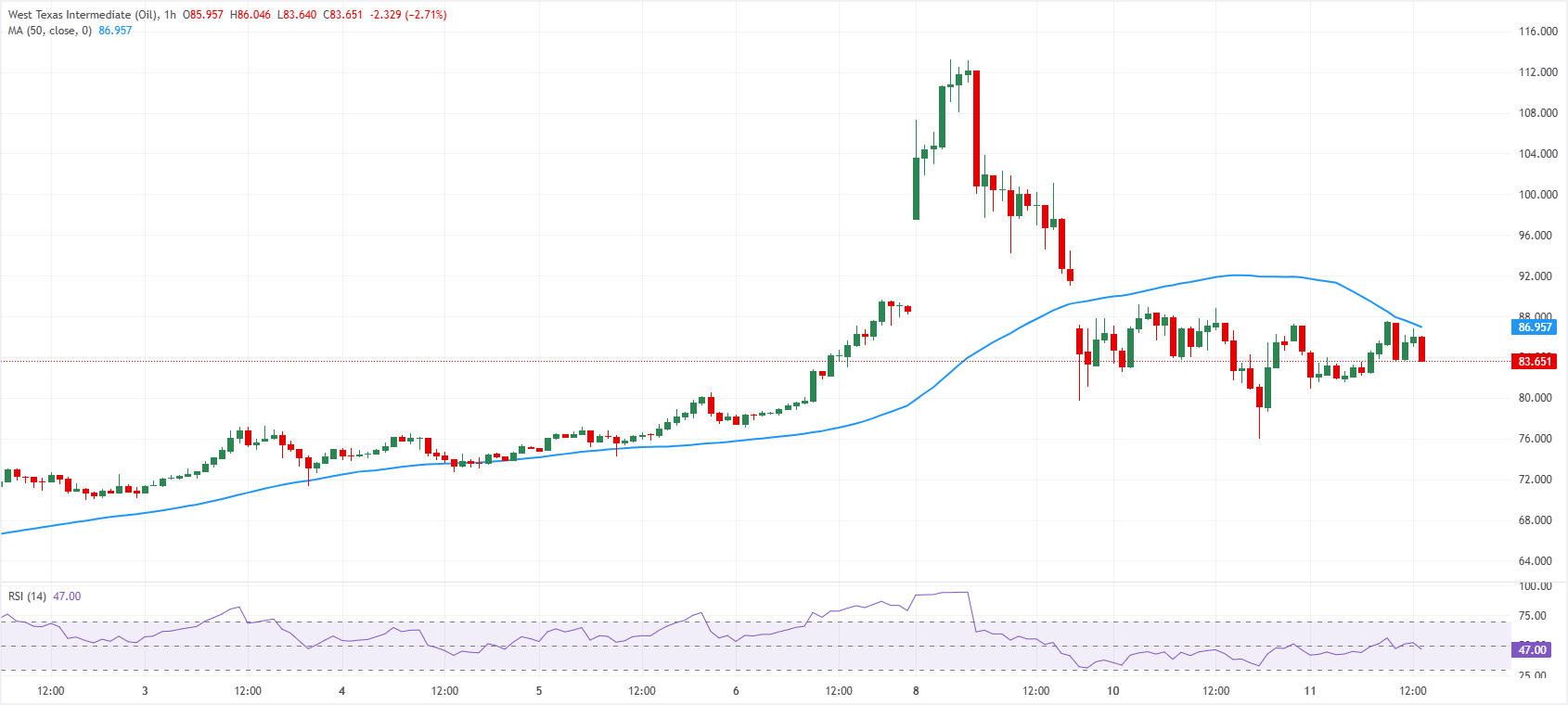
WTI price chart
Hourly WTI price chart

Author

Ghiles Guezout

Ghiles Guezout is a Market Analyst with a strong background in stock market investments, trading, and cryptocurrencies. He combines fundamental and technical analysis skills to identify market opportunities.

More from Ghiles Guezout
Share:

Editor's Picks

EUR/USD: Cautiously optimistic near 1.1550 ahead of the ECB

EUR/USD extends its weekly recovery for the third day in a row on Wednesday, navigating in a sidelined fashion around 1.1550 on the back of humble losses in the US Dollar. In the meantime, market participants continue to closely follow developments in the Middle East while slowly gearing up for the ECB gathering on Thursday.

GBP/USD recedes from tops, hovers around 1.3400

GBP/USD could not sustain the initial bull run and is now slipping back toward the 1.3400 neighbourhood on Wednesday. Cable’s continuation of the ongoing leg higher follows mild selling pressure on the Greenback, despite steady uncertainty on the geopolitical front and elevated US inflation.

Gold bleeding continues as Middle East crisis escalates, Fed hike coming

Gold is accelerating its downward trends and approaches the area of $4,100 per troy ounce on Wednesday, where the 2026 bottom sits so far. The persistent decline in the precious metal almost exclusively follows the swelling opinion that the Fed will keep a cautious stance in H2, a view that was reinforced following earlier US CPI data.

$1,500: Why Ethereum just crashed 20% despite spot markets barely selling
Ethereum (ETH) recently suffered one of its sharpest declines of 2026, dropping more than 20% and briefly testing the $1,500 area. While the sell-off appeared to reflect broader market fears, derivatives and on-chain data suggest a more complex story may be unfolding beneath the surface.
Brutal sell-off: Silver deepens months-long slide, refocusing on $60

Silver has never been known for its calm temperament. The precious metal can spend weeks grinding higher before suddenly giving back months of gains in a matter of days. That volatile reputation has been on full display in recent weeks.

The US economy defies the rules: 100 days into the Oil shock and the recession signal is still missing

More than three months after the start of the Iran war and the resulting disruption to global energy markets, the US economy continues to display remarkable resilience. The conflict has triggered a sharp rise in Oil prices, reignited inflationary pressures and fueled widespread concerns about a potential economic slowdown.