OKLO is testing $44.80 – the next stop could be $39.72

There's a particular kind of exhaustion that shows up on a chart. You see it when a support level has been tested repeatedly over weeks — buyers showing up each time, doing just enough to keep the level alive, but never quite generating the kind of follow-through that would build real confidence. That's exactly what I'm looking at on OKLO right now, and it's the reason today's session matters more than it might appear.
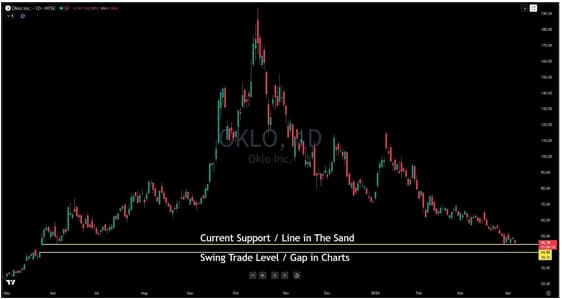
Oklo is a next-generation nuclear power company: advanced fission reactors, small modular designs, the kind of technology story that caught serious momentum in 2025. Price ran from the low twenties all the way to nearly $190. That was a spectacular move. It was also the kind of move that leaves behind a long trail of investors who bought on the way up and are now sitting at a loss, waiting for a chance to get out closer to even. That overhead supply has been governing this chart ever since the peak.
We're trading around $45.79 as I write this, down over 6% from yesterday’s session, pressing directly into support at $44.80.
What I keep returning to about this chart is how that $44.80 level has been worn down. Support doesn't get stronger from absorbing selling, it gets depleted. Every time buyers have stepped in to defend that price, they've used capital to do it. And the way price is arriving there today, with a six-percent loss on the session and no base being built underneath, doesn't suggest the buyers stepping in right now are doing so from a position of strength.
A confirmed daily close below $44.80 opens the door to the gap at $39.72. Gaps tend to get filled. With the broader trend on OKLO firmly lower since those summer highs, there isn't much in this chart to suggest the sellers have finished what they started.
Aggressive traders can use a confirmed close below $44.80 as the trigger. Conservative traders should wait for follow-through on a second session — an intraday pierce that reverses by the close is not a breakdown, and acting on the former is how you end up on the wrong side of a fakeout.
The bull case requires a confirmed close back above $55. That's a lot of ground to reclaim from where price sits today, and I'm not seeing the momentum that would make me confident it happens soon. The chart has been pointing one direction for months. Until that changes, $39.72 is where I expect this to resolve.
Author

Benjamin Pool
Verified Investing
A seasoned financial expert with a passion for empowering individuals to mastering smart money management.