NZD/USD slumps amid concerns over China’s economic recovery and strong US Dollar
- NZD/USD slips below 0.6100 as China’s economy slows down.
- US trade deficit shrunk in June, with Imports at a 1.5-year low. Trade Balance narrows to $-65.5 billion, slightly above the estimated $-65 billion.
- NZD/USD traders eagerly await China’s upcoming inflation data, and US inflation data for July remains a key focal point.

NZD/USD slides sharply below the 0.6100 figure after data in China portrays a weak economic recovery after the country lifted its Covid-19 restrictions, sparking investor worries. Hence, traders braced for the safe-haven status of the US Dollar (USD), a headwind for the NZD/USD, which exchanges hands at 0.6051, down 1%, after hitting a daily high of 0.6109.
US Dollar safe-haven allure and poor Chinese economic data pressure the New Zealand Dollar below 0.6100
A subdued sentiment characterizes Tuesday’s session as global equities are slumping. Data in the Asian session showed that China, the second largest economy in the world, is struggling to gain traction, which turned the mood sour amongst investors. China’s Imports and Exports plunged below forecasts and June readings, pressuring the Government to provide additional stimulus.
The US economic docket showed the trade deficit shrinking in June, with Imports hitting a one-and-a-half-year low, as the US Commerce Department revealed. Exports came at $247.5 billion, below May’s $247 billion, while Imports dipped to $313 billion from $316.1 billion the prior’s month. Hence, the Trade Balance came at $-65.5, a tick higher than the $-65 billion estimated but below the previous reading of $-68.3 billion.
The NZD/USD reached a daily low after the US data release, while the US Dollar Index (DXY), a measure that tracks the buck’s performance against a basket of peers, advances 0.56%, at 102.650, weighing on the New Zealand Dollar’s (NZD) exchange rate.
Meanwhile, US Treasury bond yields are falling, as US central bank speakers shifted their tone toward a neutral policy stance, except for Federal Reserve (Fed) Governor Michell Bowman, saying that more rate increases are needed.
An absent New Zealand (NZ) economic docket would leave NZD/USD traders leaning toward China’s inflation data. If China’s CPI extends its downtrend, that would portray further economic weakness, suggesting the NZD could weaken further. On the US front, the release of July inflation data is much awaited by market participants, with estimates remaining unchanged compared to last month’s data.
NZD/USD Price Analysis: Technical outlook
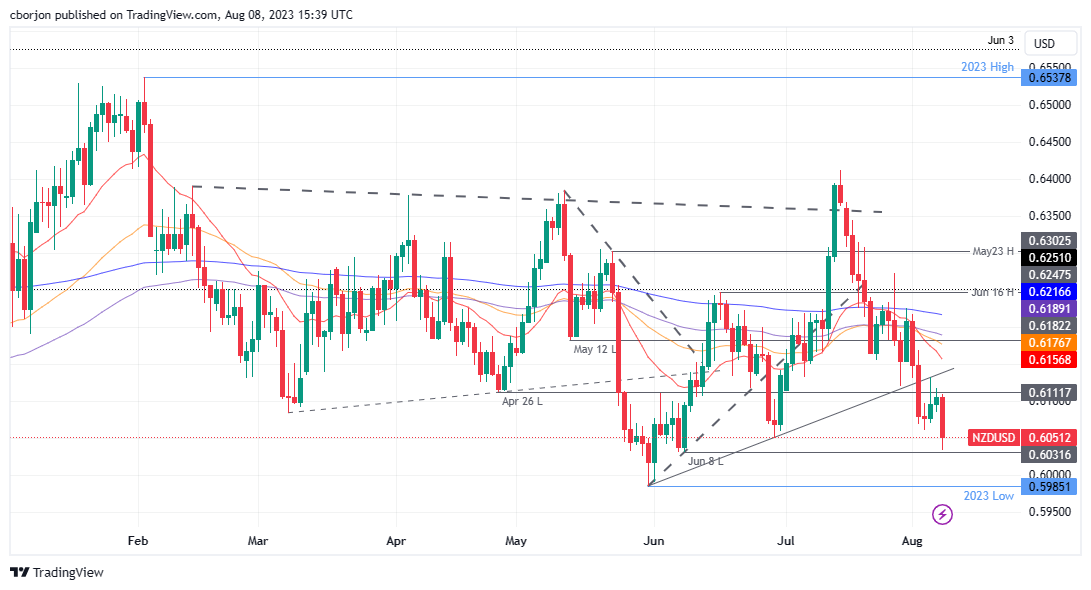
The NZD/USD turned bearish since falling below the daily Exponential Moving Averages (EMAs) and is approaching the June 8 low at 0.6031, which, once cleared, the pair might test the 0.6000 figure. A breach of the latter will expose the year-to-date (YTD) low of 0.5985. If NZD/USD surpasses that level, the next stop would be the November 10 daily low of 0.5840. On the flip side, if NZD/USD buyers keep the pair above 0.6000, the first resistance would be the 0.6100 figure, followed by the August 4 high of 0.6133.
Author

Christian Borjon Valencia
FXStreet
Markets analyst, news editor, and trading instructor with over 14 years of experience across FX, commodities, US equity indices, and global macro markets.