NZD/USD Price Analysis: Pair edges lower to 0.5760 as selling pressure mounts
- NZD/USD declines on Friday, settling around 0.5760 after trimming earlier gains near 0.5850.
- Pair remains capped by the 20-day SMA, with upside attempts thwarted by persistent selling pressure.
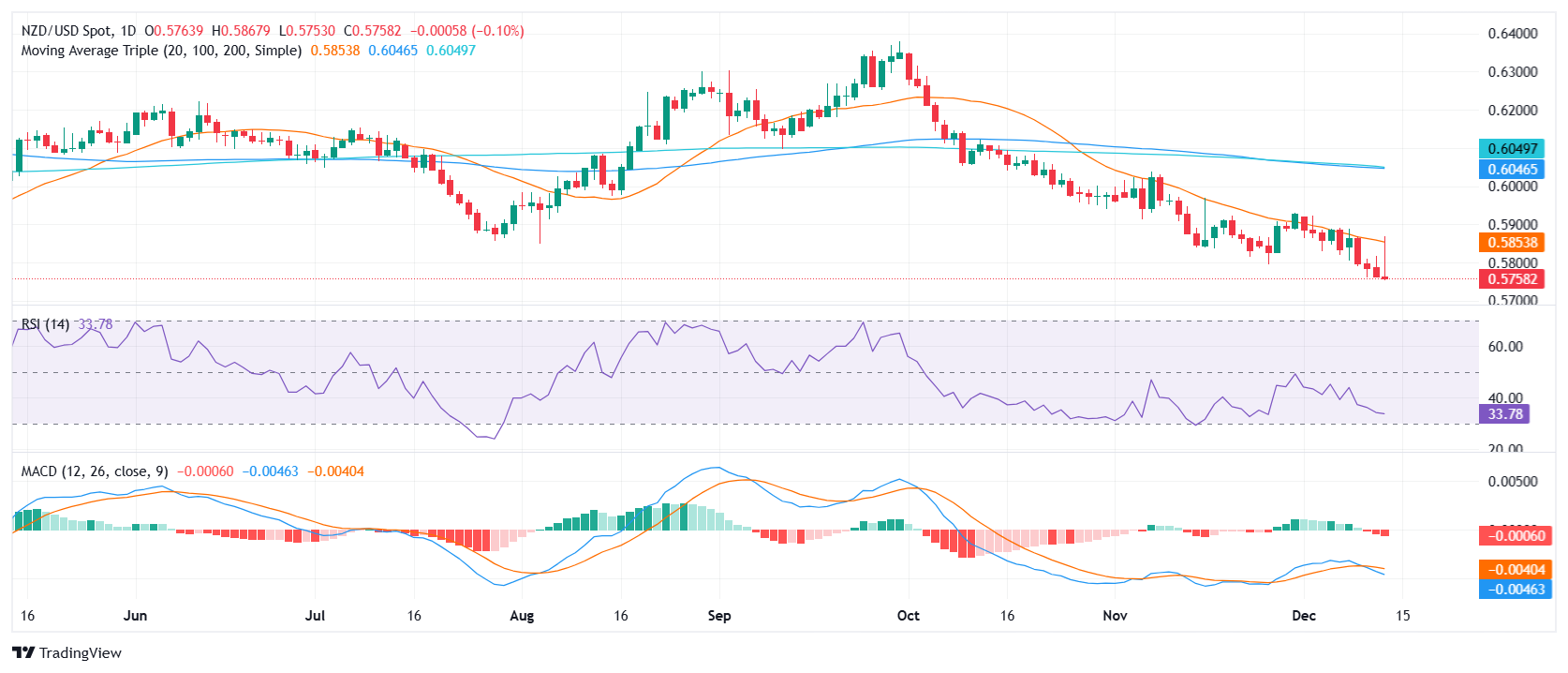
- RSI hovers near oversold territory at 34, while MACD histogram prints rising red bars, indicating intensifying bearish momentum.

The NZD/USD pair struggled on Friday, slipping by 0.14% to 0.5760 and failing to hold onto gains that briefly lifted it toward the 0.5850 area. Persistent selling pressure and the inability to break above the 20-day Simple Moving Average (SMA), currently near 0.5890, continue to weigh on the pair’s short-term prospects.
Technical indicators reinforce the bearish outlook. The Relative Strength Index (RSI) stands at 34, nearing oversold conditions, while still pointing downward and reflecting ongoing weakness. Meanwhile, the Moving Average Convergence Divergence (MACD) histogram now prints rising red bars, signaling that bearish momentum is intensifying, despite the pair’s recent attempts at recovery.
With the NZD/USD drifting lower, immediate support lies around the 0.5750 region, followed by the psychological 0.5700 mark if the selling persists. On the upside, a decisive break above the 20-day SMA would be required to negate the current bearish bias and offer the bulls a chance to regain control.
NZD/USD daily chart
Author

Patricio Martín
FXStreet
Patricio is an economist from Argentina passionate about global finance and understanding the daily movements of the markets.














