|

NZD/USD bears in control, targetting daily channel support

  • NZD/USD is on the offer and building the case for a test of channel support. 
  • The US dollar is bod on strong US yields, but it may be a shortlived theme for the greenback. 

NZD/USD is under pressure in Tokyo as the US dollar firms some more following a strong performance in Wall Street ad the European session. 

At the time of writing, NZD/USD is trading at 0.7194 between a low of 0.7182 and 0.7211, down some 0.2% on the session so far. 

NZD/USD initially rose from 0.7240 to 0.7269, before falling to 0.7200 in New York.

The Kiwi has given back territory from a 6-week high On Monday as rising US bond yields take front and centre of the forex space, propelling the greenback to test recent resistance. 

''A steeper yield curve is generally a good sign, but it was well expected and this looks more like a positioning move/retracement rather than the start of a big USD move,'' analysts at ANZ Bank argued.

Specifically for the kiwi, the analysts explained that the market has shown its capacity to look through the move to covid Levels 2/3 locally; ''that seems appropriate given how well-resourced the Government is to tackle any outbreaks. Higher milk prices overnight are a reminder of how well commodity prices are holding up.''

NZD/USD technical analysis

As per the prior analysis, NZD/USD Price Analysis: Trapped between daily support and resistance, the price remains in familiar territory offering opportunities on fading tops of the channel to target the lows:
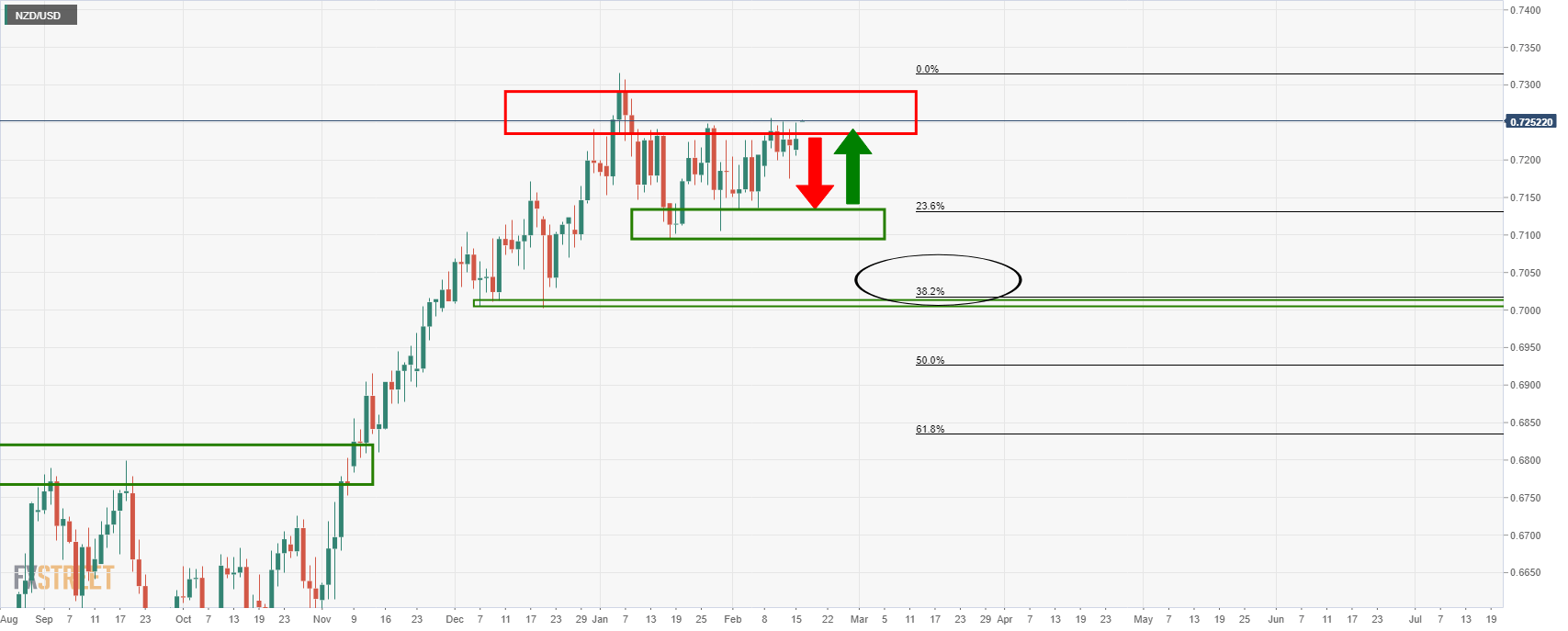
(Prior analysis)

4-hour chart
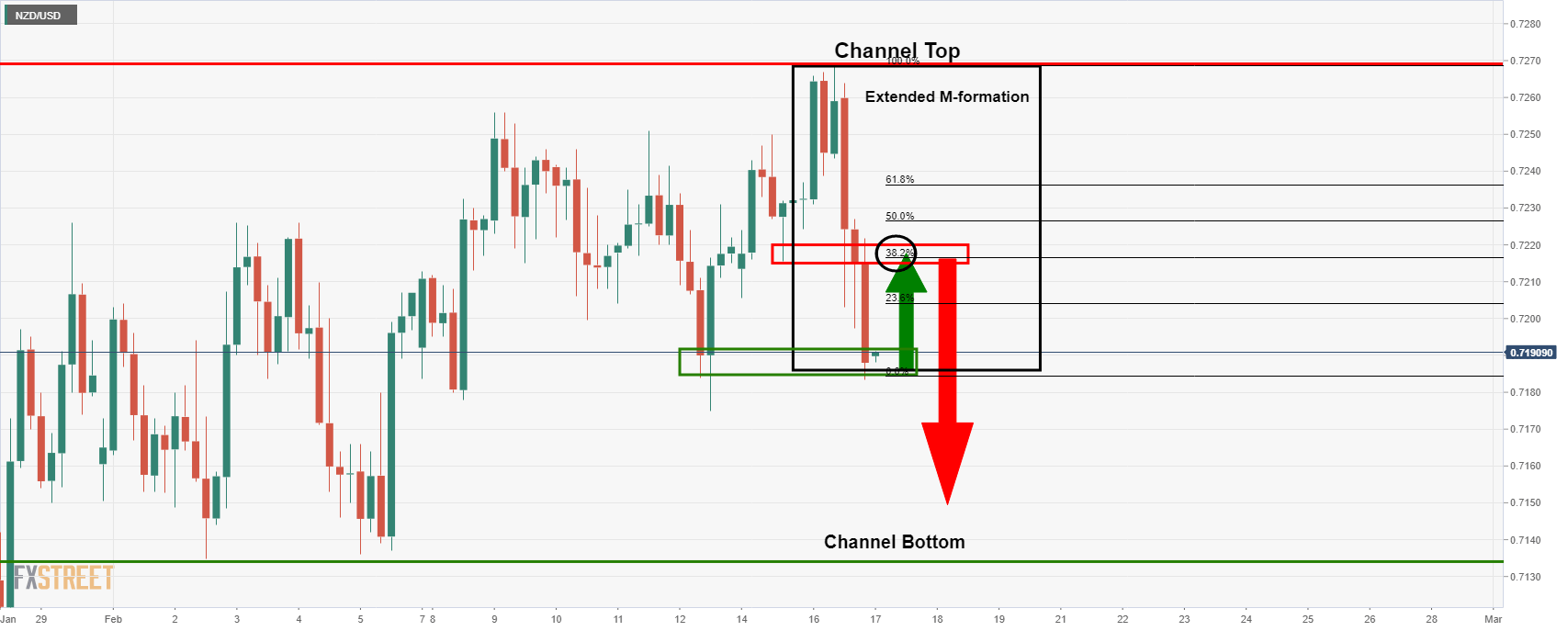
Meanwhile, from 4-hour perspective, bulls could well tempt the commitments of the bears at this juncture as price meets support. 

The expended M-formation would be expected to see a retracement to at least a 38.2% Fibonacci level which meets prior structure in the case above.

This may result in a bearish extension to the channel's bottom in an otherwise trapped market between daily support and resistance

Author

Ross J Burland

Ross J Burland, born in England, UK, is a sportsman at heart. He played Rugby and Judo for his county, Kent and the South East of England Rugby team.


More from Ross J Burland
Share:

Editor's Picks

GBP/USD bounces off lows, back above 1.3200

After bottoming out near 1.3160, GBP/USD manages to regain a bit of shine and reclaim the 1.3200 mark and beyond at the end of the week. Stronger-than-expected UK Retail Sales data seem to be helping the British Pound limit its losses, while the chaotic UK political environment keeps the bulls at bay for now.

EUR/USD looks consolidative around 1.1460

EUR/USD stages a modest rebound after slipping to a three-month low below 1.1420 at the end of the week. That said, the pair now looks to consolidate humble gains just above 1.1460 despite growing uncertainty surrounding the next round of US-Iran negotiations, which keeps the US Dollar’s downside contained.

Gold slips back to six-day lows, targets $4,100

Gold retreats for the third consecutive day on Friday, eroding gains seen in the first half of the week and approaching the key $4,100 mark per troy ounce. Indeed, the precious metal continues to face headwinds from the Fed's hawkish stance and renewed uncertainty surrounding the next round of US-Iran negotiations.

Solana extends correction despite ETF inflows, RWA adoption

Solana (SOL) price edges below $70 extending its losses for the fourth straight day this week. The institutional demand for Solana is building, with steady inflows so far this week and Morgan Stanley’s amended S-1 filing for a Solana-focused Exchange-Traded Fund.

The Iran war didn't break the US economy, but what happens next?

Nearly four months after the start of the Iran war, the US economy remains remarkably resilient. While the conflict initially triggered a severe disruption to global energy markets and a sharp rise in Oil prices, recent diplomatic progress between Washington and Tehran has eased concerns about a prolonged supply shock.

Regime change: Inside Kevin Warsh's first move to make the Fed unreadable on purpose

The rate did not move. That was the least interesting thing about Kevin Warsh's first meeting in charge of the Fed. The FOMC held its benchmark at 3.50%-3.75% for the fourth straight meeting, exactly as priced, and then the new chair used his first press conference to dismantle the machinery the market has leaned on for a decade.