Nvidia’s record breaking results fail to wow investors, for now
- Record breaking revenues and forecasts were the highlight
- Costs rose and so did shareholder returns, including the dividend and the share buyback programme
- This was not enough to stop the share price from sliding, and the stock experienced a mild sell off in after hours trading
- Investors may worry about Nvidia’s competitors, and its concentrated customer base
- The stock price may have a delayed reaction on Thursday, once the dust has settled on today’s release

The world’s most valuable company has finally released its results for last quarter. The company announced record breaking revenue for the first three months of the year at $81.6bn, an 85% increase on a year ago. The bulk of this revenue came from data centres, where revenue more than doubled in the past 12 months to $75.2bn. Revenue forecasts for this quarter suggest that the good times for Nvida are still rolling. Q2 revenue is expected to set another record, with forecasts for more than $91bn in sales. This exceeds Wall Street expectationsand is double compared to Q2 2025.
Nvidia results fail to end jitters about the AI trade
These monster results suggests that Nvidia is reaping the benefits of the hyperscalers’ big-spending capex plans, and it could put to bed fears that AI trade is over. However, even though Nvidia has posted monster revenues, the share price is experiencing a mild sell-off in post-market trading. Investors have grown accustomed to enormous revenues and forecasts from Nvidia, so tonight’s numbers are not moving the dial for investors, especially after the share price rallied 1.5% ahead of the earnings report. The stock is already up 17% YTD and is outpacing gains for the S&P 500 and other Magnificent 7 stocks.
Nvidia remains in robust financial health
Gross margins were in line with Q4 results at 75%. We doubt that investors were concerned about gross margin compression at this stage, instead, the stuttering market reaction to these undoubtedly good results could be a sign that investors are worried about cost creep. Operating costs rose 50% last quarter compared to a year ago, but this pales in comparison to the 85% jump in revenues.
AI at heart of AI revolution, boasts Huang
The company remains in robust financial health, and there are no signs that it will deteriorate. Jensen Huang once again talked up the potential for AI and said that the AI buildout is accelerating at extraordinary speed. He also reiterated Nvidia’s unique position in the AI ecosystem, saying that it is the only platform that runs in every cloud, powers every open-source model, and scales everywhere that AI is produced. This is a strong statement directed at the naysayers, and those who have voiced concerns about Nvidia’s circular funding model – it buys or invests in companies in return for them using Nvidia products.
Nvidia leans into shareholder returns
There was also an interesting addition to these results. In our preview we pointed out that Nvidia had a paltry dividend and had room to boost shareholder returns. Today, Nvidia leaned further into shareholder returns. It boosted its dividend from 1 cent per share to 25 cents per share, and it also increased its share buyback programme by $80bn, bringing it to $118.5bn.
Why are investors lukewarm about these results?
So why are investors finding it hard to love Nvidia’s results? There are two reasons why investors have given this earnings report a lukewarm reception. Firstly, when a company boosts shareholder returns to this degree it could be a sign that they are running out of ideas. This money must be diverted from somewhere, and although there is only a small chance of this happening, it could stifle innovation at the firm. Nvidia is now in an AI arms race, as new competitors come to market and as Nvidia’s own customers like Google and Meta look at making their own custom chips. Added to this, Google’s tensor processors could pose a threat to Nvidia’s dominance down the line.
Narrow customer base still a concern for investors
Secondly, there has been no mention of new customers, and a widening of Nvidia’s cusgtomer base. It remains extremely reliant the hyperscalers, who generated more than half of Nvidia’s data centre revenue last quarter. This is disappointing. Although Nvidia remains at the heart of the AI revolution, analysts had been expecting to see a wider enterprise customer base. This suggests that for now, the bulk of AI spend is coming from the same mega cap tech firms who have been boosting Nvidia’s coffers for most of this decade.
While Nvidia is in an incredible position from a revenue-generating viewpoint, it remains vulnerable to changes in hyperscalers’ spending plans. If they turn off the taps for AI investment in the coming quarters then Nvidia would be in the firing line, and revenues could dry up very quickly.
Same old playbook for Nvidia
This is certainly not a problem for today, but with a market capitalization of more than $5.412 trillion, the company needs to work harder each quarter to justify this colossal valuation.
There are few holes to pick in this earnings report, but investors seem unwilling to react to the same old playbook from Nvidia. Although the company threw in plenty of shareholder sweeteners, investors may have preferred if they announced a broader client base.
The sell-off in the stock has been mild so far, and it is down by less than 1%. However, ahead of the earnings report, the options market priced in a swing of $350bn in either direction. Thus, there could be further volatility in Nvidia’s share price on Thursday, once the dust has settled.
Overall, these results have confirmed that Nvidia is a cash-generating machine and will continue to be for at least this quarter. Nvidia only gives 1 quarter of forecasts, and this may limit the market reaction to this report. In this environment, where questions are being asked about the AI trade, investors want the company to give a firmer steer on what will happen in 6-9 months’ time, and how the company will grow its customer base. For now, Nvidia has not been forthcoming with this information, which is limiting its upside.
Chart 1: Nvidia backs away from record highs
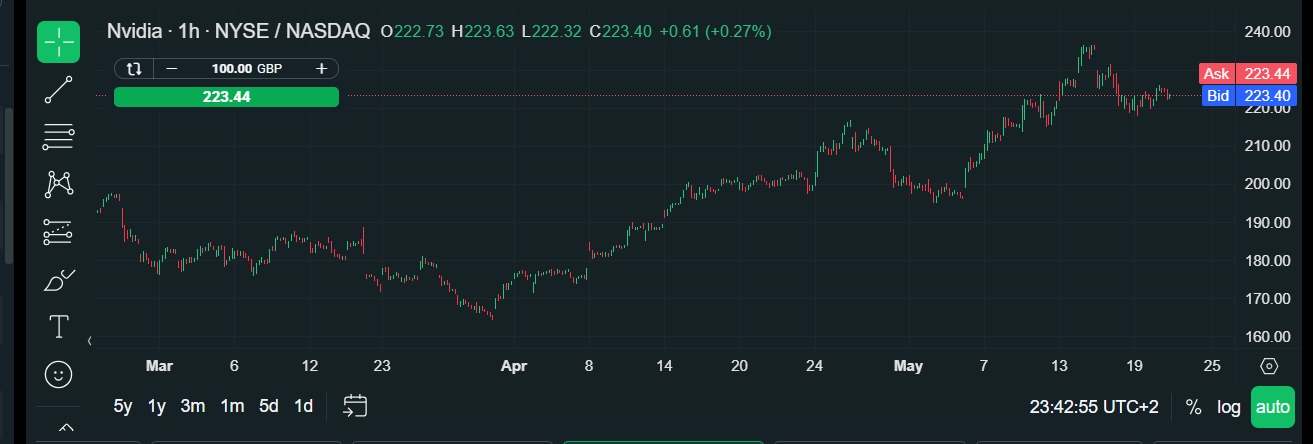
Source: XTB
Author

Kathleen Brooks
XTB UK
Kathleen has nearly 15 years’ experience working with some of the leading retail trading and investment companies in the City of London.