|

NVIDIA earnings loom: A closer look at expectations

The Q1 earnings cycle continues to roll along, with this week’s reporting docket highlighted by none other than AI favorite NVIDIA (NVDA). The release will wrap up the reporting cycle for the broader Mag 7 group as well, whose growth has remained strong overall.

As has been the case over the past several years, the release is among the most important during the period. We’ve learned again this earnings season that many companies remain committed to big CapEx plans concerning their AI infrastructure buildouts, a key development to keep in mind heading into the release.

Quarterly estimates

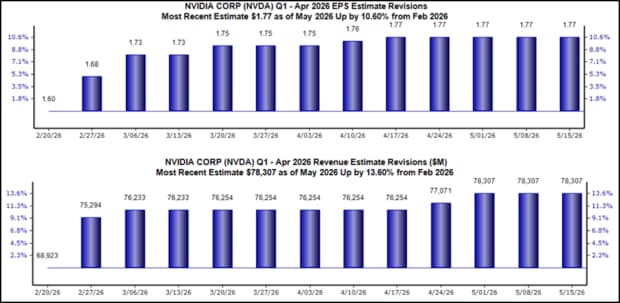
Both EPS and sales expectations for NVIDIA’s upcoming print remain bullish, with the giant expected to see 120% EPS growth on nearly 80% higher sales. The growth that NVDA has witnessed has been historical, a development we likely won’t see from a company its size in a long time.
Nvidia
Image Source: Zacks Investment Research

Data center expectations

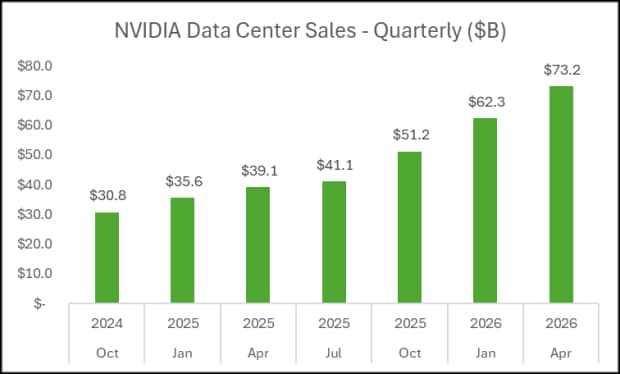
To little surprise, Data Center results from NVIDIA will be the major focus, which have been the primary driving force behind its positivity over recent years. Unrelenting demand has led to huge growth, with everybody wanting the AI GPUs.

Below is a chart illustrating the company’s Data Center sales on a quarterly basis. Our consensus estimate for Data Center sales for the quarter to be reported stands at $73.2 billion, well above the $39.1 billion mark in the same period last year.
Nvidia
Image Source: Zacks Investment Research

Bottom line

NVIDIA’s (NVDA) release will wrap up the reporting cycle for the Mag 7 group, whose results were overall positive and constructive. It’s more than reasonable to expect the AI favorite to spend the bulk of its time discussing the AI outlook, a trend many have become accustomed to over recent years.


Want the latest recommendations from Zacks Investment Research? Download 7 Best Stocks for the Next 30 Days. Click to get this free report

Author

Zacks

Zacks

Zacks Investment Research

Zacks Investment Research provides unbiased investment research and tools to help individuals and institutional investors make confident investing decisions. 

More from Zacks
Share:

Editor's Picks

AUD/USD bulls regain control above 0.6950 amid USD retreat

AUD/USD regains traction and extends the previous day's bounce from the weekly low, aiming for 0.7000 in Asia on Friday. The overnight pullback in US bond yields keeps the US Dollar below an 18-month high, which in turn offers some support to the pair. Meanwhile, hawkish RBA expectations also keep the major underpinned.

USD/JPY holds gains near 158.00 after Japan's weak Household Spending data

USD/JPY clings to gains around 158.00 after data showed on Friday that Japan's Household Spending fell for the ninth straight month, undermining the Japanese Yen. Meanwhile, the US Dollar remains depressed as the overnight fall in US bond yields counters a hawkish Fed and geopolitical uncertainties, could cap any downside in the pair.

Gold remains range-bound below $4,200

Gold has given up some ground after an initial bullish attempt to reach weekly highs, returning to below the $4,200 mark per troy ounce on Friday. The US Dollar’s strong upside momentum, combined with rising US Treasury yields across the curve, seems to keep further gains in the yellow metal under scrutiny.

Week ahead: US CPI, France’s budget crisis and Q3 earnings to set the market tone
The US dollar held relatively strong this week, despite the disappointing US jobs report on October 2, which further decreased the probability of a back-to-back rate hike by the Fed at the upcoming gathering on October 28.
CFTC Report: Euro and Aussie shorts expand amid diverging signals

The week in one sentence: Euro and Australian Dollar shorts deepened in the week to October 6, while Yen longs rebuilt. In addition, Coffee buying continued, and Gold exposure remained elevated despite another price decline. Speculators turned more negative on the Euro, increasing the net exposure to around 99.3K contracts.

Has Bitcoin really escaped the macro forces it was built to fight?
Over 17 years ago, Satoshi Nakamoto designed Bitcoin (BTC) on the back of a global financial crisis as an alternative to the global monetary system outside the control of central banks, governments and traditional intermediaries. This raises a key question: has Bitcoin really become independent of the macroeconomic forces it was built to challenge?