|

NVDA has ripped 21% in 12 days, now it’s heading straight into a gap fill

NVIDIA, the massive semiconductor company behind the chips powering artificial intelligence infrastructure worldwide, has had one of the more impressive short-term recoveries on any chart I’ve looked at recently.
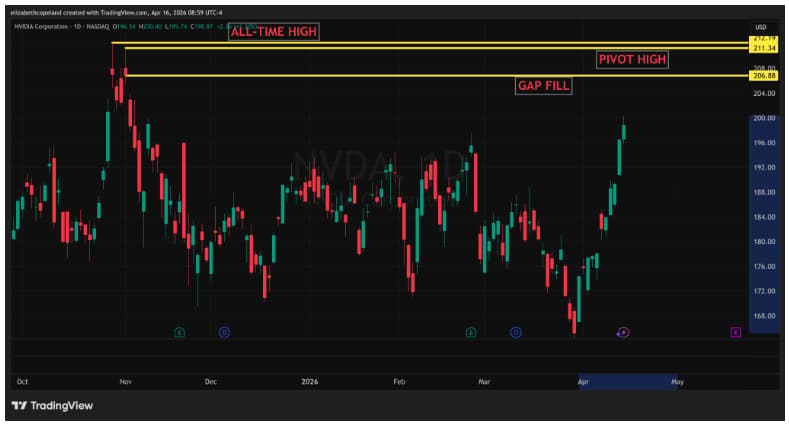
Chart

Off the March 30 pivot low, price has pushed over 21% higher in just 12 sessions. It is trading around $199 as of this morning. The gap fill at $206.88 is the level that matters right now. That level sits just above current price, and if the semiconductor sector keeps pushing, NVDA is going to get there.

After a 21% run in less than two weeks, $206.88 is where I'd be watching most closely for a reversal. Above the gap fill, the resistance levels (marked in yellow on the chart) start to stack up quickly.

The pivot high at $211.34 is the next level overhead, and just above that sits the all-time high at $212.19. Those two levels are close enough together that if price pushes through $206.88 without reversing, the $211–$212 zone becomes the next meaningful area of resistance. That's been capping price on every prior approach, and there is no reason to expect a different outcome without a significant shift in momentum, especially with the current momentum pushing higher.

For both aggressive and conservative traders, the gap fill at $206.88 is the shared target on this setup. A sustained move above $206.88 with a close above the pivot high at $211.34 is the next level to see a reversal with a forceful move up. The structure right now favors the sellers at $206.88, provided the rejection shows up when price gets there.  

Author

Elizabeth Copeland

Elizabeth Copeland

Verified Investing

Elizabeth is a trader and financial journalist who uses her sharp analytical skills to spot market shifts early and trade with precision.


More from Elizabeth Copeland
Share:

Editor's Picks

GBP/USD treads water just below 1.3300

GBP/USD alternates gains with losses just below 1.3300 the figure on Tuesday. Indeed, Cable struggles to build recovery momentum as the Greenback benefits from a cautious market mood ahead of the Fed’s meeting on Wednesday and the BoE’s gathering on Thursday.

EUR/USD turns positive past 1.1370

EUR/USD rebounds from earlier multi-week lows and flirts with the 1.1380 zone, up marginally for the day on Tuesday. Uncertainty surrounding the US-Iran conflict weighs on risk sentiment and caps the pair’s upside, while investors avoid taking large positions ahead of the highly anticipated Fed meeting on Wednesday.

Gold closes in on $4,000 ahead of FOMC decision

Gold (XAU/USD) maintains its offered on Tuesday and declines toward the $4,000 psychological level. This follows the previous day's failure to find acceptance above the $4,100 mark and suggests that the path of least resistance for the bullion remains to the downside amid a bullish US Dollar (USD), which draws support from escalating geopolitical tensions ahead of the cricital FOMC meeting.

Bitcoin slips below $64,000 as risk-off sentiment grips markets
Bitcoin (BTC) is extending its correction, trading below $64,000 at the time of writing on Tuesday after losses of over 2.5% the previous day. Institutional demand shows early signs of weakness, with spot Exchange Traded Funds (ETFs) recording a mild outflow on Monday, marking three consecutive days of withdrawals.
Indian Rupee outlook: Downtrend set to persist – Just at a slower pace
The Indian Rupee just endured its most brutal six-month stretch in years, battered by a perfect storm of global shocks. From United States (US)-India trade uncertainty to surging Oil prices and the significant outflow of Foreign Institutional Investment (FII) from the Indian stock market, every event brought nothing but pain for the Indian currency.
US Dollar mid-year outlook: Exceptional currency, exceptional risks?
The US Dollar enters the second half of 2026 in a markedly different position from a year ago. The King currency has recovered, reflecting persistent US inflation, changing expectations for Fed policy, geopolitical tensions and renewed demand for defensive assets.