Natural Gas traders on edge as storage numbers are due
- Natural Gas jumps higher after suprise US tariffs imposed.
- The US Dollar is firmly stronger after FOMC minutes reveal the Fed is still not happy with current inflation levels.
- The overall technical picture still shows a longer-term ascending trend channel.

Natural Gas prices are jumping higher to make a new two-day high, after the US opening bell as headlines are hitting the wires with the US imposing tariffs on Tin Mill Steel imports from China, Canada and Europe. Markets are pushing commodity prices higher on the back of these headlines, creating a tailwind for Natural Gas as well. Expect to see a possible jump higher above the high of Wednesday near $2.77, which could stretch towards $2.95..
A firmly stronger US Dollar weighs on the Natural Gas price as well, limiting any firm further upside. With the FOMC minutes showing that the Fed wants to do more by either additional interest-rate hikes or keeping current levels steady for longer, a slump in demand could start to trickle into Natural Gas prices. Weaker demand against steady supply means lower prices.
At the time of writing, Natural Gas is trading at $2.778 per MMBtu.
Natural Gas news and market movers
- After a weak start of this Thursday, Natural Gas prices are picking up as US tariffs are catching markets by surprise.
- Traders will be looking forward to the weekly Gas Storage Changes at 14:30 GMT. The US Energy Information Administration will publish the change from the previous 29B. Expectations are for a rise to 34B, which could put more pressure to the downside for Natural Gas prices.
- There is a big divergence between the European and US gas prices. Europe saw a firm spike after headlines that Australian unions went on strike and halted gas deliveries to Europe.
- In some good news for Europe, gas storages in the continent are nearly full. The German stockpile is up to 92%.
- Current weather projections point to an elevated possibility of a cold winter in Europe, which would underpin current gas price levels even as storages are already almost full.
- Gas company ADNOC gas signed a deal with Japan Petroleum Exploration (JAPEX) for a 5-year LNG supply pact worth between $450M and $550M.
- Tropical storm Hilary is on its way to the Baja California peninsula and will be closely monitored as it will grow into a hurricane by Friday.
- Latest FOMC minutes show that the US Federal Reserve is still not happy with where or how inflation is behaving. This could mean that policy makers will either keep interest rates steady for longer or will perform one or two more hikes.
Natural Gas Technical Analysis: Support not needed
Natural Gas has received a beating these past few trading days on Tuesday and Wednesday. With an overall 8% decline since its opening price on Tuesday, it becomes clear that the equilibrium between supply and demand is very fragile and the slightest shift on any side moves the needle in any direction. In this case, the FOMC minutes tripped the markets, which are erasing potential future demand as elevated rates could cap or diminish the usage of Natural Gas.
On the upside, $3 is still the level to watch as the overall ascending trend channel since April is being well respected. Should Natural Gas prices be able to recover, look for a close above $2.935, the high of Tuesday, in order to confirm that demand is picking up again. More upside towards $3 and $3.065 (high of August 9) would be targets or levels to watch.
On the downside, the trend channel is doing its work with a 55-day Simple Moving Average (SMA) at $2.639, which is underpinning the price. In case more downside pressure builds, look for $2.579, which is the lower trend line of the trend channel.
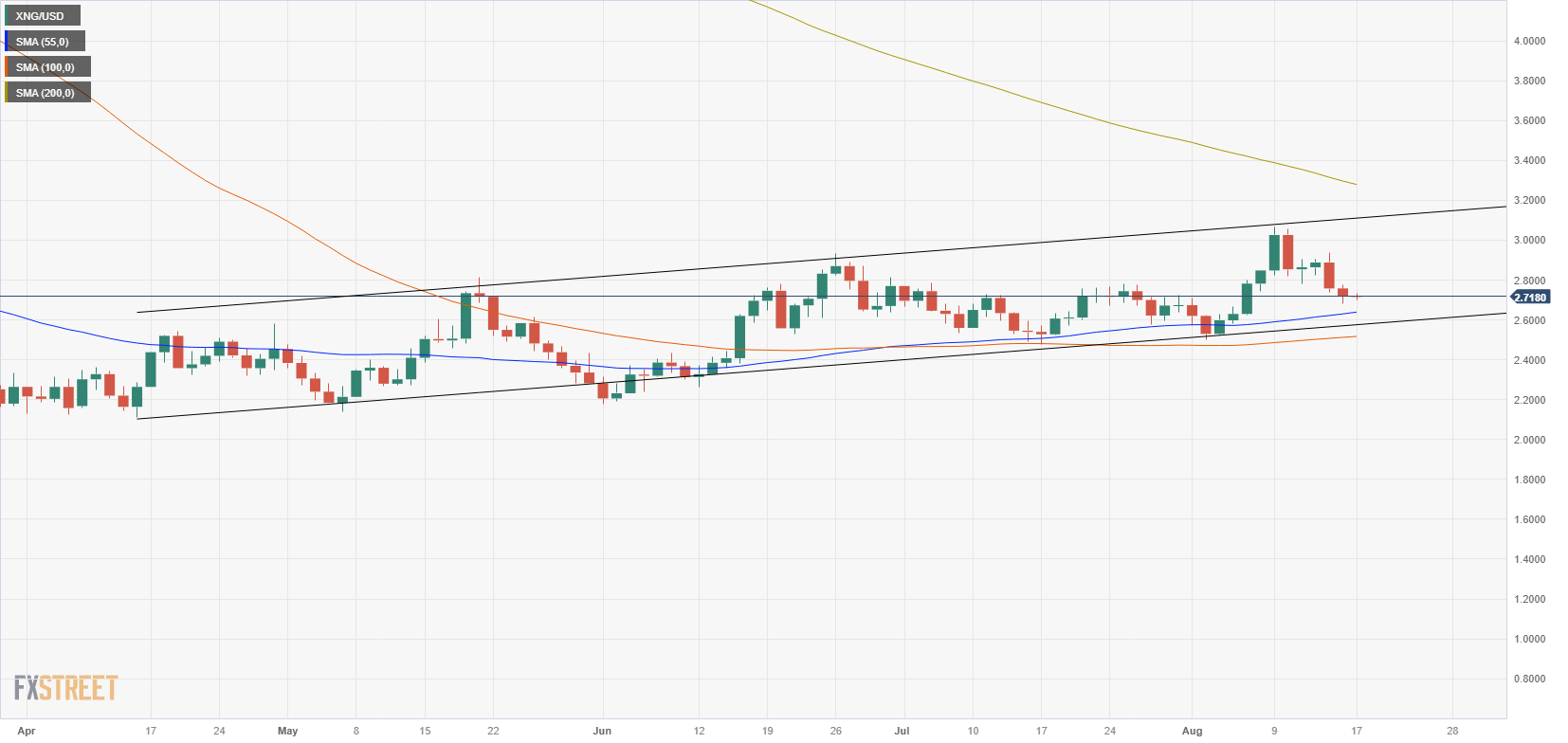
XNG/USD (Daily Chart)
Natural Gas FAQs
What fundamental factors drive the price of Natural Gas?
Supply and demand dynamics are a key factor influencing Natural Gas prices, and are themselves influenced by global economic growth, industrial activity, population growth, production levels, and inventories. The weather impacts Natural Gas prices because more Gas is used during cold winters and hot summers for heating and cooling. Competition from other energy sources impacts prices as consumers may switch to cheaper sources. Geopolitical events are factors as exemplified by the war in Ukraine. Government policies relating to extraction, transportation, and environmental issues also impact prices.
What are the main macroeconomic releases that impact on Natural Gas Prices?
The main economic release influencing Natural Gas prices is the weekly inventory bulletin from the Energy Information Administration (EIA), a US government agency that produces US gas market data. The EIA Gas bulletin usually comes out on Thursday at 14:30 GMT, a day after the EIA publishes its weekly Oil bulletin. Economic data from large consumers of Natural Gas can impact supply and demand, the largest of which include China, Germany and Japan. Natural Gas is primarily priced and traded in US Dollars, thus economic releases impacting the US Dollar are also factors.
How does the US Dollar influence Natural Gas prices?
The US Dollar is the world’s reserve currency and most commodities, including Natural Gas are priced and traded on international markets in US Dollars. As such, the value of the US Dollar is a factor in the price of Natural Gas, because if the Dollar strengthens it means less Dollars are required to buy the same volume of Gas (the price falls), and vice versa if USD strengthens.
Author

Filip Lagaart
FXStreet
Filip Lagaart is a former sales/trader with over 15 years of financial markets expertise under its belt.

















