Mexican Peso selloff deepens as Fed hawks drive USD/MXN toward 17.50
- USD/MXN hits two-month high as Dollar breaks above 101.
- Strong US PMIs reinforce expectations for additional Fed tightening.
- Banxico hold looms as Peso faces shrinking rate advantage.

The Mexican Peso extends its depreciation against the Greenback, as the USD/MXN pair rallies over 1.25% amid speculation that the Fed will raise rates more than once, with Fed officials leaning hawkish, underpinning the US Dollar. The exotic pair trades at 17.50, its highest level in nearly two months.
US Dollar surge, tightening bets overwhelm Mexican Peso ahead of Banxico decision
Broad US Dollar strength drives the USD/MXN price action. The Greenback rose over 0.57%, according to the US Dollar Index (DXY), which is up above 101.00, for the first time since late July.
Economic data in the US revealed that business activity in the manufacturing and services sector expanded in September, exceeding estimates and August’s numbers, according to S&P Global.
Speeches by Federal Reserve officials pushed investors to price in nearly 93 basis points of tightening towards the end of 2027.
On Tuesday, Boston Fed Susan Collins warned of elevated inflation risks and backed the rate increase. After her, Richmond Fed President Thomas Barkin said inflationary shocks could take some time.
Recently, Fed Governor Michael Barr noted that further rate hikes are likely needed to ensure a timely return to the 2% inflation target.
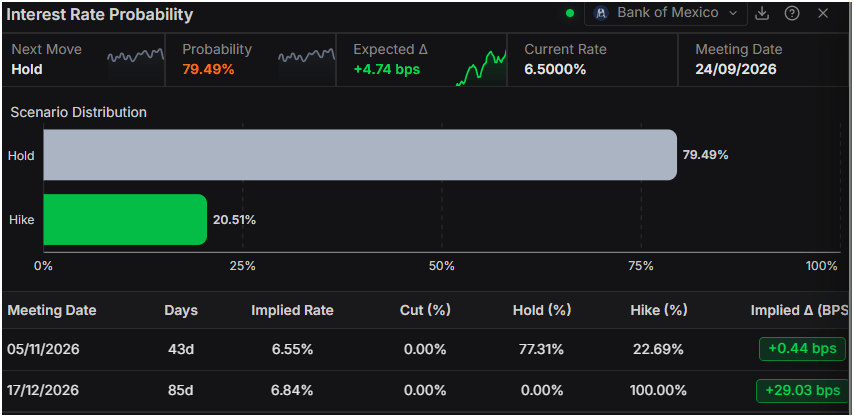
In Mexico, traders are bracing for the Bank of Mexico (Banxico) monetary policy decision on September 24. Money markets had priced in a 79% chance that Banxico would keep rates unchanged at 6.50%, revealed Prime Terminal.
Ahead, the US economic docket will feature US Initial Jobless Claims and Fed speaking.
USD/MXN Price Forecast: Technical Outlook
Given the backdrop, the USD/MXN continues to recover ground as the interest rate differential has reduced to its narrowest level since 2015. Further tightening by the Fed and Banxico holding rates steady suggests upside in the exotic pair.
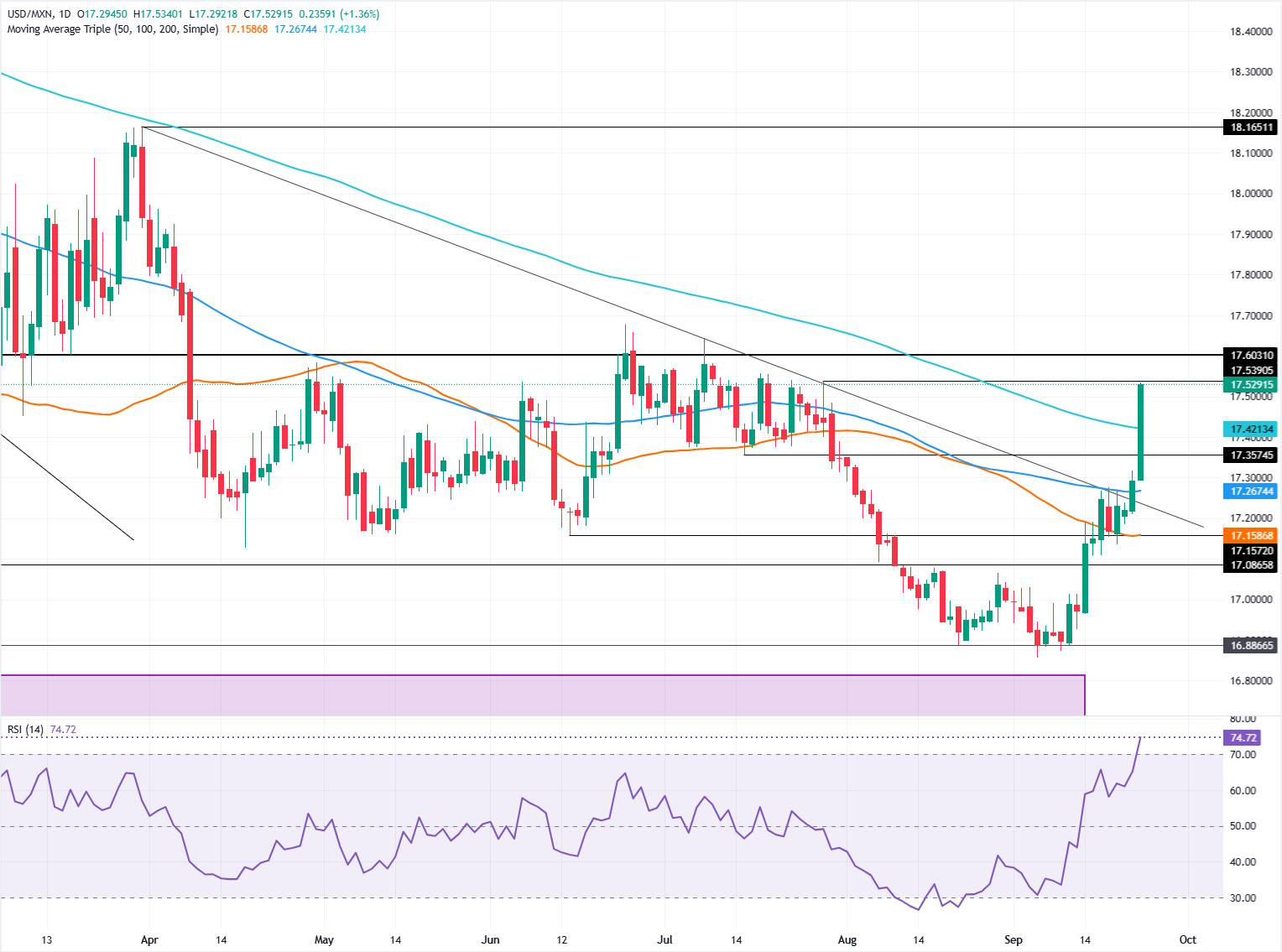
Price action shows that USD/MXN cleared the 200-day Simple Moving Average (SMA) at 17.42, immediately opening the door to challenge 17.50.
The Relative Strength Index (RSI) turned overbought for the first time since early August 2024. Therefore, further upside is seen, as the last time the index peaked above the 70 level, the USD/MXN exchange rate peaked at around 20.06.
If USD/MXN clears 17.50, this paves the way for further gains, with the 18.00 psychological level being up next. Above the next resistance is the March 31 high of 18.16, followed by the November 25, 2025, high at 18.53 and by the November 5 peak of 18.77.
On the flip side, the 200-day SMA is the first support at 17.42. Below is the 100-day SMA at 17.26, followed by the 50-day SMA at 17.15 and the 17.00 figure.
Mexican Peso FAQs
The Mexican Peso (MXN) is the most traded currency among its Latin American peers. Its value is broadly determined by the performance of the Mexican economy, the country’s central bank’s policy, the amount of foreign investment in the country and even the levels of remittances sent by Mexicans who live abroad, particularly in the United States. Geopolitical trends can also move MXN: for example, the process of nearshoring – or the decision by some firms to relocate manufacturing capacity and supply chains closer to their home countries – is also seen as a catalyst for the Mexican currency as the country is considered a key manufacturing hub in the American continent. Another catalyst for MXN is Oil prices as Mexico is a key exporter of the commodity.
The main objective of Mexico’s central bank, also known as Banxico, is to maintain inflation at low and stable levels (at or close to its target of 3%, the midpoint in a tolerance band of between 2% and 4%). To this end, the bank sets an appropriate level of interest rates. When inflation is too high, Banxico will attempt to tame it by raising interest rates, making it more expensive for households and businesses to borrow money, thus cooling demand and the overall economy. Higher interest rates are generally positive for the Mexican Peso (MXN) as they lead to higher yields, making the country a more attractive place for investors. On the contrary, lower interest rates tend to weaken MXN.
Macroeconomic data releases are key to assess the state of the economy and can have an impact on the Mexican Peso (MXN) valuation. A strong Mexican economy, based on high economic growth, low unemployment and high confidence is good for MXN. Not only does it attract more foreign investment but it may encourage the Bank of Mexico (Banxico) to increase interest rates, particularly if this strength comes together with elevated inflation. However, if economic data is weak, MXN is likely to depreciate.
As an emerging-market currency, the Mexican Peso (MXN) tends to strive during risk-on periods, or when investors perceive that broader market risks are low and thus are eager to engage with investments that carry a higher risk. Conversely, MXN tends to weaken at times of market turbulence or economic uncertainty as investors tend to sell higher-risk assets and flee to the more-stable safe havens.
Author

Christian Borjon Valencia
FXStreet
Markets analyst, news editor, and trading instructor with over 14 years of experience across FX, commodities, US equity indices, and global macro markets.