Mexican Peso recovers for three days in a row after risk appetite returns

Most recent article: Mexican Peso succumbs as crucial US inflation data looms
- The Mexican Peso is edging higher in key pairs, extending its three-day rally.
- Fears the US economy is entering a recession caused market turmoil last week, but these are subsiding, helping MXN.
- From a technical perspective, USD/MXN is correcting within a broadly uptrending market.
The Mexican Peso (MXN) makes marginal gains against key counterparts at the start of the new trading week amid the return of the risk appetite in the market.
Asian markets rose after being handed the baton from Wall Street’s rebound on Friday. The recovery stops the dramatic sell-off last week, sparked by fears of a recession in the US. These fears appear to be ebbing – a factor that is supporting the Peso.
At the time of writing, one US Dollar (USD) buys 18.83 Mexican Pesos, EUR/MXN trades at 20.58, and GBP/MXN at 24.03.
Mexican Peso recovers after market turmoil subsides
The Mexican Peso edges higher after posting three up days in a row in its most heavily traded pairs.
MXN is sensitive to market volatility and its recent recovery comes after fears of a US recession dissipated and investors regained their appetite for risk.
The most recent significant event for the Peso was the Banxico meeting last Thursday. This saw the central bank reducing its key interest rate by 0.25% to 10.75% in response to core inflation in Mexico declining from 4.05% to 4.00% in July. This contrasts with rising headline inflation – from 5.10% to 5.57% – although factors driving up the broader gauge are considered temporary.
The move had a positive effect on the Mexican Peso that ran counter to expectations. Usually, lower interest rates are negative for a currency as they reduce its attractiveness to foreign investors as a place to park capital, however, on this occasion the opposite was the case. The rate cut also came as a surprise to market participants.
That said, analysts believe demand for the Mexican Peso may be declining overall due to reduced carry-trade flows. The MXN has benefited from demand from carry traders using Yen-funded loans to purchase Pesos because of the high interest rates offered in Mexico. However, this could be less of a factor going forward.
“We doubt the exuberance over the Yen-funded carry trade will resume any time soon and lead the Peso to revisit its highs reached earlier this year,” says Giulia Bellicoso, Assistant Economist at Capital Economics.
In addition, Bellicoso adds that the Peso is now also “closer to what we think its fair value is.”
Technical Analysis: USD/MXN pulls back within uptrend
USD/MXN is falling within an upward channel on the 4-hour chart, suggesting it is in a corrective short-term down move within a longer-term uptrend.
USD/MXN 4-hour Chart
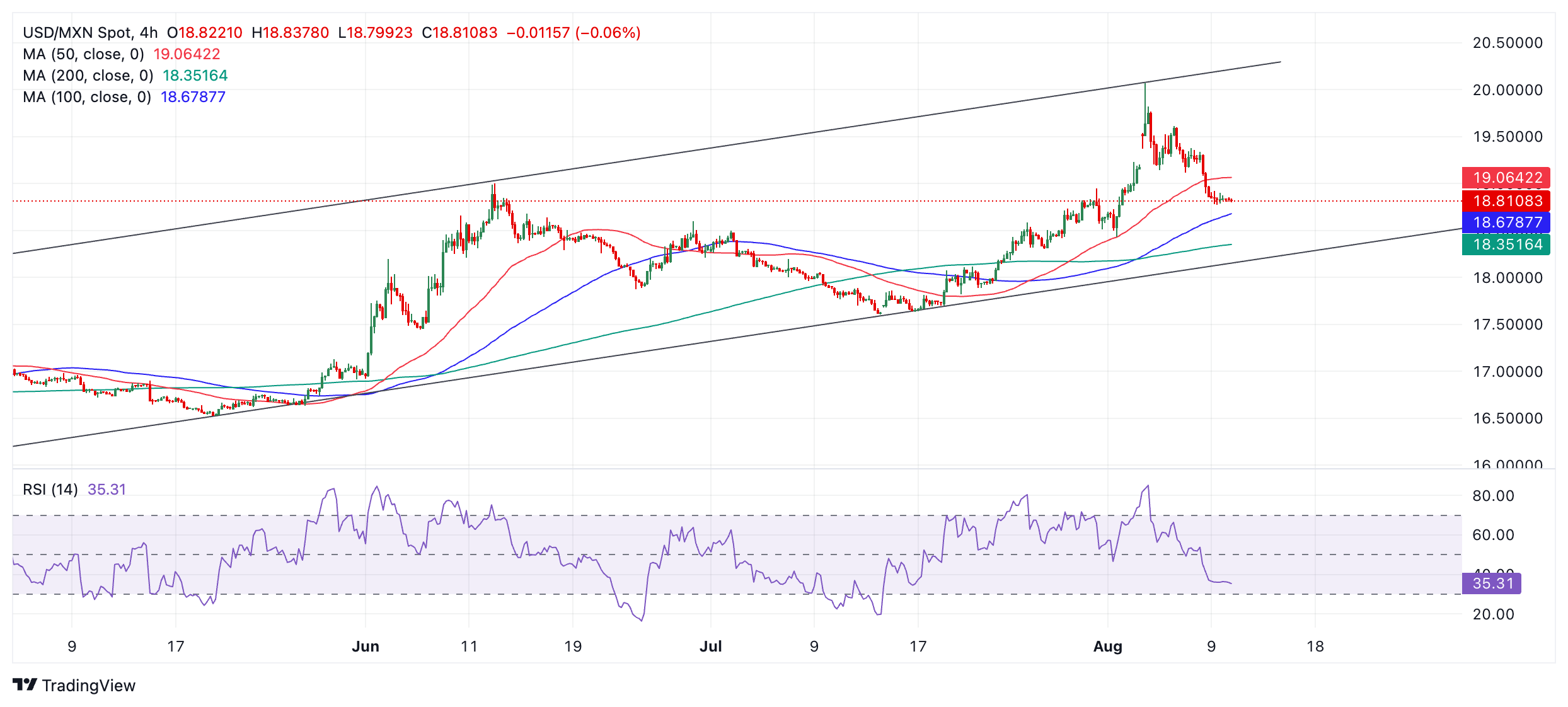
The decline is probably a correction of the broader bullish trend, which will eventually peter out before a recovery.
A break below Friday’s low of 18.77 would confirm more downside towards a target at 18.44 (August 1 low), followed by 18.35 and the 200-period Simple Moving Average (SMA). The lower channel line will likely provide solid support at roughly 18.30, too.
The Relative Strength Index (RSI) is nearing oversold but still above, further suggesting more declines are possible before the down move becomes overextended.
Mexican Peso FAQs
The Mexican Peso (MXN) is the most traded currency among its Latin American peers. Its value is broadly determined by the performance of the Mexican economy, the country’s central bank’s policy, the amount of foreign investment in the country and even the levels of remittances sent by Mexicans who live abroad, particularly in the United States. Geopolitical trends can also move MXN: for example, the process of nearshoring – or the decision by some firms to relocate manufacturing capacity and supply chains closer to their home countries – is also seen as a catalyst for the Mexican currency as the country is considered a key manufacturing hub in the American continent. Another catalyst for MXN is Oil prices as Mexico is a key exporter of the commodity.
The main objective of Mexico’s central bank, also known as Banxico, is to maintain inflation at low and stable levels (at or close to its target of 3%, the midpoint in a tolerance band of between 2% and 4%). To this end, the bank sets an appropriate level of interest rates. When inflation is too high, Banxico will attempt to tame it by raising interest rates, making it more expensive for households and businesses to borrow money, thus cooling demand and the overall economy. Higher interest rates are generally positive for the Mexican Peso (MXN) as they lead to higher yields, making the country a more attractive place for investors. On the contrary, lower interest rates tend to weaken MXN.
Macroeconomic data releases are key to assess the state of the economy and can have an impact on the Mexican Peso (MXN) valuation. A strong Mexican economy, based on high economic growth, low unemployment and high confidence is good for MXN. Not only does it attract more foreign investment but it may encourage the Bank of Mexico (Banxico) to increase interest rates, particularly if this strength comes together with elevated inflation. However, if economic data is weak, MXN is likely to depreciate.
As an emerging-market currency, the Mexican Peso (MXN) tends to strive during risk-on periods, or when investors perceive that broader market risks are low and thus are eager to engage with investments that carry a higher risk. Conversely, MXN tends to weaken at times of market turbulence or economic uncertainty as investors tend to sell higher-risk assets and flee to the more-stable safe havens.
Author

Joaquin Monfort
FXStreet
Joaquin Monfort is a financial writer and analyst with over 10 years experience writing about financial markets and alt data. He holds a degree in Anthropology from London University and a Diploma in Technical analysis.