|premium|

Memory chip rout sends NASDAQ 100 futures off a cliff

  • Memory chips and semiconductors sell off in premarket.
  • South Korea's SK Hynix refocuses away from HBM product lines.
NASDAQ 100 futures sank nearly 3% in Tuesday's premarket as high-flying memory chip stocks like Micron (MU) and Sandisk (SNDK) shed part of their recent rallies.

The culprit seems to be the Korean Composite Stock Index (KOSPI), which shunted 10% lower overnight. The KOSPI is dominated by Samsung Electronics and SK Hynix, two chipmakers that have both risen at an extraordinary pace over the past year due to spiking prices in the memory chip industry.

News emerged in South Korea on Tuesday that SK Hynix was switching some of its outlays from high-bandwidth memory (HBM) production toward traditional dynamic random access memory (DRAM) production.

The thought is that SK Hynix, one of the three largest players in the global memory chip industry, might be seeing emerging weakness in demand for HBM chips.

S&P 500 futures are also down 1.5% as Micron, Sandisk, Applied Materials (AMAT), Western Digital (WDC), CoreWeave (CRWV) and Lam Research (LRCX) have all sold off 7% to 8% in the premarket.

The VanEck Semiconductors ETF (SMH) sold off 6% in the premarket. Alphabet (GOOGL) is down another 2% in Tuesday's premarket after losing about 5% on Monday on news that two of its top AI researchers are leaving for competitors.
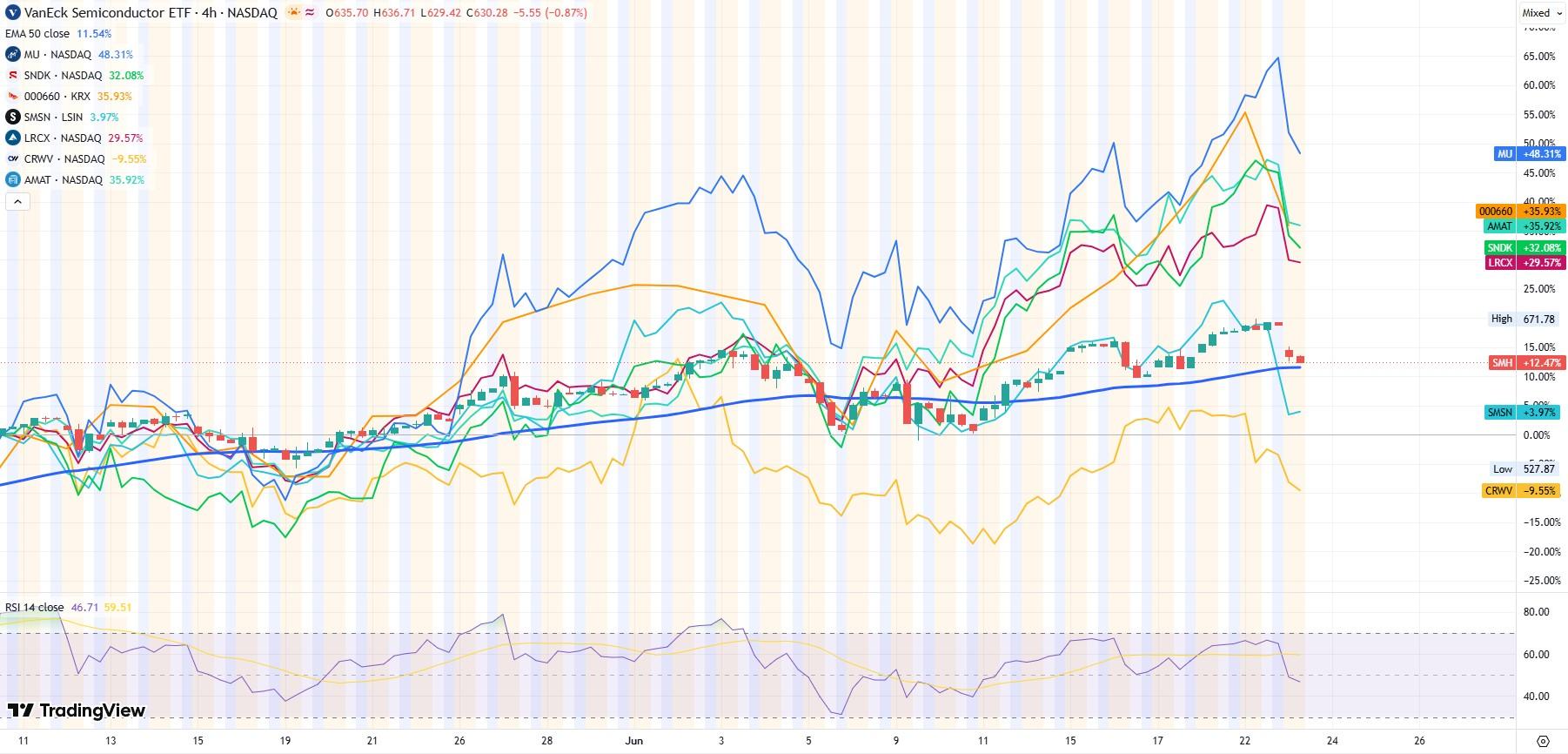
VanEck Semiconductors ETF
SMH VanEck Semiconductors ETF (candles) 1-hour chart with MU, SNDK, CRWV, SK Hynix, Samsung Electronics, AMAT, LRCX

Premium

You have reached your limit of 3 free articles for this month.

Start your subscription and get access to all our original articles.

Subscribe to PremiumSign In

Author

Clay Webster

Clay Webster

FXStreet

Clay Webster grew up in the US outside Buffalo, New York and Lancaster, Pennsylvania. He began investing after college following the 2008 financial crisis.


More from Clay Webster
Share:

Editor's Picks

GBP/USD extends losses toward 1.3200 on broad USD strength

GBP/USD declines toward 1.3200 in the second half of the day on Tuesday. Political uncertainty in the United Kingdom weighs on the British Pound, alongside weak business PMI data for June. Meanwhile, the US Dollar capitalizes on the risk-off mood and stronger-than-forecast PMI readings, making it difficult for the pair to find its footing.

EUR/USD falls to fresh 12-month low below 1.1400

EUR/USD comes under renewed selling pressure in the second half of the day on Tuesday and trades at its lowest level since June 2025 below 1.1400. Mixed PMI data from Germany and the Eurozone makes it difficult for the Euro to find demand, while the risk-averse market atmosphere and the upbeat PMI prints support the USD, forcing the pair to stay on the back foot.

Gold drops to nearly two-week low, tests $4,100

Gold (XAU/USD) turns south following Monday's rebound and trades deep in the red near $4,100 on Tuesday. Despite positive signals from US-Iran peace talks, widespread skepticism remains toward a final deal and weighs on the precious metal. In the meantime, the USD gathers strength on hawkish Fed expectations and drags XAU/USD lower.

Crypto Today: Bitcoin, Ethereum, XRP slide as capital outflows persist

The cryptocurrency market is experiencing broad-based declines on Tuesday, as Bitcoin retests support at $62,000, Ethereum extends losses toward $1,600, and Ripple remains anchored near the key $1.10 demand zone.

Will PCE inflation data fuel bets of early Fed rate hike?

Warsh’s hawkish debut sparks sharp repricing in Fed funds futures. Inflation is front and centre as September hike now seen likely. Will PCE report due Thursday, 12:30 GMT, support the hawkish bets?

Regime change: Inside Kevin Warsh's first move to make the Fed unreadable on purpose

The rate did not move. That was the least interesting thing about Kevin Warsh's first meeting in charge of the Fed. The FOMC held its benchmark at 3.50%-3.75% for the fourth straight meeting, exactly as priced, and then the new chair used his first press conference to dismantle the machinery the market has leaned on for a decade.















