Japanese Yen adds to intraday losses; USD/JPY jumps to 148.30 area amid broad-based USD strength
- The Japanese Yen continues losing ground against the USD and lifts USD/JPY to a one-week high.
- Diminishing odds for an immediate BoJ rate hike and the risk-on mood seem to undermine the JPY.
- Subdued USD price action might cap the pair ahead of the crucial FOMC/BoJ meetings this week.

The Japanese Yen (JPY) continues to lose ground against a broadly stronger US Dollar (USD) and pushes the USD/JPY pair to a fresh one-week top, around the 148.30 area during the early European session on Monday. The latest optimism over a trade deal between the US and the European Union (EU) remains supportive of the upbeat market mood and is seen undermining the safe-haven JPY. Apart from this, reduced bets for an immediate interest rate hike by the Bank of Japan (BoJ), amid signs of easing inflation in Japan and domestic political uncertainty, turn out to be another factor weighing on the JPY.
Meanwhile, Japan's trade deal with the US has removed economic uncertainty, suggesting that conditions for the BoJ policy normalization may start to fall in place again, though the expectations do little to impress the JPY bulls. The USD, on the other hand, benefits from the growing acceptance that the Federal Reserve (Fed) will keep interest rates elevated for an extended period amid a still resilient labor market and inflationary concerns. This further contributes to the USD/JPY pair's move higher for the third straight day and ahead of this week's key central bank events and US economic data risks.
Japanese Yen selling bias remains unabated amid reduced BoJ rate hike bets, risk-on mood
- News of a deal between the US and European Union on Sunday, and that US and Chinese officials are meeting again to extend the trade truce, add to the trade optimism ahead of the August 1 deadline. This, in turn, boosts investors' appetite for riskier assets and undermines demand for the safe-haven Japanese Yen at the start of a new week.
- Data released on Friday showed that consumer inflation in Japan's capital city, Tokyo, eased more than expected in July. Apart from this, rising political risks in Japan, especially after the ruling coalition's bruising defeat in the upper house election, might force the Bank of Japan to delay raising interest rates and keep the JPY bulls on the defensive.
- The US Dollar, on the other hand, preserves its gains registered over the past two days. This, in turn, assists the USD/JPY pair to attract buyers for the third straight day and climb above the 148.00 mark, or a one-week top during the Asian session. That said, a combination of factors might keep a lid on any further appreciating move for spot prices.
- Japan's trade deal with the US, announced last week, has reduced economic uncertainty and raised the possibility that the BoJ will resume its tightening cycle later this year, which, in turn, could act as a tailwind for the JPY. Traders might also opt to move to the sidelines ahead of this week's central bank event risks and key US macro releases.
- The Federal Reserve and the BoJ will announce their policy decisions on Wednesday and Thursday, respectively, and are widely expected to maintain the status quo. Investors, however, will look for cues about the future policy outlook, which, in turn, will play a key role in determining the next leg of directional move for the USD/JPY pair.
- Investors this week will also confront the release of important US macro data – the Advance Q2 GDP print on Wednesday, the Personal Consumption Expenditure (PCE) Price Index on Thursday, and the Nonfarm Payrolls report on Friday. This might further contribute to infuse volatility around the currency pair during the latter part of the week.
USD/JPY remains on track to retest last week's swing high, around the 148.65 region
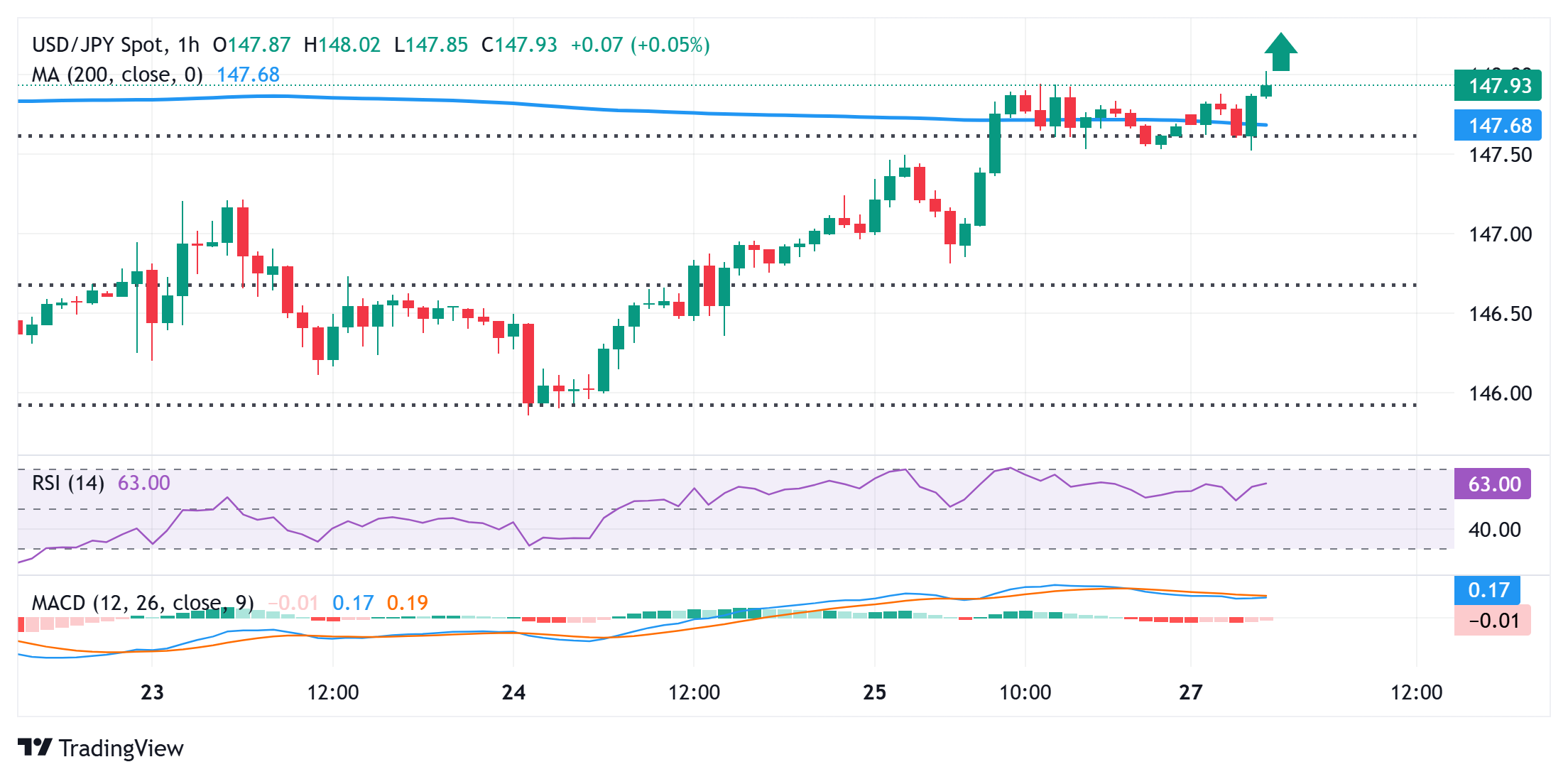
From a technical perspective, last week's bounce from the 50% retracement level of the July upswing and a subsequent strength beyond the 200-hour Simple Moving Average (SMA) could be seen as a key trigger for the USD/JPY bulls. This, along with positive oscillators on daily/hourly charts, suggests that the path of least resistance for spot prices is to the upside. A sustained move and acceptance above the 148.00 mark will reaffirm the constructive outlook, which, in turn, should pave the way for additional gains towards last week's swing high, around the 148.65 region. The momentum could extend further and allow the pair to make a fresh attempt towards conquering the 149.00 mark.
On the flip side, the 100-hour SMA, currently pegged around the 147.70-147.65 area, which now coincides with the 23.6% Fibo. retracement level could offer support to the USD/JPY pair. Any further slide could be seen as a buying opportunity near the 147.00 mark and remain limited near the 146.70-146.65 region, or the 38.2% Fibo. retracement level. Some follow-through selling below the 100-day SMA, currently pegged near the 146.55 area, could make spot prices vulnerable to retest sub-146.00 levels. This is closely followed by the 145.75 area (July 10 low), below which the currency pair could slide to the 145.20-145.15 region, or the 61.8% Fibo. retracement level, en route to the 145.00 psychological mark.
US Dollar FAQs
The US Dollar (USD) is the official currency of the United States of America, and the ‘de facto’ currency of a significant number of other countries where it is found in circulation alongside local notes. It is the most heavily traded currency in the world, accounting for over 88% of all global foreign exchange turnover, or an average of $6.6 trillion in transactions per day, according to data from 2022. Following the second world war, the USD took over from the British Pound as the world’s reserve currency. For most of its history, the US Dollar was backed by Gold, until the Bretton Woods Agreement in 1971 when the Gold Standard went away.
The most important single factor impacting on the value of the US Dollar is monetary policy, which is shaped by the Federal Reserve (Fed). The Fed has two mandates: to achieve price stability (control inflation) and foster full employment. Its primary tool to achieve these two goals is by adjusting interest rates. When prices are rising too quickly and inflation is above the Fed’s 2% target, the Fed will raise rates, which helps the USD value. When inflation falls below 2% or the Unemployment Rate is too high, the Fed may lower interest rates, which weighs on the Greenback.
In extreme situations, the Federal Reserve can also print more Dollars and enact quantitative easing (QE). QE is the process by which the Fed substantially increases the flow of credit in a stuck financial system. It is a non-standard policy measure used when credit has dried up because banks will not lend to each other (out of the fear of counterparty default). It is a last resort when simply lowering interest rates is unlikely to achieve the necessary result. It was the Fed’s weapon of choice to combat the credit crunch that occurred during the Great Financial Crisis in 2008. It involves the Fed printing more Dollars and using them to buy US government bonds predominantly from financial institutions. QE usually leads to a weaker US Dollar.
Quantitative tightening (QT) is the reverse process whereby the Federal Reserve stops buying bonds from financial institutions and does not reinvest the principal from the bonds it holds maturing in new purchases. It is usually positive for the US Dollar.
Author

Haresh Menghani
FXStreet
Haresh Menghani is a detail-oriented professional with 10+ years of extensive experience in analysing the global financial markets.

















