Japanese Yen extends consolidative price move against USD; downside seems limited
- The Japanese Yen struggles to lure buyers as BoJ uncertainty offsets Tokyo CPI print.
- Fiscal concerns and the upbeat market mood further undermine the safe-haven JPY.
- Dovish Fed expectations act as a headwind for the USD and cap gains for USD/JPY.

The Japanese Yen (JPY) trades with a mild negative bias against the rebounding US Dollar (USD) during the Asian session on Friday, though any meaningful depreciation seems elusive. Investors remain worried about Japan's deteriorating fiscal condition on the back of the government's massive economic package, which led to the recent spike in the Japanese government bond (JGB) yields. Apart from this, the upbeat market mood, bolstered by the prospects for lower US interest rates and hopes for a Russia-Ukraine peace deal, turns out to be a key factor undermining the safe-haven JPY.
Meanwhile, slightly higher than forecast Tokyo consumer inflation data, released earlier today, backs the case for further policy tightening by the Bank of Japan (BoJ). Furthermore, speculations that authorities could step in to stem further weakness in the domestic currency might hold back the JPY bears from placing aggressive bets. The USD, on the other hand, struggles to attract any meaningful buyers amid dovish Federal Reserve (Fed) expectations. This might contribute to capping the USD/JPY pair, warranting some caution before positioning for any meaningful appreciating move.
Japanese Yen bulls have the upper hand as Tokyo CPI reaffirms BoJ rate hike bets
- Government data released earlier this Friday showed that the headline Consumer Price Index (CPI) in Tokyo – Japan's capital city – rose 2.7% YoY in November, while a gauge, which excludes volatile fresh food prices, came in at 2.8% YoY. Moreover, the core CPI, excluding both fresh food and energy prices, held steady at 2.8% during the reported month.
- The data pointed to sticky inflation in Japan and backs the case for further policy tightening by the Bank of Japan (BoJ). The Japanese Yen, however, struggles to gain any meaningful traction as bulls remain on the sidelines amid growing concerns over Japan's worsening fiscal situation on the back of Prime Minister Sanae Takaichi’s pro-stimulus stance.
- In fact, reports on Thursday suggested that Japan's government plans to issue more new bonds to fund Takaichi’s economic package. Worries about the supply of new government debt had pushed longer-dated government bond yields to their highest in more than two decades earlier this month and contributed to the Japanese Yen's relative underperformance.
- Meanwhile, BoJ board member Asahi Noguchi signaled that the monetary tightening must follow an incremental path. This seems to have tempered market expectations for an imminent BoJ rate cut in December, which, along with a generally positive tone around the equity markets, is seen undermining the safe-haven JPY during the Asian session on Friday.
- In contrast, the recent comments from several Federal Reserve officials suggested that another interest rate cut in December is a live option. Adding to this, speculations about a dovish successor to Fed Chair Jerome Powell might cap the US Dollar (USD) recovery from a one-and-a-half-week low, touched on Thursday, and act as a headwind for the USD/JPY pair.
- On the geopolitical front, Russian President Vladimir Putin said that a revised US proposal could form the basis of a future Ukraine agreement. This follows US President Donald Trump's remarks, saying that a Ukraine–Russia agreement is very close. The optimism, in turn, further undermines the JPY's safe-haven status and lends support to the USD/JPY pair.
USD/JPY struggles to find acceptance above 100-hour SMA; not out of the woods yet
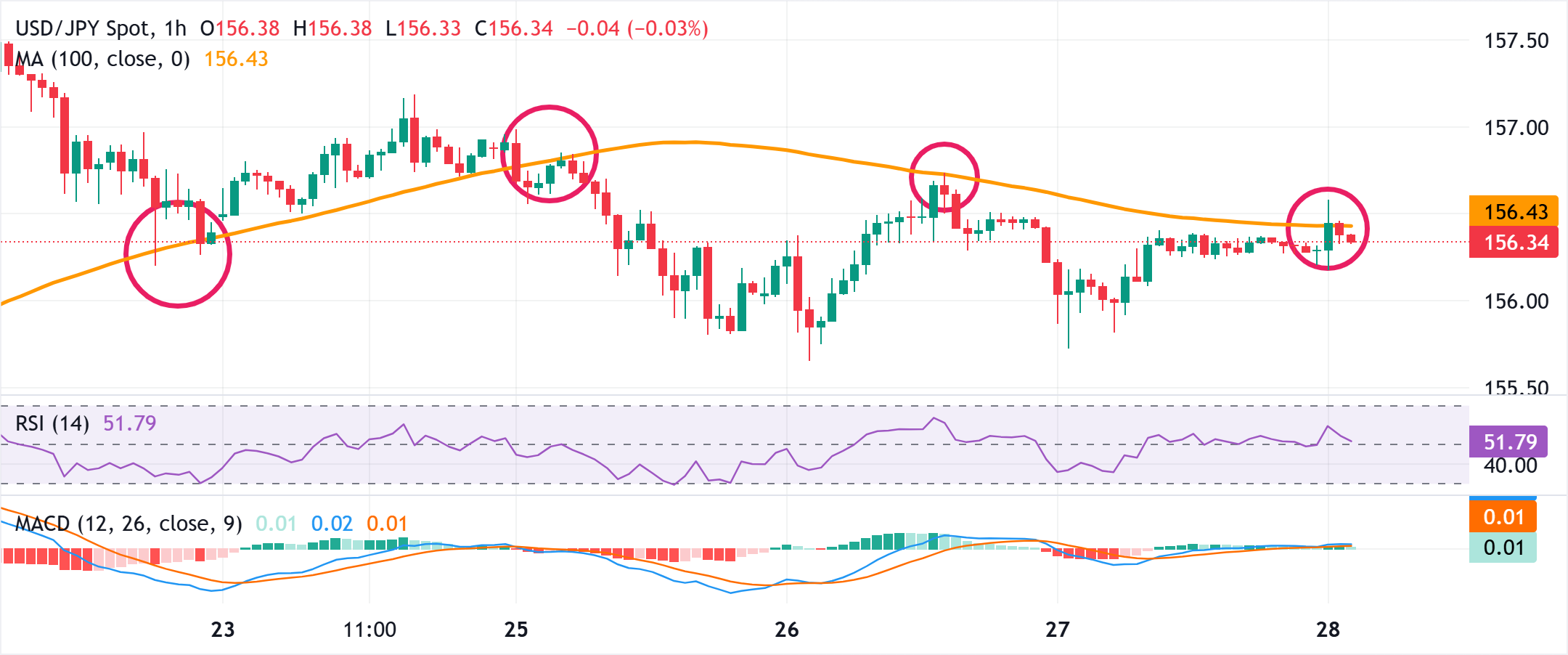
Spot prices need to find acceptance above the 100-hour Simple Moving Average (SMA), currently around the 156.45-156.50 area, to back the case for additional gains. The subsequent move up could allow the USD/JPY pair to reclaim the 157.00 mark and climb further toward the 157.45-157.50 intermediate hurdle en route to the 158.00 neighborhood, or the highest level since mid-January, touched last week.
On the flip side, the 156.00 round figure could protect the immediate downside ahead of the weekly swing low, around the 155.70-155.65 region. Some follow-through selling could make the USD/JPY pair vulnerable to test the 155.00 psychological mark. A convincing break below the latter will be seen as a fresh trigger for bearish traders and set the stage for an extension of a one-week-old downtrend.
Risk sentiment FAQs
In the world of financial jargon the two widely used terms “risk-on” and “risk off'' refer to the level of risk that investors are willing to stomach during the period referenced. In a “risk-on” market, investors are optimistic about the future and more willing to buy risky assets. In a “risk-off” market investors start to ‘play it safe’ because they are worried about the future, and therefore buy less risky assets that are more certain of bringing a return, even if it is relatively modest.
Typically, during periods of “risk-on”, stock markets will rise, most commodities – except Gold – will also gain in value, since they benefit from a positive growth outlook. The currencies of nations that are heavy commodity exporters strengthen because of increased demand, and Cryptocurrencies rise. In a “risk-off” market, Bonds go up – especially major government Bonds – Gold shines, and safe-haven currencies such as the Japanese Yen, Swiss Franc and US Dollar all benefit.
The Australian Dollar (AUD), the Canadian Dollar (CAD), the New Zealand Dollar (NZD) and minor FX like the Ruble (RUB) and the South African Rand (ZAR), all tend to rise in markets that are “risk-on”. This is because the economies of these currencies are heavily reliant on commodity exports for growth, and commodities tend to rise in price during risk-on periods. This is because investors foresee greater demand for raw materials in the future due to heightened economic activity.
The major currencies that tend to rise during periods of “risk-off” are the US Dollar (USD), the Japanese Yen (JPY) and the Swiss Franc (CHF). The US Dollar, because it is the world’s reserve currency, and because in times of crisis investors buy US government debt, which is seen as safe because the largest economy in the world is unlikely to default. The Yen, from increased demand for Japanese government bonds, because a high proportion are held by domestic investors who are unlikely to dump them – even in a crisis. The Swiss Franc, because strict Swiss banking laws offer investors enhanced capital protection.
Author

Haresh Menghani
FXStreet
Haresh Menghani is a detail-oriented professional with 10+ years of extensive experience in analysing the global financial markets.