Japanese Yen pares intraday losses against a weaker USD amid BoJ-Fed policy divergence
- The Japanese Yen kicks off the new week on a weaker note in the wake of domestic political turmoil.
- Japanese PM Shigeru Ishiba’s resignation could temporarily hinder the BoJ’s policy normalization path.
- Rising Fed rate cut bets weigh on the USD and keep a lid on any further gains for the USD/JPY pair.

The Japanese Yen (JPY) trims a part of heavy intraday losses against a weaker US Dollar (USD), though it sticks to a negative bias through the early European session amid hawkish Bank of Japan (BoJ) expectations. Against the backdrop of stronger-than-expected private spending data released on Friday, an upward revision of Japan's Q2 GDP growth figures reaffirmed market bets that the central bank will hike interest rates by the end of this year. This, along with the optimism over the recently signed US-Japan trade deal, helps limit deeper losses for the JPY.
The USD, on the other hand, struggles to attract any meaningful buyers amid expectations for a more aggressive policy easing by the Federal Reserve (Fed), bolstered by Friday's disappointing US Nonfarm Payrolls (NFP) report. This further contributes to the USD/JPY pair's intraday pullback from a technically significant 200-day Simple Moving Average (SMA). Meanwhile, Japan's Prime Minister Shigeru Ishiba announced his resignation over the weekend, which adds a layer of uncertainty over the likely timing for the next BoJ rate hike and might cap the JPY.
Japanese Yen draws support from a broadly weaker USD and BoJ rate hike bets
- Prime Minister Shigeru Ishiba announced his resignation on Sunday and instructed his Liberal Democratic Party (LDP) to hold an emergency leadership race. This adds a layer of uncertainty, which may temporarily hinder the Bank of Japan from normalising policy and weighs heavily on the Japanese Yen at the start of a new week.
- On the economic data front, the Cabinet Office reported this Monday that Japan's economy expanded at an annualised 2.2% rate in the April-June period from the previous quarter, much faster than the initial reading of 1.0% growth. On a quarterly basis, GDP grew 0.5% compared to a median forecast and the estimate of a 0.3% rise.
- This comes on top of the upbeat data on Friday, which showed that real wages in Japan turned positive for the first time in seven months and a further rise in household spending. This keeps hopes alive for a BoJ rate hike by the end of this year, which might hold back the JPY bears from placing aggressive bets and help limit losses.
- From the US, the closely-watched Nonfarm Payrolls report showed on Friday that the economy added just 22K jobs in August and missed expectations by a big margin. Moreover, revisions to earlier prints revealed the economy lost 13K jobs in June, marking the first monthly decline since December 2020 and pointing to a softening US labor market.
- Additional details revealed that the US Unemployment Rate edged higher to 4.3% from 4.2% in July, as anticipated, while the Labor Force Participation Rate ticked up to 62.3% from 62.2%. Finally, annual wage inflation, as measured by the change in the Average Hourly Earnings, declined to the 3.7% YoY rate from the 3.9% previous.
- The data cemented bets for a rate cut by the Federal Reserve in September and also opened the door for more aggressive policy easing. In fact, traders are now pricing in a small possibility of a jumbo interest rate cut later this month and expect that the US central bank could lower borrowing costs three times by the end of this year.
- The speculations caused a slump in the US Treasury bond yields and favor the US Dollar bears, which should keep a lid on any further appreciating move for the USD/JPY pair. The focus now shifts to the US inflation figures – the Producer Price Index (PPI) and the Consumer Price Index (CPI) on Wednesday and Thursday, respectively.
USD/JPY fails near 200-day SMA hurdle; 146.80-146.70 holds the key for bulls
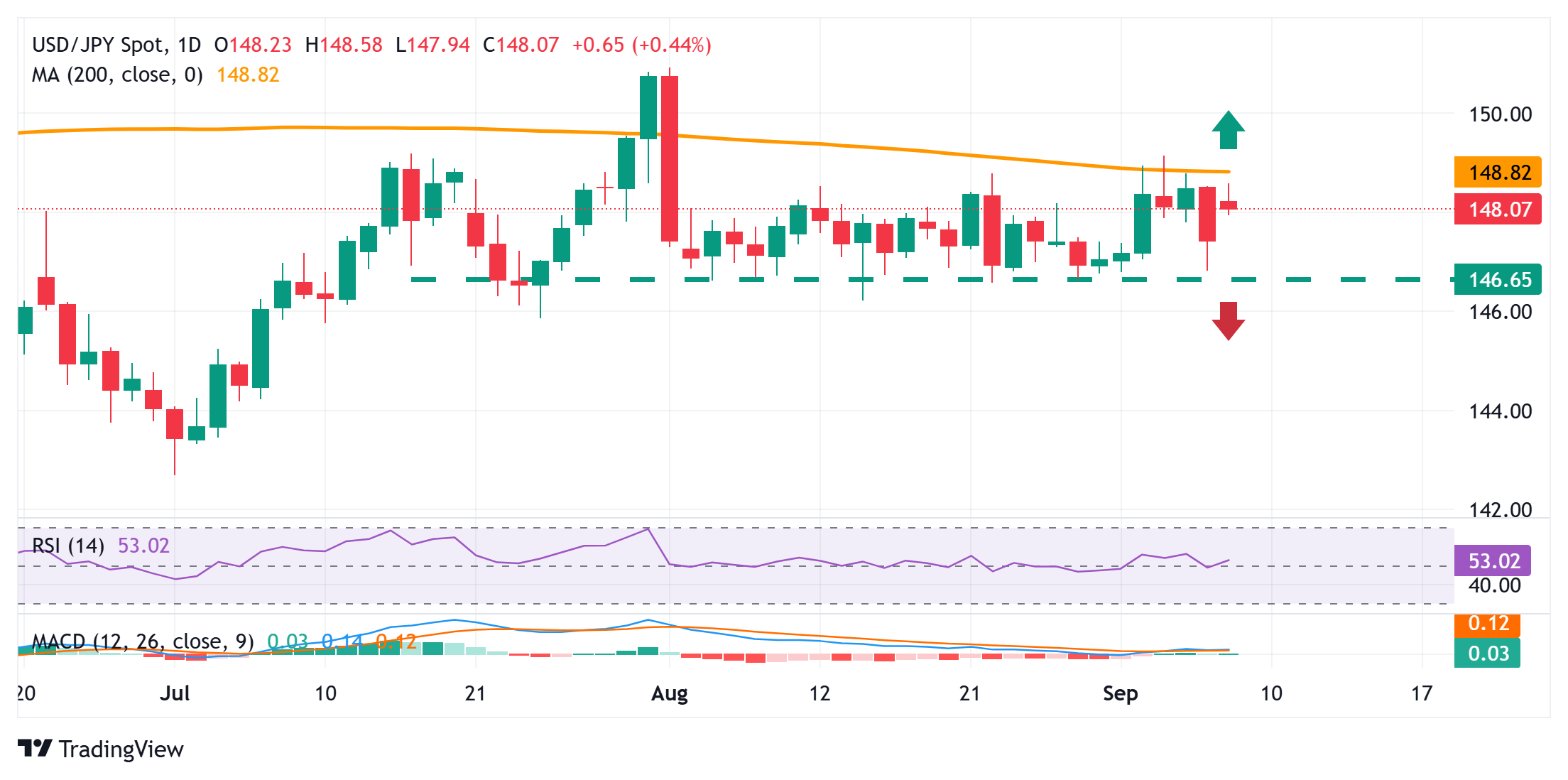
From a technical perspective, the intraday move higher stalls near the very important 200-day Simple Moving Average (SMA) barrier, currently pegged near the 148.75 region. This is closely followed by the 149.00 round figure and the 149.20 area, or a one-month high touched last week. The latter represents the 61.8% Fibonacci retracement level of the decline from the August swing high, which, if cleared decisively, would be seen as a fresh trigger for the USD/JPY bulls. Spot prices might then aim to reclaim the 150.00 psychological mark and extend the momentum further towards challenging the August monthly swing high, around the 151.00 neighborhood.
On the flip side, weakness below the 148.00 round figure could attract some dip-buyers near the 147.45-147.40 region. This should limit the downside for the USD/JPY pair near the 147.00 mark. Some follow-through selling below the 146.80-146.70 strong horizontal support would shift the near-term bias in favor of bearish traders and expose the August swing low, around the 146.20 region, before spot prices eventually drop to the 146.00 mark.
Fed FAQs
Monetary policy in the US is shaped by the Federal Reserve (Fed). The Fed has two mandates: to achieve price stability and foster full employment. Its primary tool to achieve these goals is by adjusting interest rates. When prices are rising too quickly and inflation is above the Fed’s 2% target, it raises interest rates, increasing borrowing costs throughout the economy. This results in a stronger US Dollar (USD) as it makes the US a more attractive place for international investors to park their money. When inflation falls below 2% or the Unemployment Rate is too high, the Fed may lower interest rates to encourage borrowing, which weighs on the Greenback.
The Federal Reserve (Fed) holds eight policy meetings a year, where the Federal Open Market Committee (FOMC) assesses economic conditions and makes monetary policy decisions. The FOMC is attended by twelve Fed officials – the seven members of the Board of Governors, the president of the Federal Reserve Bank of New York, and four of the remaining eleven regional Reserve Bank presidents, who serve one-year terms on a rotating basis.
In extreme situations, the Federal Reserve may resort to a policy named Quantitative Easing (QE). QE is the process by which the Fed substantially increases the flow of credit in a stuck financial system. It is a non-standard policy measure used during crises or when inflation is extremely low. It was the Fed’s weapon of choice during the Great Financial Crisis in 2008. It involves the Fed printing more Dollars and using them to buy high grade bonds from financial institutions. QE usually weakens the US Dollar.
Quantitative tightening (QT) is the reverse process of QE, whereby the Federal Reserve stops buying bonds from financial institutions and does not reinvest the principal from the bonds it holds maturing, to purchase new bonds. It is usually positive for the value of the US Dollar.
Author

Haresh Menghani
FXStreet
Haresh Menghani is a detail-oriented professional with 10+ years of extensive experience in analysing the global financial markets.














