Intervention buys the Japanese Yen less ground every time
- USD/JPY trades near 158.50 after tagging 160.00 in Asian hours.
- Japan's 10-year government bond yield touched 3%, a first since 1996.
- July's coordinated defence cost above $100 billion and has nearly unwound.

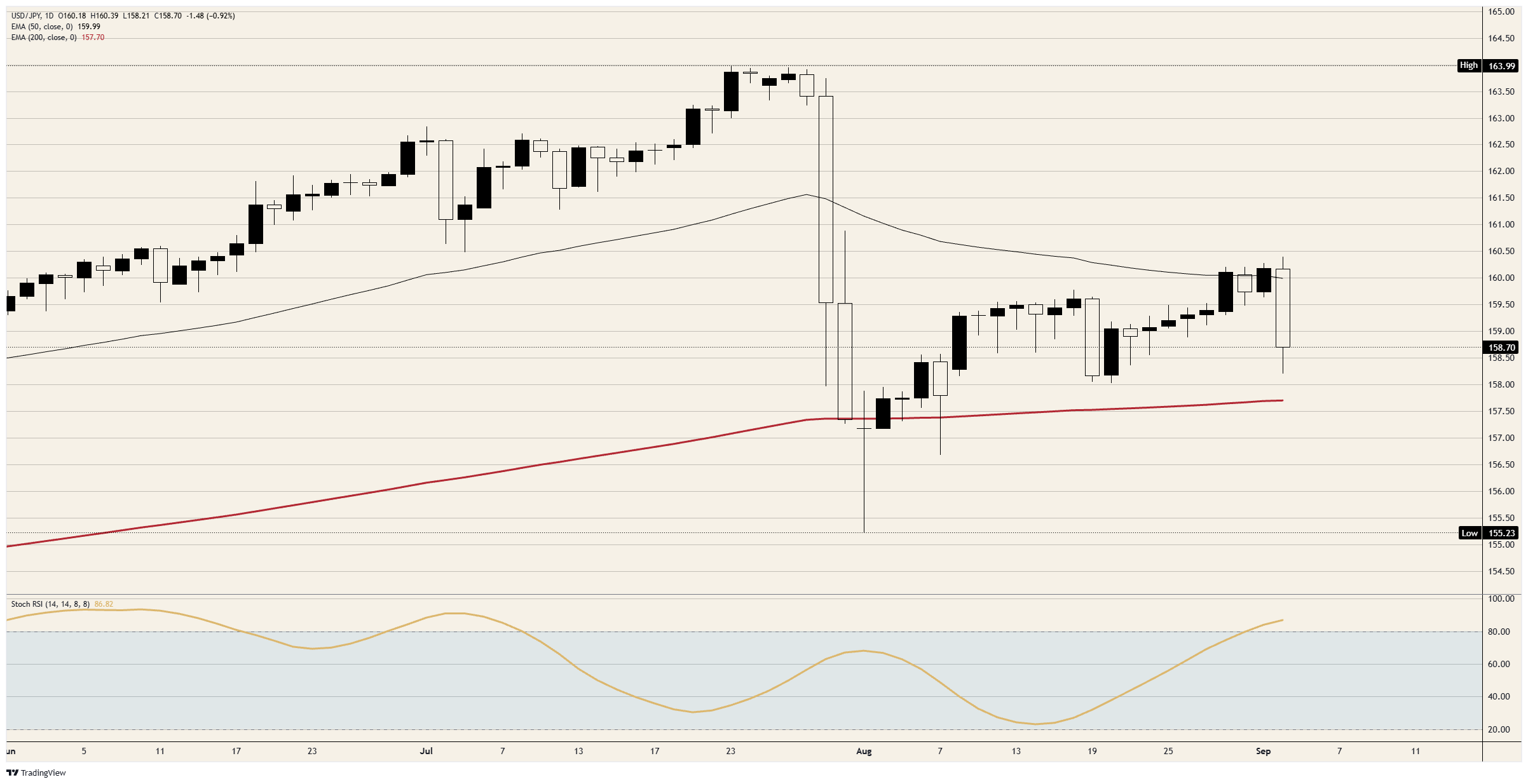
The Yen had its best session in weeks on Wednesday and it still looks like a losing position. USD/JPY printed just above 160.00 in Asian hours, the highest since the last days of July, then reversed more than two Yen to trade near 158.50 on nothing more concrete than a meeting readout and renewed intervention chatter. The 158.50 shelf gave way by roughly thirty pips before the pair reclaimed it.
What the deterrent costs now
Six weeks ago Tokyo and Washington ran the first joint Yen-buying operation since 1998, and the invoice was enormous. Reported Japanese selling ran near $60 billion on the Thursday and $25 billion on the Friday, with a further tranche the following Monday and an American leg sized in the region of $5 to $10 billion. The pair fell from close to 164.00 to a low near 155.25.
That is roughly nine Yen for more than $100 billion of reserves, and five weeks later the tape was back above 160.00 with almost all of it given away. Wednesday's two-Yen drop cost nothing at all, arriving on a readout of a meeting between Japan's finance minister and the US Treasury Secretary in which both sides agreed that orderly moves matter. The deterrent is getting cheaper and smaller at the same time, which is what happens when a market stops trading a level and starts trading a speed limit.
Firepower is not the binding constraint, which is the part the market has correctly worked out. Tokyo secured access to a Federal Reserve facility that lets it raise Dollar liquidity against Treasury collateral rather than selling the bonds outright, so the reserve position is not the ceiling on how often it can act. What limits the defence is that every operation sells into a fundamental picture that refills the trade within weeks. Ammunition is abundant. Durability is the missing ingredient.
The differential is being set in the bond market
The 10-year Japanese government bond yield reached 3% this week for the first time since 1996, and on any conventional reading that should be the Yen's rescue. It is not, because the move is being driven by an expansionary fiscal programme and the debt service arithmetic that comes with it, rather than by expectations of tighter policy. Bond investors are pricing supply. Currency investors are pricing the same thing and reaching the opposite conclusion.
The one lever that genuinely changes the carry is the September 18 Bank of Japan decision, and the signals point one way. The Governor has flagged that upside price risks deserve more weight, Washington has been openly pressing for a move, and imported inflation is running through an energy bill the conflict keeps inflating. Even a quarter point leaves the gap to a Federal Reserve priced around two thirds for a hike on September 16 more than two and a half percentage points wide.
The American labour week decides the retest
Thursday delivers initial jobless claims at 12:30 GMT with a 205K consensus against 203K, and the Institute for Supply Management (ISM) services Purchasing Managers Index (PMI) at 14:00 GMT, seen at 54.3 against 54.1 with prices paid last at 70.3. Wednesday's private payrolls miss at 38K against a 47K consensus did not dent the Dollar, which is the clearest evidence available that this market is trading the inflation leg of the mandate rather than the employment leg.
Friday's nonfarm payrolls at 12:30 GMT carry a 58K consensus against a prior reading of 23K jobs lost, with unemployment seen at 4.1% and average hourly earnings at 0.3% on the month. A firm print puts the pair back at 160.00 inside a fortnight of the Bank of Japan meeting, and it does so from a starting level the authorities have already described as disorderly once this summer. That is the setup worth watching, because it forces a decision from Tokyo before the policy tool arrives. Two Federal Reserve officials speak on Thursday, at 12:30 and 19:00 GMT, and either one can move the front end of the American curve far enough to matter here.
Levels and bias
Resistance: The 160.00 handle carries the 50-day Exponential Moving Average (EMA) almost exactly and doubles as the zone that draws official comment, so the first test above it is a policy event rather than a technical one. Beyond that, 160.50 is the nearest clean level, and the late-July peak near 164.00 is the only structure left above it.
Support: The 158.50 area is the floor that matters and it held on a retest Wednesday, with 158.00 beneath it. The 200-day EMA near 157.50 is the level a genuine trend change would need to break, and the intervention low near 155.25 sits well below anything the tape is currently negotiating.
Bias: Bullish while 158.50 holds. The Stochastic Relative Strength Index (Stoch RSI) near 87 argues the upside is stretched in the short run, and it should be, because the rate gap does the work here and momentum readings do not. Official action caps this pair rather than reversing it, and a daily close beneath 158.00 is the only thing that would change that reading.
USD/JPY daily chart
Japanese Yen FAQs
The Japanese Yen (JPY) is one of the world’s most traded currencies. Its value is broadly determined by the performance of the Japanese economy, but more specifically by the Bank of Japan’s policy, the differential between Japanese and US bond yields, or risk sentiment among traders, among other factors.
One of the Bank of Japan’s mandates is currency control, so its moves are key for the Yen. The BoJ has directly intervened in currency markets sometimes, generally to lower the value of the Yen, although it refrains from doing it often due to political concerns of its main trading partners. The BoJ ultra-loose monetary policy between 2013 and 2024 caused the Yen to depreciate against its main currency peers due to an increasing policy divergence between the Bank of Japan and other main central banks. More recently, the gradually unwinding of this ultra-loose policy has given some support to the Yen.
Over the last decade, the BoJ’s stance of sticking to ultra-loose monetary policy has led to a widening policy divergence with other central banks, particularly with the US Federal Reserve. This supported a widening of the differential between the 10-year US and Japanese bonds, which favored the US Dollar against the Japanese Yen. The BoJ decision in 2024 to gradually abandon the ultra-loose policy, coupled with interest-rate cuts in other major central banks, is narrowing this differential.
The Japanese Yen is often seen as a safe-haven investment. This means that in times of market stress, investors are more likely to put their money in the Japanese currency due to its supposed reliability and stability. Turbulent times are likely to strengthen the Yen’s value against other currencies seen as more risky to invest in.
Author

Joshua Gibson
FXStreet
Joshua joins the FXStreet team as an Economics and Finance double major from Vancouver Island University with twelve years' experience as an independent trader focusing on technical analysis.
















