Indian Rupee hits fresh all-time lows as oil prices rise further
- The Indian Rupee declines further against the US Dollar as oil prices extend their rally.
- FIIs turned out to be net buyers in the Indian stock market in the last two trading days.
- Traders expect the Fed to deliver at least one interest rate hike this year.

The Indian Rupee (INR) extends its over-a-week-long downfall against the US Dollar (USD) at the start of the week. The USD/INR pair explores the uncharted territory and posts a fresh all-time high at 96.33, as a fresh upside move in oil prices has weakened the Indian Rupee further.
As of writing, the WTI Oil price is up almost 1.66% to near $102.60. Currencies from economies, such as India, which rely heavily on oil imports to meet their energy needs, tend to underperform in a high-oil-price environment.
Fears of US-Iran war resumption boost oil prices
Over the weekend, United States (US) President Donald Trump threatened consequences against Iran, through a post on Truth Social, if the nation fails to reach a deal soon.
“For Iran, the Clock is Ticking, and they better get moving, FAST, or there won’t be anything left of them. TIME IS OF THE ESSENCE!” Trump wrote.
Negotiations between the US and Iran were stalled before US President Trump’s visit to Beijing, as Trump dismissed Tehran’s counterdemands, calling them “totally unacceptable”. In response, Iran's foreign ministry spokesperson Esmaeil Baghaei said that the proposal to the US was not “excessive”, and Washington continues to have “unreasonable demands”.
Meanwhile, a report from the New York Times (NYT) has shown that the US and Israel are preparing for coordinated attacks against Iran as soon as next week, according to The Times of Israel.
FIIs increase stake in Indian stock market in last two trading days
According to the data published on the NSE, Foreign Institutional Investors (FIIs) remained net buyers in the Indian stock market for the second straight trading day on Friday. Overseas investors infused an investment worth Rs. 1,329.17 crore on Friday. On Thursday, FIIs poured investment worth Rs. 187.46 crore.
Though there seems to be a slight improvement in FIIs’ sentiment towards the Indian equity market, the overall sentiment is still uncertain amid concerns over India Inc.’s earnings projections due to higher oil prices.
Before Thursday, FIIs remained net sellers for seven trading days in a row, and the average selling was Rs. 4,144.01 crore.
FOMC minutes come under spotlight
This week, Investors will pay close attention to the Federal Open Market Committee (FOMC) minutes of the April policy meeting, which will be published on Wednesday. The FOMC minutes will provide fresh cues regarding the Federal Reserve's (Fed) monetary policy outlook.
According to the CME FedWatch tool, the odds of the Fed delivering at least one interest rate hike this year are 53.7%, while the rest favor the central bank maintaining the status quo. This is a sharp turnaround from two interest rate cuts anticipated before the onset of the war.
Traders have priced out dovish Fed bets as oil prices have pushed the US inflation higher. The US Consumer Price Index (CPI) data showed last week that the headline inflation accelerated to 3.8% Year-on-Year (YoY) in April from 3.3% in March.
Technical Analysis: USD/INR remains above key 20-day EMA
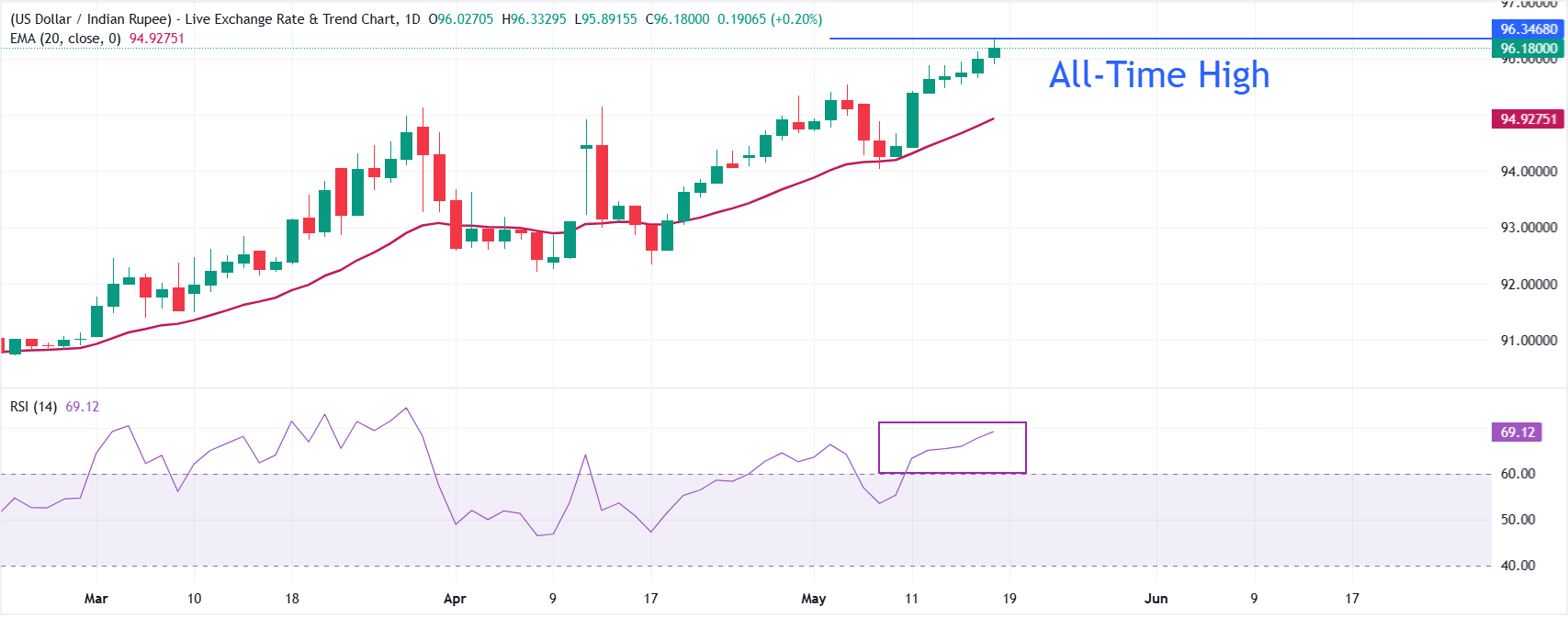
USD/INR jumps to near 96.33 at the start of the week. The pair maintains a clear bullish near-term bias, as it holds well above the 20-day Exponential Moving Average (EMA) at 94.93.
The strong advance has pushed the 14-day Relative Strength Index close to the overbought band near 69, suggesting firm upward momentum, though the steep run-up hints that upside could become more constrained if buyers lose intensity.
On the downside, immediate support is 96.00, with a deeper corrective floor emerging at the 20-day EMA around 94.93, where trend-following demand is likely to reappear on dips. As long as USD/INR defends these supports on closing bases, the broader bullish structure remains intact despite growing risks of consolidation after the recent sharp climb. Looking up, the pair could extend its advance towards 97.00.
(The technical analysis of this story was written with the help of an AI tool.)
Indian economy FAQs
The Indian economy has averaged a growth rate of 6.13% between 2006 and 2023, which makes it one of the fastest growing in the world. India’s high growth has attracted a lot of foreign investment. This includes Foreign Direct Investment (FDI) into physical projects and Foreign Indirect Investment (FII) by foreign funds into Indian financial markets. The greater the level of investment, the higher the demand for the Rupee (INR). Fluctuations in Dollar-demand from Indian importers also impact INR.
India has to import a great deal of its Oil and gasoline so the price of Oil can have a direct impact on the Rupee. Oil is mostly traded in US Dollars (USD) on international markets so if the price of Oil rises, aggregate demand for USD increases and Indian importers have to sell more Rupees to meet that demand, which is depreciative for the Rupee.
Inflation has a complex effect on the Rupee. Ultimately it indicates an increase in money supply which reduces the Rupee’s overall value. Yet if it rises above the Reserve Bank of India’s (RBI) 4% target, the RBI will raise interest rates to bring it down by reducing credit. Higher interest rates, especially real rates (the difference between interest rates and inflation) strengthen the Rupee. They make India a more profitable place for international investors to park their money. A fall in inflation can be supportive of the Rupee. At the same time lower interest rates can have a depreciatory effect on the Rupee.
India has run a trade deficit for most of its recent history, indicating its imports outweigh its exports. Since the majority of international trade takes place in US Dollars, there are times – due to seasonal demand or order glut – where the high volume of imports leads to significant US Dollar- demand. During these periods the Rupee can weaken as it is heavily sold to meet the demand for Dollars. When markets experience increased volatility, the demand for US Dollars can also shoot up with a similarly negative effect on the Rupee.
Author

Sagar Dua
FXStreet
Sagar Dua is associated with the financial markets from his college days. Along with pursuing post-graduation in Commerce in 2014, he started his markets training with chart analysis.