Indian Rupee slides to two-week low amid surging US Treasury Yields
- The Indian Rupee falls sharply against the US Dollar as surging US bond yields diminish the appeal of risky currencies.
- Investors await the US ADP Employment Change, ISM Manufacturing PMI, and the NFP data for June.
- Lower oil prices will likely limit the Indian Rupee’s downside.

The Indian Rupee (INR) trades sharply lower against the US Dollar (USD) on Wednesday, with the USD/INR pair reclaiming the two-week high near 95.25. The pair jumps higher as stronger United States (US) Treasury Yields have strengthened the US Dollar and have diminished the appeal of risk-sensitive currencies.
During press time, 10-year US Treasury Yields trade almost 0.3% higher to near 4.47%. On Tuesday, US bond yields surged a little over 2%, following strong US JOLTS Job Openings data for May. The US Dollar Index (DXY), which tracks the Greenback’s value against six major currencies, is up 0.2% to near 101.37.
On Tuesday, the US Bureau of Labor Statistics reported that employers posted 7.594 million fresh jobs, higher than the estimated 7.3 million and the previous reading of 7.585 million.
Meanwhile, the Indian central bank likely intervened in the foreign exchange market to support the rupee on Wednesday, according to Reuters.
Investors keenly await US NFP data
This week, the major trigger for USD/INR will be the US Nonfarm Payrolls (NFP) data for June, which will be released on Thursday. The significance of the US official employment data over the Federal Reserve’s (Fed) interest rate expectations is expected to be high, as the latest remarks from Fed Chair Kevin Warsh showed that he would refrain from delivering forward-looking guidance in the current policy conjuncture.
Currently, the CME FedWatch tool shows an over 82% chance that the Fed will deliver at least one interest rate hike this year.
The US NFP report is expected to show that the economy created 110K fresh jobs, lower than 172K in May. The Unemployment Rate is seen remaining steady at 4.3%.
In Wednesday’s session, investors will focus on the US ADP Employment Change and the ISM Manufacturing PMI data for June, which will be released during the North American session.
According to estimates, the US private sector created 113K fresh jobs, slightly lower than 122K in May. The ISM Manufacturing PMI is expected to remain steady at 54.0.
Investors await fresh cues regarding Hormuz future
The MCX Crude Oil contract expiring on July 20 remains close to its lowest level in months at around 6,500, as energy flows through the Strait of Hormuz, a critical chokepoint to almost one-fifth of global energy supply, have increased. However, Iran’s multiple attempts for global recognition of its authority near the chokepoint have renewed concerns over energy supply disruption.
On Tuesday, negotiation teams from the US and Iran were scheduled to meet in Oman to discuss the Hormuz situation. However, the meeting didn’t take place as Washington refused to have direct talks with Iran, citing that it would only meet through mediators despite landing in Oman.
Technical Analysis: USD/INR eyes Descending Triangle breakout
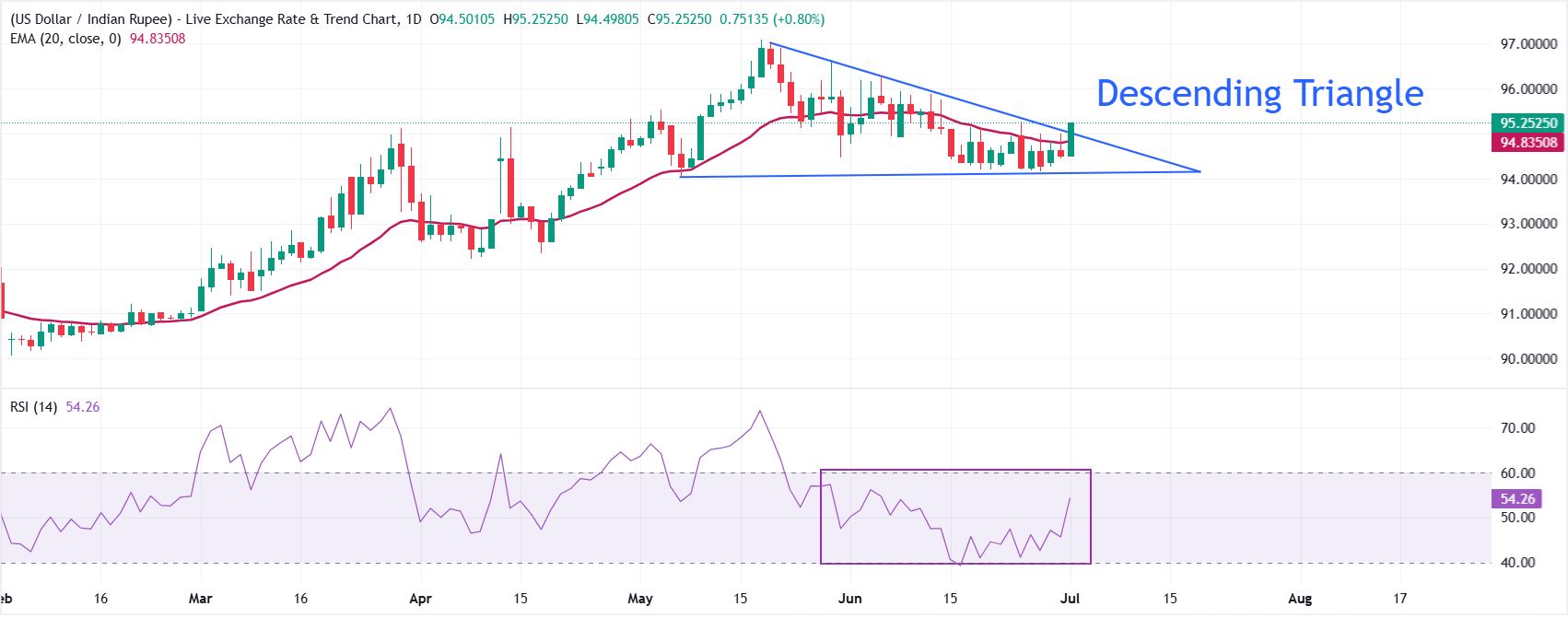
USD/INR jumps to near 95.16, holding a mild bullish bias as spot recovers above the 20-day exponential moving average (EMA) at roughly 94.83. The recent recovery off the mid-94.00s keeps price supported by this uptrend structure, while the Relative Strength Index (RSI) around 53 suggests a modest positive tilt in momentum rather than overbought conditions, leaving room for further gains as long as the pair stays anchored above its short-term EMA floor.
On the downside, immediate support is seen at the 20-day EMA around 94.83 and horizontal support of the Descending Triangle chart pattern around 94.03. On the topside, the next notable resistance comes from the broader descending trendline drawn from the 97.02 region, and a decisive break above this cap would be needed to strengthen the bullish case and open the way for a more pronounced advance.
(The technical analysis of this story was written with the help of an AI tool.)
Economic Indicator
ADP Employment Change
The ADP Employment Change is a gauge of employment in the private sector released by the largest payroll processor in the US, Automatic Data Processing Inc. It measures the change in the number of people privately employed in the US. Generally speaking, a rise in the indicator has positive implications for consumer spending and is stimulative of economic growth. So a high reading is traditionally seen as bullish for the US Dollar (USD), while a low reading is seen as bearish.
Read more.Next release: Wed Jul 01, 2026 12:15
Frequency: Monthly
Consensus: 113K
Previous: 122K
Source: ADP Research Institute
Traders often consider employment figures from ADP, America’s largest payrolls provider, report as the harbinger of the Bureau of Labor Statistics release on Nonfarm Payrolls (usually published two days later), because of the correlation between the two. The overlaying of both series is quite high, but on individual months, the discrepancy can be substantial. Another reason FX traders follow this report is the same as with the NFP – a persistent vigorous growth in employment figures increases inflationary pressures, and with it, the likelihood that the Fed will raise interest rates. Actual figures beating consensus tend to be USD bullish.
Author

Sagar Dua
FXStreet
Sagar Dua is associated with the financial markets from his college days. Along with pursuing post-graduation in Commerce in 2014, he started his markets training with chart analysis.
















