Indian Rupee falls as Iran tightens Hormuz reopening conditions
- The Indian Rupee trades lower against the US Dollar as oil prices recover further.
- Fears of a prolonged energy supply disruption boost oil prices.
- The Fed is not expected to deliver an interest rate hike in the September meeting anymore.

The Indian Rupee (INR) is down against the US Dollar (USD) at the start of the week. The USD/INR pair rebounds to near 95.30 as oil prices extend their recovery move and the US Dollar regains ground after a weak Friday.
In the opening session, the MCX Crude Oil futures expiring on August 19 trade over 1% higher at Rs. 7,500.
Currencies from economies, such as India, which rely heavily on oil imports to meet their energy needs, tend to underperform in a high-oil-price environment.
At press time, the US Dollar Index (DXY), which tracks the Greenback’s value against six major currencies, trades 0.1% higher to near 99.70.
Hormuz reopening uncertainty boosts oil prices
Renewed uncertainty over the reopening of the Strait of Hormuz, a critical chokepoint to almost one-fifth of global energy supply, in the near term due to compensation demands from Iran has boosted oil prices.
Over the weekend, Iranian Foreign Ministry spokesperson Abbas Araghchi said that Tehran demands reparations from the United States (US) before allowing navigation through the Hormuz, West Asia News Agency reported.
Separately, continuous military attacks by Iran-aligned Houthis on Saudi Arabian oil tankers are also keeping fears of global supply disruption on the horizon. Also, Iran-backed rebels striking Saudi energy infrastructure are raising concerns over prolonged energy supply disruption.
US Dollar’s recovery to remain under scrutiny
The US Dollar rebounds at the start of the week as higher oil prices have de-anchored global inflation expectations. However, the US currency seems unlikely to hold the recovery move, as traders have trimmed hawkish Federal Reserve (Fed) bets and are not expecting an interest rate hike at the September policy meeting.
According to the CME FedWatch tool, the odds of the Fed raising policy rates in the September meeting are 46%, a sharp decline from 67% seen a week ago.
Financial market participants have scaled back hawkish Fed expectations on escalated labor market concerns. On Friday, the US Nonfarm Payrolls (NFP) report for July showed that employers fired 23K workers, while they were anticipated to create 80K fresh jobs. Also, June’s NFP print was revised lower to 20K from 57K.
Weak US employment data led to a significant decline in the US Dollar, pushing the USD Index to a fresh almost eight-week low at 99.40. The likelihood of a resumption in the US Dollar’s decline would limit the downside in USD/INR.
Technical Analysis: USD/INR stays below 20-day EMA
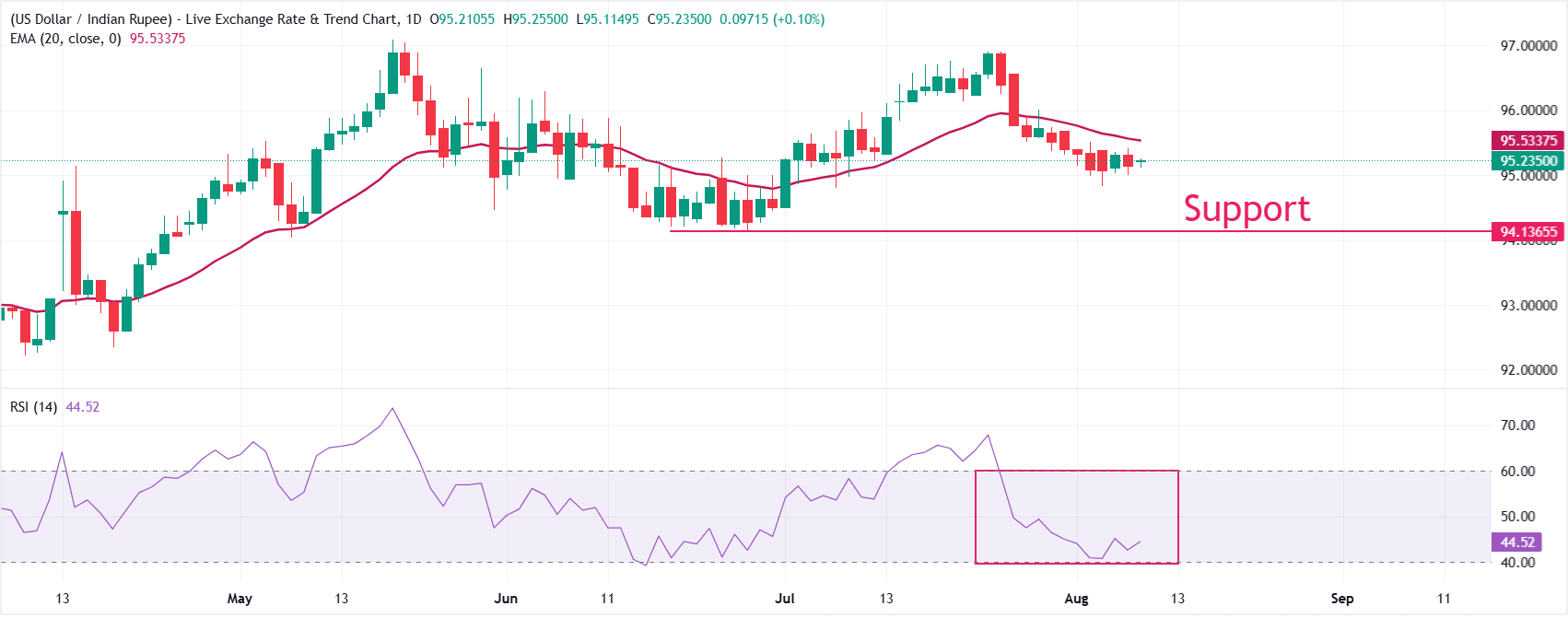
In the daily chart, USD/INR trades at 95.30, keeping a mild bearish bias as spot holds below the 20-day Exponential Moving Average (EMA) at 95.53. The pair’s inability to reclaim this dynamic barrier suggests upside attempts remain capped for now, while the Relative Strength Index (RSI) around 45 hints at subdued momentum rather than outright oversold conditions.
On the topside, immediate resistance is located at the 20-day EMA near 95.53, and a sustained break above this level would be needed to ease the current downside bias. Looking down, the pair could slide towards the June low at 94.15 if it fails to hold the August 5 low at 94.83.
(The technical analysis of this story was written with the help of an AI tool. Know more.)
Indian Rupee FAQs
The Indian Rupee (INR) is one of the most sensitive currencies to external factors. The price of Crude Oil (the country is highly dependent on imported Oil), the value of the US Dollar – most trade is conducted in USD – and the level of foreign investment, are all influential. Direct intervention by the Reserve Bank of India (RBI) in FX markets to keep the exchange rate stable, as well as the level of interest rates set by the RBI, are further major influencing factors on the Rupee.
The Reserve Bank of India (RBI) actively intervenes in forex markets to maintain a stable exchange rate, to help facilitate trade. In addition, the RBI tries to maintain the inflation rate at its 4% target by adjusting interest rates. Higher interest rates usually strengthen the Rupee. This is due to the role of the ‘carry trade’ in which investors borrow in countries with lower interest rates so as to place their money in countries’ offering relatively higher interest rates and profit from the difference.
Macroeconomic factors that influence the value of the Rupee include inflation, interest rates, the economic growth rate (GDP), the balance of trade, and inflows from foreign investment. A higher growth rate can lead to more overseas investment, pushing up demand for the Rupee. A less negative balance of trade will eventually lead to a stronger Rupee. Higher interest rates, especially real rates (interest rates less inflation) are also positive for the Rupee. A risk-on environment can lead to greater inflows of Foreign Direct and Indirect Investment (FDI and FII), which also benefit the Rupee.
Higher inflation, particularly, if it is comparatively higher than India’s peers, is generally negative for the currency as it reflects devaluation through oversupply. Inflation also increases the cost of exports, leading to more Rupees being sold to purchase foreign imports, which is Rupee-negative. At the same time, higher inflation usually leads to the Reserve Bank of India (RBI) raising interest rates and this can be positive for the Rupee, due to increased demand from international investors. The opposite effect is true of lower inflation.
Author

Sagar Dua
FXStreet
Sagar Dua is associated with the financial markets from his college days. Along with pursuing post-graduation in Commerce in 2014, he started his markets training with chart analysis.