Goldman’s Delta one desk: Equities driven by one thing, AI spend
- Equities are no longer broadly based; the entire tape is being driven by one force, AI spend, with everything else orbiting that single gravity well.
- Hyperscaler capex is the fuel line, as long as Microsoft, Amazon, Alphabet and Meta Platforms keep spending aggressively, the AI flywheel remains intact.
- Semiconductors have become the purest expression of that spend, with NVIDIA and peers capturing the upside while the rest of the market lags.
- The risk is not demand, it is the rate of change in capex, flat spending in a rising cost world is effectively a slowdown and a direct threat to current positioning.
- Market breadth is thin and concentration extreme; you are either inside the AI supply chain or you are not participating, leaving the tape vulnerable if the narrative even slightly loses momentum.

Equities driven by AI spend
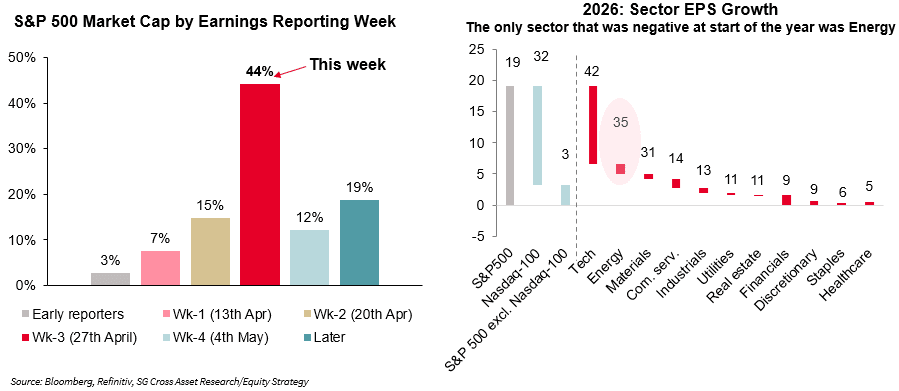
This is the week where the tape stops trading mood music and starts trading hard proof. As previewed earlier, profits and policy are now landing on the same runway, with every G5 central bank stepping up to the microphone just as Hormuz negotiations continue to flicker across the headline tape. More than 42% of the S&P reports this week, representing roughly $29 trillion in market cap, which means this is not just earnings season anymore. It is a full market stress test, where AI optimism, rate expectations, oil risk, and geopolitical hope all get marked to market in real time.
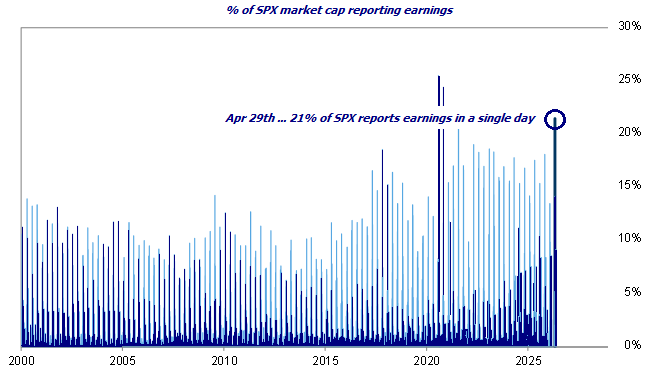
…and Wednesday is where it all compresses into a single point of impact. One of the most concentrated earnings sessions in market history, measured by sheer percentage of index market cap reporting in a single window. This is not a drip-fed information; it is a liquidity event disguised as a calendar entry. Alphabet, Microsoft, Amazon and Meta Platforms all hit after the close, effectively forcing the entire AI complex to mark its books in one coordinated print. Then Apple walks in a day later, less as a follow-up and more as the final calibration of whether the consumer side of the equation can still carry the weight.
This is where concentration risk stops being a slow burn and becomes an event. The generals are reporting at the same time, and when that happens the market does not get the luxury of narrative drift. It gets repriced, clean and immediate, in the cold light of realized earnings versus the expectations that have been doing all the heavy lifting.
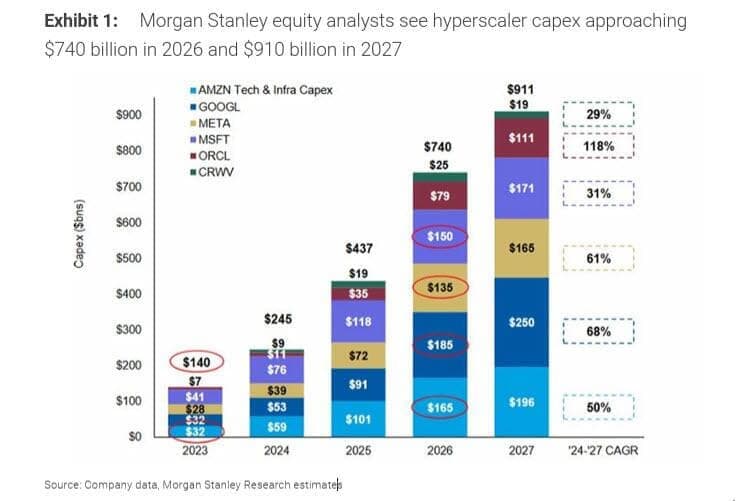
That day is not about the headline EPS beats or misses; it is about the plumbing behind the story. It is where the market digs into forward capex guidance to see whether the AI narrative is still being funded at full throttle or quietly being rationed. The tape knows the number, more than $740Bn in AI capex already signposted for 2026, but what it does not know is whether that number holds, expands, or starts to leak at the margins.
When Alphabet, Microsoft, Amazon and Meta Platforms open the books, they are not just reporting earnings; they are effectively underwriting the next leg of the cycle. Capex is the oxygen in this trade. If those commitments stay intact or, more importantly, get pushed higher, the market reads that as validation that the AI buildout is still in land grab mode, and multiples can justify their altitude.
But if there is even a hint of hesitation, a subtle shift from aggressive expansion to capital discipline, the entire complex has to reprice. Because this rally has not been built on what AI is today, it has been built on what it is expected to become, and that expectation is financed through capex. Cut the fuel line, even slightly, and the coiled spring in positioning does not unwind gently; it snaps.
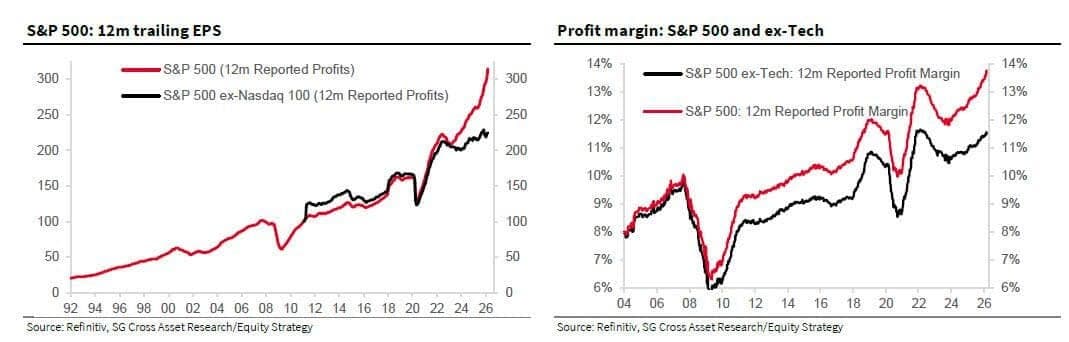
Semiconductors are no longer just part of the story, they are the transmission mechanism. The direct beneficiaries of that capex torrent, and right now the cleanest expression of where the money is actually flowing. Year to date they have run 42%, leaving the so called leadership cohort looking almost stationary, with the Mag 7 barely scraping +2% and ex NVIDIA effectively flat. Strip away the narrative, and what you are left with is a market where the picks and shovels have dramatically outperformed the gold miners.
Put differently, roughly 40% of S&P 500 Growth in 2026 is being driven by semiconductors, and that growth is not organic in the traditional sense; it is being pulled forward by the capex commitments of the very same hyperscalers reporting this week. Microsoft, Amazon, Alphabet and Meta Platforms are effectively writing the revenue line for the chip complex in advance.
This is where the feedback loop becomes critical. Capex drives semiconductor demand, semiconductor performance drives index returns, and index performance reinforces the belief that the capex is justified. It is a self-sustaining flywheel until it is not. Because the moment that capex guidance even wobbles, the first place the market looks is not at the platforms, it is at the suppliers. And in a tape this concentrated, where one segment is doing the heavy lifting for the entire growth complex, any disruption to that flow does not diffuse. It cascades.
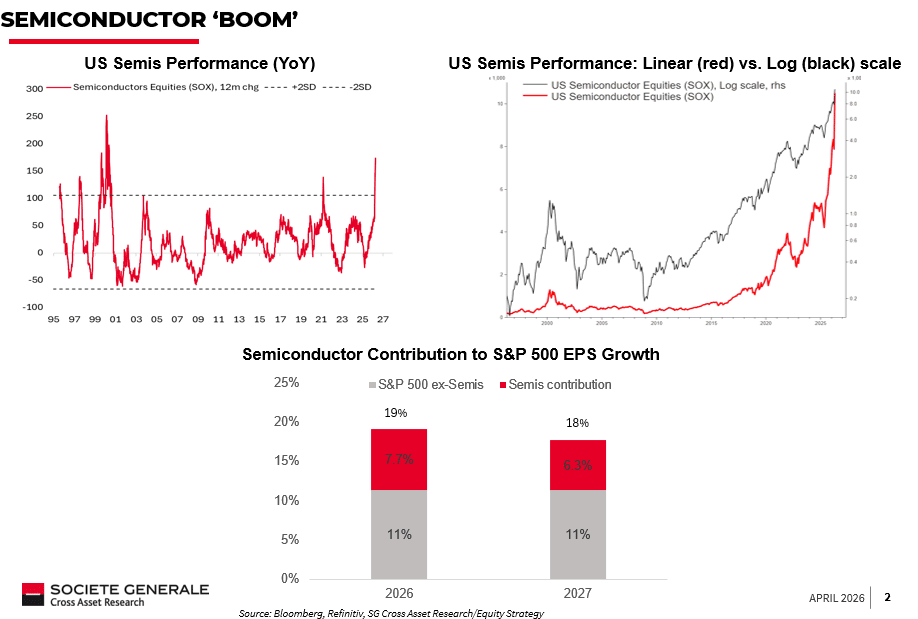
What you are seeing beneath the surface is not a broad earnings recovery, it is a concentration trade masquerading as one. Since the war kicked off, the upward revisions to S&P earnings have not been a rising tide lifting all boats; they have been a handful of supertankers dragging the index higher while the rest of the fleet drifts.
At the center of that move sits Micron Technology, which alone has accounted for more than half of the total upward EPS revision. That is not incremental improvement; that is a step change, with consensus estimates effectively doubling after a print and guide that blew past expectations, all anchored in the belief that memory demand tied to the AI supercycle is not just strong but insatiable. In second place is Exxon Mobil, contributing roughly 14% of the revision, a reminder that while AI is the narrative, energy is still the pricing engine sitting underneath inflation and margins.
Everything else tells a very different story. The median S&P name has seen little to no change in estimates. No surge, no broad upgrade cycle, just a flatline. That is the tell. Because when earnings revision breadth narrows like this, the index starts to behave less like a diversified portfolio and more like a levered position in a few dominant themes.
From my seat, the market is no longer being carried by a chorus; it is being carried by a soloist with a very loud microphone. And that works, right up until the moment the voice cracks.
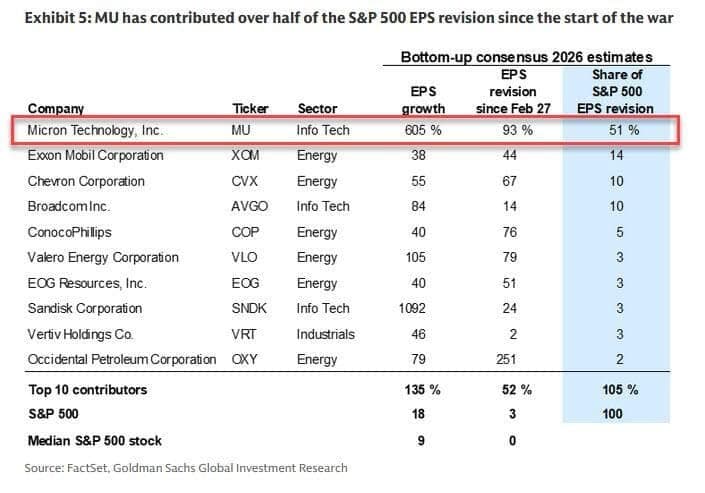
Take a step back and the bigger picture snaps into focus. Strip out the noise of weekly flows and headline roulette, and what you see over the past five years is a market where virtually all earnings growth and margin expansion has been carried on the shoulders of tech. Not supported by, not complemented by, but outright driven by it.
The rest of the index has been along for the ride, at times stabilizing, occasionally contributing, but never truly leading. The heavy lifting, the multiple expansion, the margin resilience in the face of inflation shocks, rate cycles, and geopolitical stress, has all come from the same core engine. Microsoft, Alphabet, Amazon, Meta Platforms, and increasingly NVIDIA have not just participated in growth, they have defined it.
Which leaves the market in a very specific place. This is no longer a diversified earnings cycle; it is a single-engine aircraft flying at altitude. As long as that engine continues to fire, the ride is smooth, even elegant. But it also means there is very little redundancy in the system. Because when all earnings and margin expansion trace back to one part of the market, that part stops being the leader. It becomes systemic.
And that is the quiet risk embedded in the charts. Not that tech has driven the last five years, but that it has been the only thing that has.
It all comes back to the same axis. Tech, capex, and the belief that the spigot stays wide open. As long as the hyperscalers keep writing ever larger checks, the market can keep telling itself the story holds. But peel that back, and the plumbing looks more complicated.
The big picture, as framed by Goldman’s Delta One desk, is brutally simple. Equities are being driven by one thing: AI spend. Everything else is orbiting around it. What is emerging beneath that is more like an arms race than a rational allocation of capital. Engineering teams are effectively “token maxing,” competing to consume as much compute as possible, because under-spending is no longer prudent; it is a career risk. That creates a system in which capital is deployed aggressively, sometimes inefficiently, but always with the same objective: not to fall behind.
And yet the constraints are already visible. Power grids are tight, GPUs are scarce, CPUs are spoken for, copper is suddenly strategic again, and even qualified engineers are a bottleneck. The physical world is pushing back against the digital ambition. But the market, for now, is choosing to look straight through it, extrapolating a clean line higher. More tokens, more intelligence, and eventually something that starts to resemble AGI.
In the here and now, it is hard to argue with the tape. Supply is constrained, earnings are accelerating, and the narrative, whether fully justified or not, carries the weight of a generational shift. That is enough to keep the bid intact. But this is where the tension builds.
This week’s earnings compress that tension into a single moment. Amazon, Microsoft, Meta Platforms and Alphabet all report into a market that already has enormous 2026 capex baked in, north of $600Bn across the group. The question is no longer whether demand is strong. That part is settled. The question is whether the spending curve steepens again.
Because if capex merely holds flat in a world where input costs are rising, that is not stability; it is a slowdown in disguise. And that is where the fault line runs between the suppliers and the spenders. The semiconductor complex has been priced as a direct call option on ever-rising capex. The hyperscalers themselves have not been rewarded in the same way for writing those checks. One side is infatuated with spending. The other is starting to question the return on it.
So you end up with a market that has been almost entirely powered by AI spend. That is the source of the upside surprise, the driver of earnings revisions, the engine behind the rally. Aside from that, the oxygen is thin. Energy prices are creeping back into the inflation narrative, Europe is lagging, and dispersion is extreme. You are either inside the AI supply chain, or you are watching from the outside.
From here, the setup shifts. The strength of the AI bid is undeniable, but the velocity has been extreme. What was a tailwind in positioning and technicals is starting to turn. When everything is priced off one variable, the risk is not that it disappears, it is that it stops accelerating. And in this tape, that alone is enough to change the direction of travel.
Author

Stephen Innes
SPI Asset Management
With more than 25 years of experience, Stephen has a deep-seated knowledge of G10 and Asian currency markets as well as precious metal and oil markets.