Gold tumbles as Oil shock fuels US Dollar rally and Fed hike bets
- Gold plunges 1.49% to $4,163 as US Dollar strength pressures bullion.
- WTI surges above $93 amid escalating Middle East hostilities.
- December Fed hike odds reach 90% ahead of crucial US inflation data.

Gold (XAU/USD) price drifts lower by about 1.49% on Monday as the Greenback gains ground amid escalating hostilities in the Middle East, pushing energy prices higher and increasing the likelihood of higher interest rates globally. At the time of writing, XAU/USD trades at $4,163 after reaching a high of $4,217.
XAU/USD slides below $4,170 as rising energy prices reinforce inflation fears
West Texas Intermediate (WTI), the US crude benchmark, is rallying more than 2%, up at $93.69, spurred by Houthi attacks on Saudi Arabia, Iran strikes ships in Hormuz and exchange of fire between Russia and Ukraine, even though US President Donald Trump announced that both countries agreed to a ceasefire of attacks on energy installations.
News reports indicated that the US had accepted some of Iran’s seven conditions to end the war, though Tehran said that Hormuz would not be opened unless its demands were met.
This keeps US Treasury yields elevated, with the US 10-year Treasury note yield flat at 5.242%. At the same time, the US Dollar Index (DXY), which measures the performance of the buck against a basket of six currencies, is up 0.3% at 102.56.
Given the backdrop, money markets still price in a rate hike by the Federal Reserve (Fed), but not at the October meeting. Prime Terminal data show that investors see a 20% chance of a 0.25% increase in the Fed funds rate, but for December, the probability is nearly 90%.
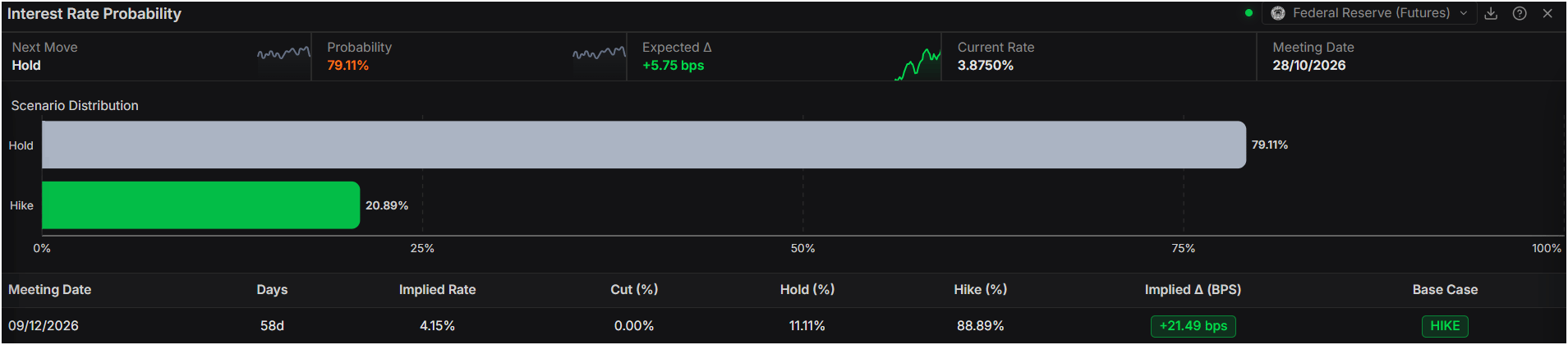
Cleveland Fed President Beth Hammack commented that higher rates are needed as inflation broadens and that, within the FOMC, she has one of the highest projections for the neutral rate.
Traders' eyes shift to Fed speakers, led by Fed Chair Kevin Warsh, and to the release of US inflation figures, with the Consumer Price Index (CPI) expected on Wednesday, followed by the Producer Price Index (PPI) on Thursday.
XAU/USD technical analysis: Gold’s downtrend resumes below $4,100
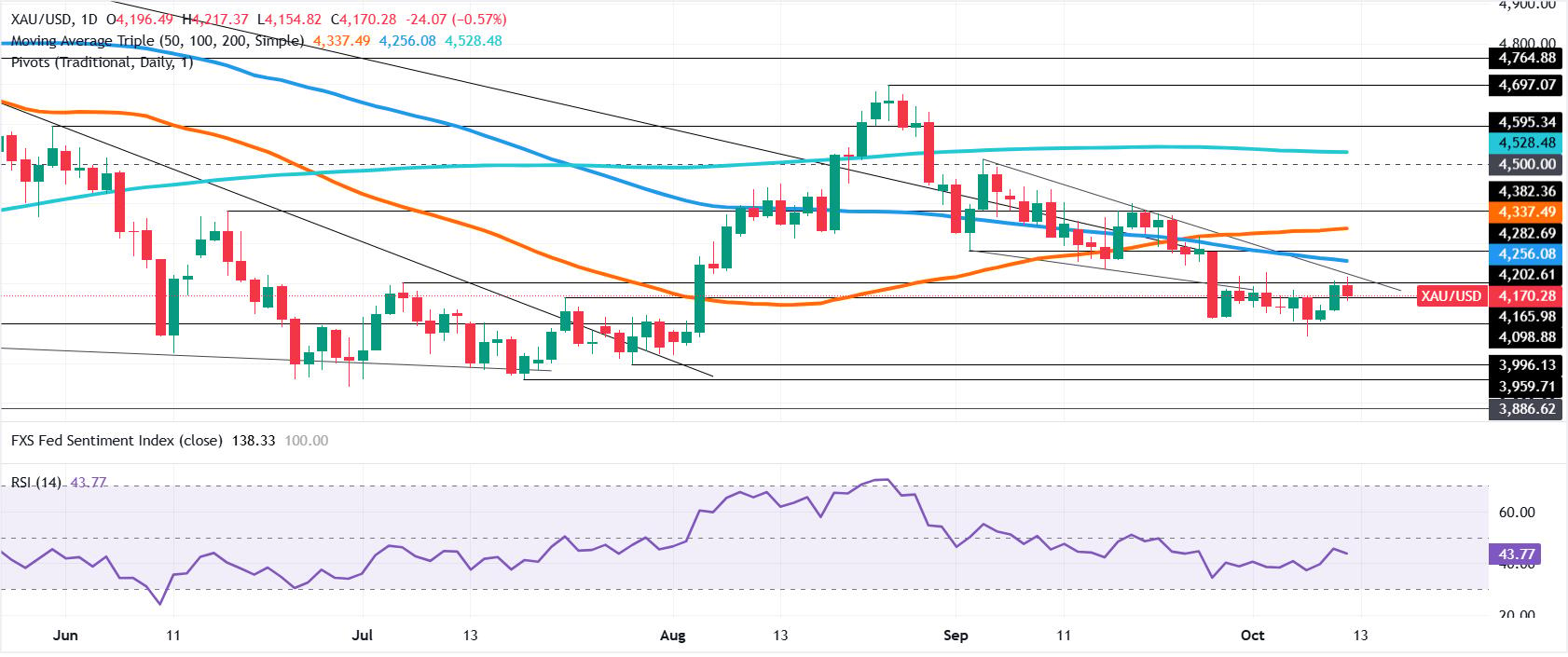
Gold’s rally stalled near $4,200, with buyers unable to decisively hold spot prices above the figure; it retreated toward the day's low at $4,150 before settling at current prices.
Although bullion seems to have found its feet near $4,100, the market structure of lower highs and lower lows remains intact, indicating that $4,000 can be challenged in the foreseeable future.
Momentum has shifted mildly bullish, with the Relative Strength Index (RSI) rising but staying below its 50-neutral level.
For a bearish resumption, Gold needs to drop below the psychologically important $4,150 level. This opens the door for a move to $4,100, followed by the July 29 cycle low of $3,996, and $4,000 below.
On the other hand, if XAU/USD reclaims $4,200, a move towards the 100-day Simple Moving Average (SMA) at $4,256 is on the cards. Up next, the 50-day SMA at $4,337 emerges as the next ceiling level, ahead of $4,500. Once those levels are cleared, the next stop is the 200-day SMA at $4,528.
Gold FAQs
Gold has played a key role in human’s history as it has been widely used as a store of value and medium of exchange. Currently, apart from its shine and usage for jewelry, the precious metal is widely seen as a safe-haven asset, meaning that it is considered a good investment during turbulent times. Gold is also widely seen as a hedge against inflation and against depreciating currencies as it doesn’t rely on any specific issuer or government.
Central banks are the biggest Gold holders. In their aim to support their currencies in turbulent times, central banks tend to diversify their reserves and buy Gold to improve the perceived strength of the economy and the currency. High Gold reserves can be a source of trust for a country’s solvency. Central banks added 1,136 tonnes of Gold worth around $70 billion to their reserves in 2022, according to data from the World Gold Council. This is the highest yearly purchase since records began. Central banks from emerging economies such as China, India and Turkey are quickly increasing their Gold reserves.
Gold has an inverse correlation with the US Dollar and US Treasuries, which are both major reserve and safe-haven assets. When the Dollar depreciates, Gold tends to rise, enabling investors and central banks to diversify their assets in turbulent times. Gold is also inversely correlated with risk assets. A rally in the stock market tends to weaken Gold price, while sell-offs in riskier markets tend to favor the precious metal.
The price can move due to a wide range of factors. Geopolitical instability or fears of a deep recession can quickly make Gold price escalate due to its safe-haven status. As a yield-less asset, Gold tends to rise with lower interest rates, while higher cost of money usually weighs down on the yellow metal. Still, most moves depend on how the US Dollar (USD) behaves as the asset is priced in dollars (XAU/USD). A strong Dollar tends to keep the price of Gold controlled, whereas a weaker Dollar is likely to push Gold prices up.
Author

Christian Borjon Valencia
FXStreet
Markets analyst, news editor, and trading instructor with over 14 years of experience across FX, commodities, US equity indices, and global macro markets.
















