Gold struggles as dovish Fed repricing meets stronger US Dollar, elevated yields
- Gold holds modest gains as weak US economic data lowers the chance of an October Fed rate hike.
- Persistent inflation risks keep the broader Fed policy outlook tilted towards further tightening.
- Buyers need to reclaim $4,200 to regain near-term bullish momentum.

Gold (XAU/USD) starts the week with a mild positive bias but remains rangebound, caught between easing Federal Reserve (Fed) interest rate hike bets and a stronger US Dollar (USD). US Treasury yields also remain elevated near multi-year highs, limiting demand for the non-yielding metal. At the time of writing, XAU/USD trades around $4,158, up 0.35% on the day.
Recent US economic data has weakened the case for another rate hike at the Fed’s October 27-28 meeting. Figures released on Friday showed that Nonfarm Payrolls (NFP) increased by only 29K in September, well below the 90K forecast. Employment gains for the previous two months were revised down by a combined 60K while the Unemployment Rate edged up to 4.2%. Annual wage growth slowed to 3.0%.
The weak employment figures followed August’s Personal Consumption Expenditures (PCE) inflation report, which also fell short of expectations, while previous readings were revised lower.
According to the CME FedWatch Tool, traders now price in only around a 20% chance of a rate hike in October, down from nearly 70% last week. The dovish repricing lends some support to the non-yielding metal. However, the broader policy outlook remains tilted towards further tightening as policymakers remain concerned about inflation running above the 2% target, while Middle East tensions keep energy-driven inflation risks alive. This caps Gold’s upside while keeping the US Dollar and Treasury yields supported.
Economists at Deutsche Bank argue that “although the headline payroll number was disappointing, the wider labour-market picture remains relatively resilient, particularly alongside recent ADP and jobless-claims readings,” and on that basis “our economists continue to expect two further 25bp Fed hikes over the next couple of quarters.” They add that “since the meeting, Fed communication has broadly reinforced the quarterly pace of rate hikes implied by the September SEP,” leaving their view of the Fed’s trajectory broadly unchanged despite the softer payroll print.
The US Dollar also draws support from a sharp decline in the Euro (EUR) amid growing political and fiscal concerns in France. The US Dollar Index (DXY), which tracks the Greenback’s value against a basket of six major currencies, trades around 102.20 after touching an intraday high of 102.53, its highest level since April 2025.
Meanwhile, the benchmark 10-year US Treasury yield holds near 5.29%, after touching 5.34% last week, its highest level since 2002. A stronger US Dollar makes Gold more expensive for overseas buyers, while elevated yields increase the opportunity cost of holding the non-yielding metal.
Looking ahead, the US economic docket features the ISM Services Purchasing Managers’ Index (PMI) on Monday, followed by the September Federal Open Market Committee (FOMC) meeting minutes on Wednesday and Initial Jobless Claims on Thursday. The preliminary University of Michigan Consumer Sentiment Index and inflation expectations will be released on Friday.
Technical analysis: Buyers struggle to reclaim $4,200
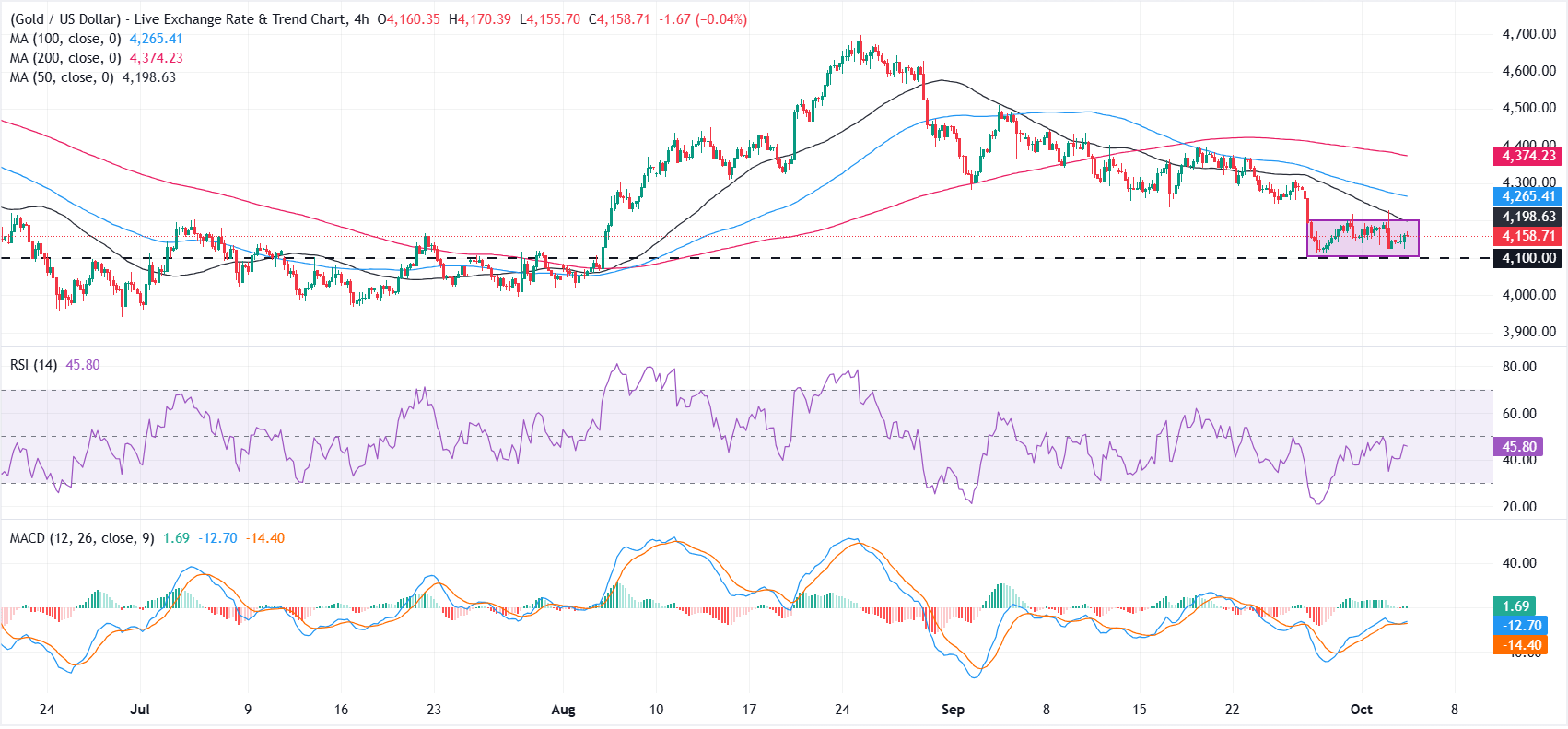
The 4-hour chart shows XAU/USD consolidating below its major moving averages, keeping the near-term bias tilted to the downside. Buyers are struggling to sustain gains above the $4,200 psychological mark, which closely aligns with the 50-period Simple Moving Average (SMA) at $4,198 and acts as the first resistance.
A sustained break above this area could expose the 100-period SMA at $4,265, followed by the 200-period SMA near $4,374. A decisive move above these moving averages would be needed to strengthen the bullish outlook. The Relative Strength Index (RSI) hovers near 46, reflecting neutral-to-soft momentum, while the Moving Average Convergence Divergence (MACD) remains slightly above zero, pointing to a modest recovery attempt.
On the downside, the $4,100 psychological mark offers immediate support. A clear break below this level could intensify selling pressure and expose the $4,000-$3,950 support zone.
(The technical analysis of this story was written with the help of an AI tool. Know more.)
Gold FAQs
Gold has played a key role in human’s history as it has been widely used as a store of value and medium of exchange. Currently, apart from its shine and usage for jewelry, the precious metal is widely seen as a safe-haven asset, meaning that it is considered a good investment during turbulent times. Gold is also widely seen as a hedge against inflation and against depreciating currencies as it doesn’t rely on any specific issuer or government.
Central banks are the biggest Gold holders. In their aim to support their currencies in turbulent times, central banks tend to diversify their reserves and buy Gold to improve the perceived strength of the economy and the currency. High Gold reserves can be a source of trust for a country’s solvency. Central banks added 1,136 tonnes of Gold worth around $70 billion to their reserves in 2022, according to data from the World Gold Council. This is the highest yearly purchase since records began. Central banks from emerging economies such as China, India and Turkey are quickly increasing their Gold reserves.
Gold has an inverse correlation with the US Dollar and US Treasuries, which are both major reserve and safe-haven assets. When the Dollar depreciates, Gold tends to rise, enabling investors and central banks to diversify their assets in turbulent times. Gold is also inversely correlated with risk assets. A rally in the stock market tends to weaken Gold price, while sell-offs in riskier markets tend to favor the precious metal.
The price can move due to a wide range of factors. Geopolitical instability or fears of a deep recession can quickly make Gold price escalate due to its safe-haven status. As a yield-less asset, Gold tends to rise with lower interest rates, while higher cost of money usually weighs down on the yellow metal. Still, most moves depend on how the US Dollar (USD) behaves as the asset is priced in dollars (XAU/USD). A strong Dollar tends to keep the price of Gold controlled, whereas a weaker Dollar is likely to push Gold prices up.
Author

Vishal Chaturvedi
FXStreet
I am a macro-focused research analyst with over four years of experience covering forex and commodities market. I enjoy breaking down complex economic trends and turning them into clear, actionable insights that help traders stay ahead of the curve.