Gold steady near $4,760 as Iran talks weigh on US Dollar
- Gold stays supported as optimism over US-Iran talks pressures the US Dollar.
- March CPI rose as expected, keeping Fed easing expectations restrained.
- Traders now watch Pakistan talks and Hormuz developments over the weekend.

Gold (XAU/USD) price remains steady on Friday, poised to finish the week with gains of almost 2% as the US Dollar tumbles amid optimism about Iran-US talks in Pakistan throughout the weekend. Also, a mildly high US inflation report trimmed the Federal Reserve's (Fed) dovish bets for 2026. The XAU/USD pair trades at $4,763, up 0.01%.
Gold's faith in US-Iran talks
An improvement in risk appetite pushed bullion prices higher, even though Israel's attacks on Lebanon continued, threatening to end the two-week ceasefire agreed by the US and Iran. On the other hand, Tehran has also failed to open the Strait of Hormuz, which US President Donald Trump qualified as "dishonorable, some would say, of allowing Oil to go through the Strait of Hormuz. That is not the agreement we have!"
Talks between the US and Iran will begin on Saturday. The Iranian delegation will participate in the negotiations despite several statements indicating that Lebanon is part of the truce deal, Al Hadath reported.
US Vice President JD Vance is on his way to Pakistan and commented that "if the Iranians are willing to negotiate in good faith, we're certainly willing to extend the open hand. If they're going to try to play us, then they're going to find the negotiating team is not that receptive."
US inflation sticks to 3%; what would the Fed do?
Data from the US showed that March inflation met forecasts, as the US Consumer Price Index (CPI) increased by 3.3% YoY, up from 2.4% in February. Core CPI also rose from 2.5% to 2.6% YoY, below estimates of 2.7%. Consequently, investors remain skeptical that the Federal Reserve will reduce borrowing costs and expect the Fed funds rate to remain unchanged in the 3.50%-3.75% range for the rest of 2026, according to data from Prime Market Terminal (PMT).
Aside from this, the University of Michigan (UoM) Consumer Sentiment tanked to a record low in April, falling from 53.3 to 47.6. At the same time, American households expect inflation to pick up over the next 12 months, rising from 3.8% to 4.8%, blamed on the Middle East war, which pushed prices at the pump higher.
San Francisco Fed President Mary Daly downplayed the CPI surprise, saying it was expected, and flagged the ceasefire as the key variable. She added that the policy is restrictive enough to tame inflation while still supporting jobs.
In the meantime, the US Dollar Index (DXY), which tracks the buck's performance against six currencies, is down 0.13% at 98.66, near a four-week low, a tailwind for Gold prices.
Next week, the US economic docket will feature housing data, the Producer Price Index (PPI), jobs data, and Fed speakers. However, Gold traders would eye the resumption of the US-Iran first round of talks in Pakistan, along with the reopening of the Strait of Hormuz.
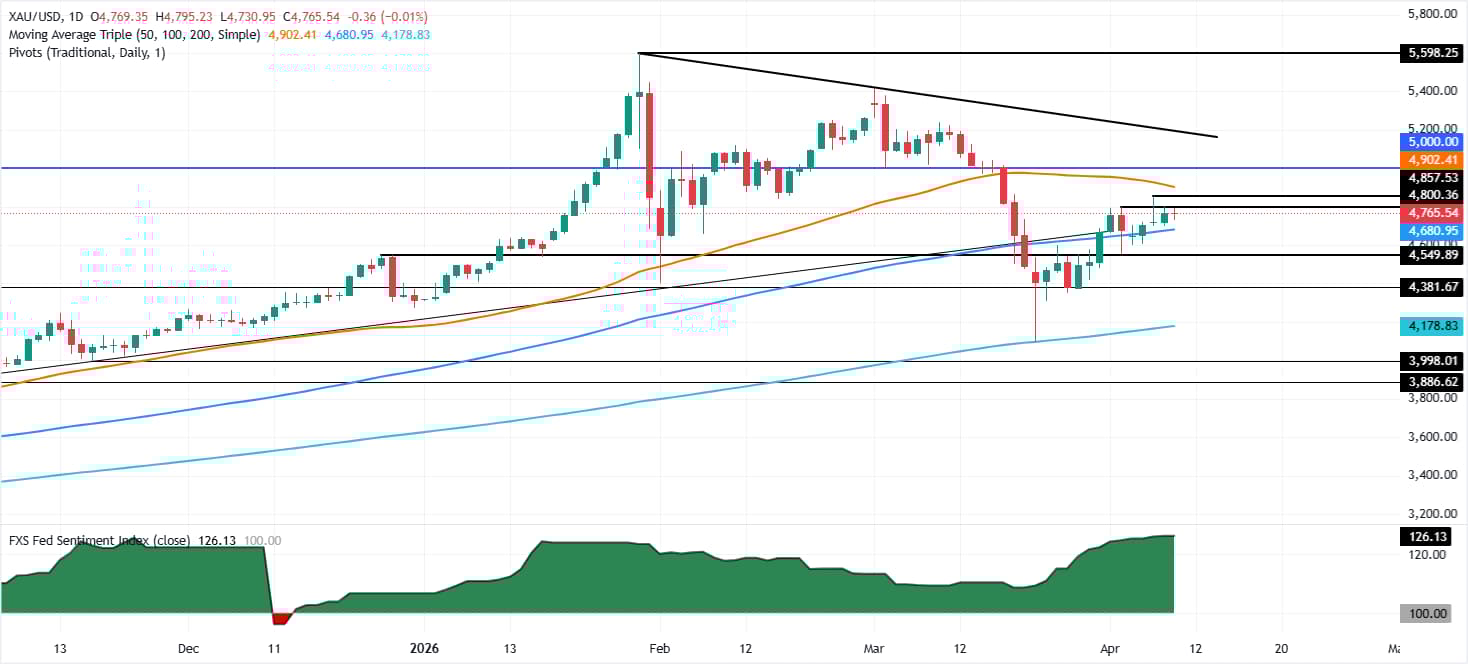
XAU/USD technical outlook: Rejected at $4,800, bears target 20-, 100-day SMA confluence
Gold price remains upwardly biased but has struggled to clear key resistance over the last two days. Three days ago, bullion hit a three-week high at $4,857, but buyers were unable to keep spot prices above the psychological $4,800 level.
If sellers push Gold below $4,750, a move towards the $4,700 mark is on the cards. Below here, the confluence of the 20- and 100-day Simple Moving Averages (SMAs), each at $4,674-$4,662, is up next.
Conversely, if Gold reclaims $4,800, it exposes the April 8 daily high at $4,857. On further strength, buyers could conquer the $4,900.
Gold FAQs
Gold has played a key role in human’s history as it has been widely used as a store of value and medium of exchange. Currently, apart from its shine and usage for jewelry, the precious metal is widely seen as a safe-haven asset, meaning that it is considered a good investment during turbulent times. Gold is also widely seen as a hedge against inflation and against depreciating currencies as it doesn’t rely on any specific issuer or government.
Central banks are the biggest Gold holders. In their aim to support their currencies in turbulent times, central banks tend to diversify their reserves and buy Gold to improve the perceived strength of the economy and the currency. High Gold reserves can be a source of trust for a country’s solvency. Central banks added 1,136 tonnes of Gold worth around $70 billion to their reserves in 2022, according to data from the World Gold Council. This is the highest yearly purchase since records began. Central banks from emerging economies such as China, India and Turkey are quickly increasing their Gold reserves.
Gold has an inverse correlation with the US Dollar and US Treasuries, which are both major reserve and safe-haven assets. When the Dollar depreciates, Gold tends to rise, enabling investors and central banks to diversify their assets in turbulent times. Gold is also inversely correlated with risk assets. A rally in the stock market tends to weaken Gold price, while sell-offs in riskier markets tend to favor the precious metal.
The price can move due to a wide range of factors. Geopolitical instability or fears of a deep recession can quickly make Gold price escalate due to its safe-haven status. As a yield-less asset, Gold tends to rise with lower interest rates, while higher cost of money usually weighs down on the yellow metal. Still, most moves depend on how the US Dollar (USD) behaves as the asset is priced in dollars (XAU/USD). A strong Dollar tends to keep the price of Gold controlled, whereas a weaker Dollar is likely to push Gold prices up.
Author

Christian Borjon Valencia
FXStreet
Markets analyst, news editor, and trading instructor with over 14 years of experience across FX, commodities, US equity indices, and global macro markets.