Gold price edges higher as S&P 500 and Nasdaq hit new record highs
- Gold price moves toward $3,300 but US equity strength caps gains.
- Fiscal concerns loom as Trump's Big Beautiful Tax Bill comes into focus ahead of the July 4 deadline.
- XAU/USD looks ahead to Thursday's Nonfarm Payroll (NFP) report for signs of when the Fed may cut rates.

Gold (XAU/USD) continues to trade below $3,300 at the time as markets brace for heightened volatility ahead of Friday’s US Independence Day holiday.
Political developments in the United States have taken center stage, with President Donald Trump’s administration accelerating efforts to pass the "One Big Beautiful Bill" by his self-imposed July 4 deadline. The legislation, which narrowly passed the Senate over the weekend, proposes a sweeping overhaul of the tax code, including broad deductions funded by cuts to Medicaid and green energy programs.
Despite the political uncertainty, equity markets remain buoyant, with the S&P 500 and Nasdaq both hitting fresh record highs on Monday, reflecting continued investor appetite for risk.
The Nonfarm Payrolls (NFP) report for June is scheduled for Thursday this time, earlier than usual due to the Fourth of July Independence Day holiday in the US on Friday.
Traders are positioning cautiously, anticipating potential shifts in currency and yield dynamics that could drive further demand for the precious metal.
Daily digest market move: Gold remains cautious ahead of President Trump’s Big Beautiful Bill
- The proposed “One Big Beautiful Bill” raises fears of a ballooning US deficit. Investors are concerned that aggressive tax cuts, paired with reductions in government spending, could erode fiscal discipline and fuel long-term inflation, supporting demand for Gold as a hedge.
- This has heightened market sensitivity to US political developments, potentially pressuring the US Dollar (USD) and lifting XAU/USD.
- Expectations that deficit-driven tax policies may re-ignite inflation fears and further bolster Gold’s role as a store of value. The metal could continue to benefit if real US yields ease, as investors reassess policy outlooks.
- A weaker US Dollar, resulting from fiscal or monetary policy, could make Gold more attractive to foreign buyers.
- Federal Reserve Chair Powell is expected to speak on Tuesday. Markets will closely analyse his tone for policy clues on when the Fed will cut interest rates. Any dovish remarks may weaken the Dollar and increase demand for Gold.
- The ADP Employment Change on Wednesday measures the strength of the private sector labour market. Wednesday’s print is expected to show 85,000 jobs added to the US private sector in June, up from just 37,000 in May. As a closely watched precursor to the NFP report, a soft print may boost safe-haven demand for Gold.
- The Nonfarm Payrolls data release due on Thursday is expected to decrease to 110,000 in June from 139,000 in May. The unemployment rate is expected to rise to 4.3% from 4.2%. A rise in unemployment may increase expectations of interest rate decreases by the Fed, which is supportive of non-yielding assets, such as Gold.
- The US Personal Consumption Expenditures (PCE) price index, which is closely watched by the Fed, was published on Friday. Since the central bank targets a 2% inflation rate, the higher-than-expected print reinforces the view that inflation remains elevated. This could complicate the outlook for monetary policy, potentially delaying rate cuts and capping short-term gains for Gold.
Gold technical analysis: Descending triangle points to downside risk below $3,300
Gold is trading at $3,285 at the time of writing on Monday, confined between the 50% and the 38.2% Fibonacci retracement levels of the April low-high move at $3,228 and $3,292, respectively.
This follows a recent break below both the 20-day and 50-day Simple Moving Averages (SMAs), which are providing additional resistance above the $3,300 psychological level at $3,350 and $3,320, respectively.
The metal’s recovery attempts remain capped by resistance around the 38.2% Fibonacci retracement level at $3,292, while downside risks persist as momentum weakens.
Gold (XAU/USD) daily chart
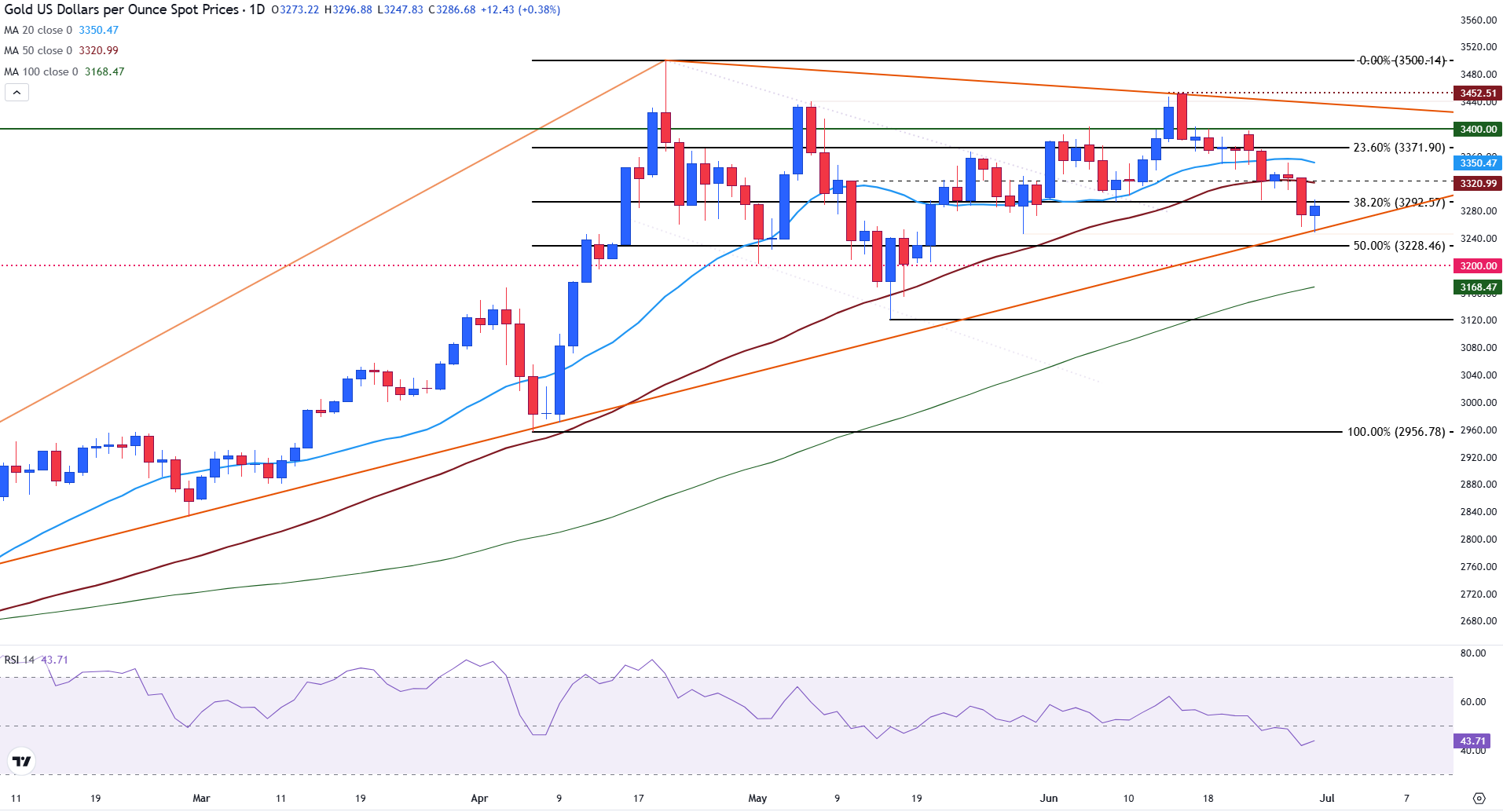
The Relative Strength Index (RSI) indicator on the daily chart is currently pointing downward, near 44, indicating increasing bearish momentum without yet entering oversold territory. A daily close below $3,228 could open the door toward the 100-day SMA at $3,168, while a sustained push back above $3,292 would be needed to shift short-term sentiment back to the upside.
US Dollar FAQs
The US Dollar (USD) is the official currency of the United States of America, and the ‘de facto’ currency of a significant number of other countries where it is found in circulation alongside local notes. It is the most heavily traded currency in the world, accounting for over 88% of all global foreign exchange turnover, or an average of $6.6 trillion in transactions per day, according to data from 2022. Following the second world war, the USD took over from the British Pound as the world’s reserve currency. For most of its history, the US Dollar was backed by Gold, until the Bretton Woods Agreement in 1971 when the Gold Standard went away.
The most important single factor impacting on the value of the US Dollar is monetary policy, which is shaped by the Federal Reserve (Fed). The Fed has two mandates: to achieve price stability (control inflation) and foster full employment. Its primary tool to achieve these two goals is by adjusting interest rates. When prices are rising too quickly and inflation is above the Fed’s 2% target, the Fed will raise rates, which helps the USD value. When inflation falls below 2% or the Unemployment Rate is too high, the Fed may lower interest rates, which weighs on the Greenback.
In extreme situations, the Federal Reserve can also print more Dollars and enact quantitative easing (QE). QE is the process by which the Fed substantially increases the flow of credit in a stuck financial system. It is a non-standard policy measure used when credit has dried up because banks will not lend to each other (out of the fear of counterparty default). It is a last resort when simply lowering interest rates is unlikely to achieve the necessary result. It was the Fed’s weapon of choice to combat the credit crunch that occurred during the Great Financial Crisis in 2008. It involves the Fed printing more Dollars and using them to buy US government bonds predominantly from financial institutions. QE usually leads to a weaker US Dollar.
Quantitative tightening (QT) is the reverse process whereby the Federal Reserve stops buying bonds from financial institutions and does not reinvest the principal from the bonds it holds maturing in new purchases. It is usually positive for the US Dollar.
Author

Tammy Da Costa, CFTe®
FXStreet
Tammy is an economist and market analyst with a deep passion for financial markets, particularly commodities and geopolitics.